
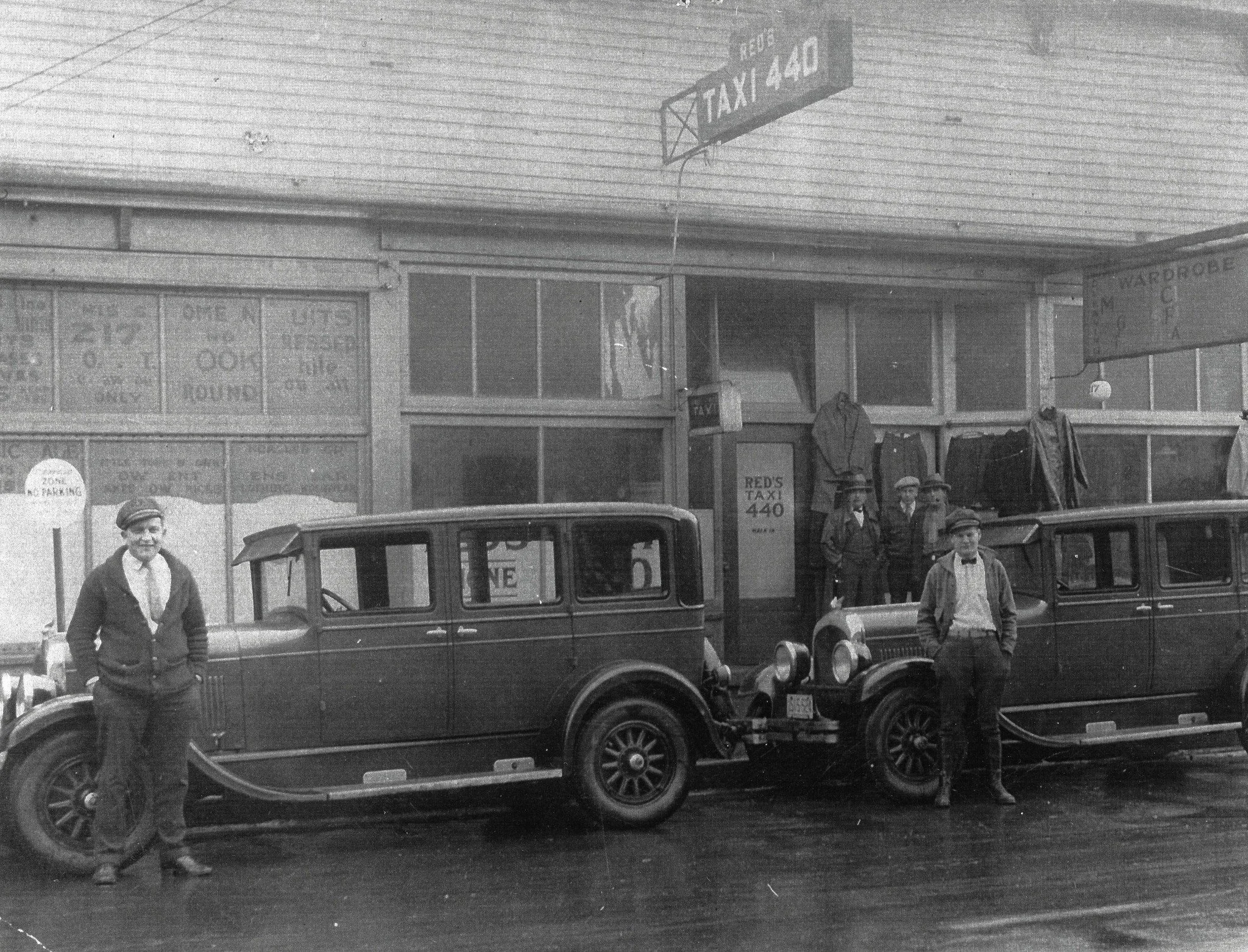
The Harbor - A Culture of Success
Information and Stories on Notable Harborites
ABOUT
In September 2003 Tom Quigg printed the first edition of The Harbor – A Culture of Success to share the information on notable people with connections to Grays Harbor who have received national and/or international recognition for their contribution to society. The work is not intended to be a biography; rather a compilation of information and stories to remind people of the great minds grown and nurtured on Grays Harbor.
And, it's interesting to note how often we discover a Harbor connection to a very notable person, or event. Occasionally we hear folks say it appears that "all roads pass through Grays Harbor."
The Brief Biographies includes short biographical information on Harborites who have been recognized nationally or internationally in various endeavors. From Nobel Laureates, to Rock & Roll Hall of Fame musicians, to NFL Hall of Fame members, to award winning artists, to inventors of devices that literally changed the world…and the list goes on.
This section is in alphabetical order with short biographical paragraphs about people and events that qualify. It's amazing to me that since the first booklet was published I still hear from first-time viewers who are in awe when they read the information. They see names of people they never realized are connected to this community.
Newspaper Articles contains 30 or more stories Tom has written about some of the people and events listed in the first section.
The Photo Gallery contains a photo gallery of some of Grays Harbor most notable people from the biographies and articles.
Harborites of Local and Regional Notoriety contains a regional list of Harborites of local notoriety. There are many other Harborites who have received a great deal of regional notoriety. Many of them deserve recognition, but it would be an overwhelming task to write bios for all on this site.
So, all of the above comes together to form a compilation of information and stories intended to remind people of the great minds grown and nurtured on Grays Harbor. We hope you find the material interesting, enjoyable, and it makes you proud to be connected to this little neck of the woods.
The biographical information and stories will be updated periodically. We occasionally get requests from readers to add a person of local or region acclaim. Many are accomplished in their field of interest, but it's nearly impossible to list everyone. To keep my information manageable, the names and stories are limited to people and events of national and/or international acclaim.
Keeping the criteria in mind, it you would like to suggest additional names, or have a correction, we'd love to hear from you.
You can reach Tom Quigg by email at harborite@icloud.com.
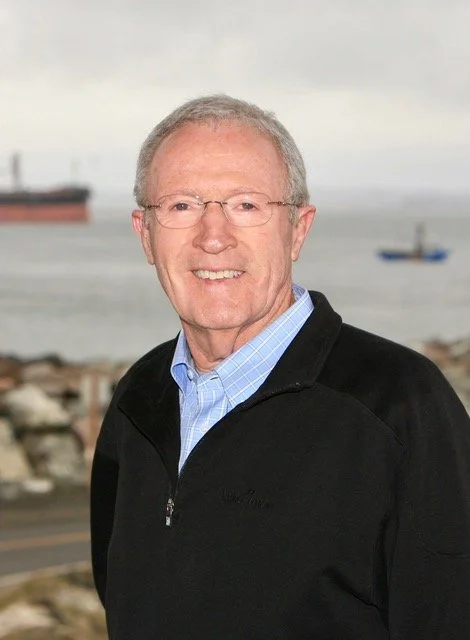
Tom Quigg, is a fourth generation Harborite on his mother's side (McGillicuddy), and third generation on his father's side (Quigg). He has been a local business owner all his adult life, and is semi-retired. Tom currently serves as a Commissioner for the Port of Grays Harbor, a position he began in 2018.
Content Sharing:
Personal use: you are welcome to share the information and stories by including credit that the material is the property and copyright of the Polson Museum, and that the content was authored by Tom Quigg.
Commercial use: prior to publishing, you must obtain written permission by the Polson Museum, and your publication must include that the material is the property and copyright of the Polson Museum, and that the content was authored by Tom Quigg.
Tom Quigg – harborite@icloud.com (last updated 09/30/2026)
-
"In 2014, at Ocosta Elementary School in Westport, WA…the school approved renovations that include a tsunami evacuation refuge with capacity for approximately 700 persons. The refuge will be the first vertical evacuation structure in the United States." — “Project Safe Haven: Tsunami Vertical Evacuation Systems on Washington State's Pacific Coast,” FEMA website, originally posted in 2014 and updated April 25, 2023.
In 2015 Paula Akerlund was Superintendent of the Ocosta School District in Westport, and led the conception, design and construction of the "nation's first vertical evacuation center." The center was "constructed using sound engineering methods that will allow the roof and upper level of the new structure on school grounds to survive multiple tsunami waves." — Washington Military Department, https://mil.wa.gov/, posted January 16, 2016.
"The new gym at Ocosta Elementary…is strong enough to withstand a mega quake and tsunami — and can shelter at least 2,000 people on its roof." Akerlund took charge of the district shortly after the Japan (tsunami) disaster. "You think: Well, that could happen here." she said. "It will happen here…It was clear the old elementary school needed to be replaced. Modern building codes require a new school to be earthquake resistant. Reinforcing a portion of the complex to serve as a tsunami-evacuation structure had never been done before." — The Seattle Times, Sandi Doughton, June 9, 2016.
Served as Ocosta School District Superintendent from 2011 to 2017.
Raised and educated in Aberdeen, Weatherwax High School 1971. Mt. Holyoke College BA. University of Oregon MA, Seattle University EdD.
-
A leading authority on wastewater treatment. Has over 100 publications, 29 United States patents, and many innovations to improve water quality.
Awards and recognition for his work include the Samuel Arnold Greeley Award of the American Society of Civil Engineers in 1996, and the American Academy of Environmental Engineers, Kappe Lecture Award in 1997, and the prestigious Thomas R. Camp Medal from the Water Environment Federation in 2008. — biography of Orris Albertson.
Raised in the East Hoquiam River Valley. Wishkah Valley High School, 1951. Master's Degree, Sanitary (Environmental) Engineering, University of Washington, 1957. — Information from his sister, Bonnie Johannes.
-
Justice on the State of Washington Supreme Court 1994-2011. Served as Chief Justice 2000-2010. Retired 2011 due to the court’s age limit.
Born in Aberdeen.
-
Delano Farms Company division was formed in the early 1990's and became one of the largest producers of table grapes in North America. The Red Cedar Vineyards division in Paso Robles, California was a large producer of wine grapes. The grape growing divisions were sold in 2021.
The company began producing its Clayhouse Vineyard wines in 2003, and in 2016 Vintage Wine Estates procured the distribution rights. Wine selection can be seen at www.clayhousewines.com
A second winery, Cadaretta, was opened in Walla Walla, Washington in 2008. "Cadaretta is named for an Anderson Middleton lumber schooner that traveled the West Coast from Washington to California, during the first half of the 20th century." The winery was closed in 2017 — information provide by Rick Middleton.
Anderson & Middleton Company was founded in 1898 in Aberdeen, is headquartered in Hoquiam.
-
ITT Rayonier, Inc., President 1970-1973, and CEO 1973-1980. Moved up to ITT, and was an ITT Executive Vice President from 1981-1987.
When asked to recall his most memorable moment, he chuckled and said, "It had to be when I was a Senior Vice President at ITT and was touring an ITT owned Continental Baking facility. I was asked to sample a warm Twinkie as it came out of the production oven. That flavor never left my memory."
Raised and educated in Aberdeen. Weatherwax High School, 1946.
-
Head basketball coach for the Oregon State University Beavers from 1990 to 1995. In 1990, the Beavers were 22-7 and tied for the Pac-10 Championship.
Named Pac-10 Coach of the Year and District Coach of the Year (by the National Association of Basketball Coaches).
While assistant basketball coach from 1965 to 1989, the Beavers won five Pac-10 and Pac-8 titles. (1966, 1980, 1981, 1982, 1984). — Sports Information Office, Oregon State University.
Inducted in Oregon State Athletics Hall of Fame in 2015. Pac-12 Basketball Hall of Honor inductee 2015-2016.
Jimmy died on March 3, 2024, and at the memorial service Gary Payton, Oregon State University All-American, Seattle Sonic, and NBA Hall of Fame Inductee had the following to say about his collegiate coach and mentor, Jimmy Anderson. "I'm here to tell you about a man who changed my life.” Gary expressed his very strong connection to Jimmy and the Anderson Family, and added that as a professional, whenever he had a bad day, he would call Jimmy and then tell himself, "I gotta be like him.” Gary said that all the professional accolades he received "…were because of Coach Anderson.” In 2013 he learned he would be inducted into the NBA Hall of Fame, and after calling his parents, Gary called Jimmy Anderson. "I told him (Jimmy) it wouldn't be right if he wouldn't be there to accept the award with me.” So he flew Jimmy and his wife to the ceremony. In his final comments at the memorial, Gary said, "My coach was with me in every accolade I got.” – Anderson Family YouTube video, "Jimmy Anderson Memorial (Gil Coliseum)”, March 16, 2024.
Raised and educated in Hoquiam. St. Mary School (Hoquiam), graduate of Hoquiam High School in 1956. Attended Grays Harbor College and graduated from Oregon State University.
-
In 2024, Jack Ryan Arthaud was nominated by President Joe Biden for promotion from Colonel to Brigadier General. Official promotion to Brigadier General was made in May 2025.
At the time of his promotion, “Brig. Gen. Jack R. Arthaud is Commander of the 48th Fighter Wing at Royal Air Force Lakenheath and RAF Feltwell, England, and the U.S. Country Representative to the United Kingdom. As commander of the only wing in the Air Force with an official name, the ‘Statue of Liberty Wing,’ he is responsible for nearly 7,000 active-duty personnel, British and U.S. civilians and 11,000 family members. Employing four combat ready fighter squadrons of F-15E Strike Eagles and F-35A Lightning II, the Liberty Wing is the largest U.S. fighter operation in Europe. As the USCR-UK, Brig. Gen. Arthaud is U.S. European Command’s senior non-diplomatic military representative in the U.K. and liaises directly with His Majesty’s Government on behalf of the 22,000 U.S. Forces (service members, dependents and civilian employees) in the U.K. under the NATO Status of Forces Agreement.”
“Brig. Gen. Arthaud is a combat pilot with more than 2,275 flying hours in 19 aircraft. He has flown combat missions in Operation Southern Watch, deployed for Operation Enduring Freedom and led Operation Noble Eagle homeland defense missions.” – Official United States Air Force Website.
Born, raised and educated in Hoquiam. Hoquiam High School, 1995.
-
Starred, or was featured, in 38 motion pictures and over 600 television shows. — biography The Films of Robert Arthur.
In an interview with Robert, I couldn't keep from asking about the rumor he had taken a bubble bath with Norma Jean Baker (aka Marilyn Monroe). He answered, "When we were young actors, we lived near each other. One evening we drank a little too much and decided to take a bubble bath."
Born, raised, educated, and died in Aberdeen. Weatherwax High School, 1943 in Hoquiam.
See NEWSPAPER ARTICLES AND STORIES section for more information on Robert Arthaud.
-
One of the best summaries of Gertrude's shooting skills appeared in a 1959 series on "Shooting Champions" in The American Rifleman.
The article starts "Mrs. Gertrude E. Backstrom, 46, housewife and mother, is the outstanding woman in pistol shooting today." She was the National Women’s Outdoor Pistol Champion from 1955 to 1959. In addition, she had been the National Women’s Indoor Pistol Champion from 1952 to 1959. According to The American Rifleman, at the time she held 17 of 30 recognized National Women's Pistol records.
In the February 2000 edition of Shooting Sports USA, a publication of the National Rifle Association, the featured article was titled "50 Great Competitive Shooters of the 20th Century." The article credited Gertrude with providing "for women's pistol shooting what almost nobody else has done: she beat men." They speak of her appearing in archival photos as a "typical 1950s era housewife pictured in a gingham dress, with a sweater for a shawl." She won an "unprecedented, four consecutive Women's National Pistol Championships from 1955 through 1958."
She also won the center-fire rapid-fire phase of the 1958 National Matches where she competed against men. Shooting Sports USA said "her finest moment occurred at the National Matches in 1957." Of course she won the women's title, but "she also laid claim to the overall civilian title, the first and only woman to obtain that honor in NRA's competitive pistol history."
Information provided by Dick Moulton and the Backstrom family.
Born, raised and educated in Aberdeen. Weatherwax High School, 1929.
When competing she lived in Hoquiam. Together with her husband, they operated Sommerville Pharmacy in Hoquiam, which became Crown Drug and is now the YMCA Learning Center.
See NEWSPAPER ARTICLES AND STORIES section for more information on Gertrude Backstrom.
-
Inventor and developer of medical ultrasound devices.
"Baker, armed with an insatiable curiosity, ravenous desire to learn, and problem-solving smarts he learned as a kid, turned his assignment into a lifetime quest that revolutionized the field of medicine, by refining ultrasound into the most vital, cost effective, diagnostic tool available today."
"In recognition of his accomplishment, the University of Washington and the UW Alumni Association have bestowed upon Baker their highest honor: The 2002 Alumnus Summa Laude Dignatus Award." — Columns, University of Washington Alumni Magazine, (June 2002).
His early inventions are on permanent display in the Smithsonian Institution's National Museum of Natural History.
[He] spent early years on a farm in Rochester, until the family moved to Baleville, near Raymond.
Raymond High School, 1950. Pre-engineering Grays Harbor College, 1951. Electrical Engineering, University of Washington, 1960. Deceased in 2018.
See Newspaper articles and stories section for more information on Don Baker.
-
In 1981, joined Delta Force, US Army counter-terrorism and hostage-rescue unit, founded 1977. – Fayetteville Online, April 5, 2001.
Commanded elements of Delta Force over a 15-year period, finishing as overall Commander of Delta Force in 1998.
Leader, Delta force missions in 1989 Panama Invasion, and 1991 Persian Gulf War. "in 1998 he took command of Special Forces in Europe, overseeing activities in Kosovo and Bosnia." — Washington Post, June 16, 2006.
Promoted to Major General by President George W. Bush, 2001. According to Eldon, his last job in the Army was as the Director of Combat Operations in Iraq. At the time of his retirement in 2007, he was the most highly decorated member of all US armed forces currently on active duty, including the US Army Distinguished Service Cross. Inducted as a Distinguished Member of the Special Forces Regiment, April 5, 2012.
General Bargewell credited much of his success to growing up on the Harbor. "Hoquiam and Aberdeen may not be the center of the universe for business and entertainment, but it is a place where you can rise to success if you have the motivation." — The Daily World, (March 13, 2006).
Died April 29, 2019, in a lawnmower accident at his home in Eufaula, AL.
A bronze statue honoring Major General Eldon Bargewell was dedicated in MG Bargewell Memorial Delta Park, Hoquiam on Armed Forces Day, May 20, 2023.
Born, raised and educated in Hoquiam. Hoquiam High School, 1965. Attended Grays Harbor College from 1965-1967 and played on the GH College Choker football team. Eldon left the college before completing his degree, to join the US Army in 1967.
See NEWSPAPER ARTICLES AND STORIES section for more information on Major General Eldon Bargewell.
-
Served as Adjutant General for the State of Washington, commanding the Army and Air National Guard from 1989 through 1999. While serving in the US Army, his major awards and declarations included the Distinguished Service Medal, Silver Star, Legion of Merit, Distinguished Flying Cross, Bronze Star Medal (with Oak Leal Cluster) and Purple Heart.
Lived his retirement years in Ocean Shores. Deceased in 2013.
-
Universally recognized astrophysicist. Retired professor, Wellesley College. — archives of Bob Preble.
Has investigated binary star systems, currently working with data from the Hubble Space Telescope under a research grant from NASA's Space Telescope Institute. — biography Wellesley College.
Born, raised and educated in Aberdeen. Weatherwax High School, 1967.
-
"During the administration of President Harry Truman, Bendetsen served as Acting Deputy to the first Secretary of Defense (Mr. Forrestal). From 1949 through 1952, he served successfully as The Asst. Secretary of Army, and Under Secretary of the Army."
Also served "as Director General of US Railroads," and was appointed by President Truman "as the first Chairman of the Panama Canal Company." — Jerry Ness, "Oral History Interviews with Karl R. Bendetsen," Truman Presidential Museum and Library, October 24, 1972, November 9, 1972, November 21, 1972.
In 1942, held the more dubious role of Commander of Wartime Civil Control Administration, which directed the evacuation and relocation of persons of Japanese ancestry.
Former CEO, Champion Paper and Fiber Company, 1967-1973.
For more on his life, read The Colonel and the Pacifist, by Klancy Clark de Nevers (Weatherwax 1951).
Born, raised and educated in Aberdeen. Weatherwax High School, 1925.
-
Defensive linebacker with BC Lions of the Canadian Football League (CFL) 2011-2016 (Grey Cup Champions 2015).
Defensive linebacker with New Orleans Saints of the National Football League (NFL) 2017. – National Football League website.
Played with the Winnipeg Blue Bombers throughout the 2018-2024 seasons (Grey Cup Champions 2019 and 2021). – Canada Football League website.
Became a free agent in 2025. While Winnipeg has opted to not sign him for the 2025 season, head coach Mike O’Shea has made clear his feelings about his defensive captain more than once, calling him one of the greatest linebackers the league has ever seen. Speculation in the media is that one day he will be inducted into the CFL Hall of Fame.
CFL Most Outstanding Defensive Player Award, 2015, 2018 and 2021. CFL All-Star Team 2012, 2013, 2014, 2015, 2016, 2018 and 2021. Highest paid defensive player in the CFL in 2018.
Born and raised in Montesano. Montesano High School, 2007.
-
-
Aberdeen philanthropists who left their fortune to the E. K. and Lillian Bishop Foundation. Since 1972, the foundation contributed over an estimate of over $100,000,000 in grants and scholarships. Most have been for projects and students in Grays Harbor County.
Endowments funded by the foundation have a combined initial value of $11,000,000 to provide future scholarships. — Information provided by Jim Mason, E. K. and Lillian Bishop Foundation Board Member.
Bishop Center for Performing Arts on the campus of Grays Harbor College, was constructed in honor of Mr. And Mrs. Bishop, and funded by a contribution from Rueben Fleet, plus an E. K. and Lillian Bishop Foundation endowment for maintenance and programming.
Lillian Fleet Bishop and her brother Rueben Fleet gifted Fleet Park to the city of Montesano in August 1946. — The Vidette, August 29, 1946.
Much of the Bishop Family wealth is felt to have come from their initial investment as co-owners of Consolidated Aircraft, founded by Lillian's brother Rueben Fleet. — Rueben Fleet and The Story of Consolidated Aircraft.
Lillian was born, raised and educated in Montesano.
-
Captain, US Navy, retired.
Former Commander of U. S. Navy Command College, Newport, Rhode Island. — Weatherwax High School Class of 1963 reunion biography.
Born, raised and educated in Aberdeen. Weatherwax High School, 1963.
-
"Boeing, who had studied engineering at Yale until quitting in 1903, opened up a profitable lumber business (Greenwood Logging Company) in Hoquiam when he was 22. While Boeing made his first fortune with lumber, he had, as history knows, a side interest in a new kind of machine called the airplane." — "Four Men Who Shaped the Seattle Century," Seattle Times, December 29, 1999.
"Bill rented a room at a boarding house at 616 – 6th Street, Hoquiam." Later, "In a nod to the industry that had given him his tremendous fortune, Bill named his Seattle mansion Aldarra.” According to The Seattle Times, "Aldarra takes its name from a tiny country between France and Spain now called Andorra" and is an Arabic word meaning "a place thick with trees." He and his wife eventually moved to a farm near Fall City. "In many ways, Bill's desire to to have his feet planted firmly in two worlds harkened back to his early days in Hoquiam, when he spent weeks slogging through the damp woods cruising his own timberland and then returned to Virginia(*) and the privileged lifestyle of a Gilded Age gentleman." — The William E. Boeing Story – the Gift of Flight, by David Williams. (*After his father’s death his mother had returned to her family in Virginia.)
Founder of the Boeing Airplane Company in 1916.
Boeing lived in Hoquiam from 1903-1908. He continued to operate Greenwood Logging Company in Grays Harbor County until 1939.
Note from Tom Quigg: My grandfather, Jerry A. McGillicuddy, Jr., was Bill Boeing's General Manager of Greenwood Logging Company from 1918 until it was dissolved.
See NEWSPAPER SRTICLES AND STORIES section for more information on Bill Boeing.
-
While attending Central Washington University, Jim Boora “Had five Top 6 finishes in the NAIA National Outdoor Track-and-Field meet between 1965 and 1968. Placed second in the 880 in 1966 and 1967 to earn AII-American honors. Placed fourth in the 880 in 1965 and fourth in the 800 meters in 1968. Also placed sixth in the 1966-mile relay. Placed second in the 880 in 1967 and third in 1966 in the NAIA National Indoor meet. Won five District 1 titles. Coached at Olympia HS and Grays Harbor CC before entering the banking business.” Inducted into the CWU Sports Hall of Fame in 1993 – wildcatsports.com.
As a track star at Aberdeen High School he took 1st place in the 880 yard race at the1964 Washington State High School AA Track competition with a time of 1:55.0. Which still stands as an Aberdeen High School record. – athletics.net, Aberdeen HS Track Records.
Raised and educated in Aberdeen. Weatherwax High School 1964.
-
After WWII, "Bowers was hired by Convair as a radar and missile guidance engineer. By 1948 he was chief Systems Development Engineer for the Navy's Terrier surface-to-air missile at Convair's Pomona Division. He was named to the Convair corporate staff in 1955 and made Assistant Chief Engineer in charge of design of the Atlas ICBM in 1956. In 1965 he became President, Convair Division, General Dynamics. In 1973 he was appointed Assistant Secretary of Navy under President Nixon." — www. astronuatix.com/ (offline).
It should be noted that the Convair Division of General Dynamics is the successor to Consolidated Aircraft, founded by Reuben Fleet of Montesano, WA.
Raised and educated in Aberdeen. Valedictorian, Weatherwax High School, 1938.
-
CEO, U. S. Plywood Corporation, and CEO, Champion – US Plywood Corporation, 1957-1969. CEO, Southwest Forest Industries, Inc., 1969-1975.
First president of National Institute of Building Sciences.
Born in Satsop, raised and educated in Montesano. Montesano High School, 1929. Buried in Satsop Cemetery, 2004.
-
Internationally renowned author of serging, sewing and home decoration publications, now retired.
Several of her titles are still being sold, and can be found at book and fabric stores, or by searching Gail Brown, sewing (or serging) through any Internet browser.
Resides in Hoquiam and Gig Harbor.
-
World-renowned choreographer and one of the most celebrated people in modern dance. 1991 recipient of a John D. and Catherine T. MacArthur Fellowship. Honored as Distinguished Alumnus of Mills College. — archives of Bob Preble.
Featured personality in Wise Women — A Celebration of Their Insights, Courage and Beauty by Joyce Tenneson, as "the first female choreographer to win the MacArthur Foundation's Genius Award."
2002 recipient of National Medal of Arts from President George W. Bush for her "extraordinary contributions to the creation, support and growth of the arts in America." — The Daily World, April 4, 2003.
For more on Trisha Brown see Trisha Brown Dance Company website.
Born, raised and educated in Aberdeen. Weatherwax High School, 1954. Deceased in 2017, and in accordance with her last wishes, Trish's ashes were scattered in the Humptulips River in northern Grays Harbor County.
See NEWSPAPER ARTICLES AND STORIES section for more information on Trisha Brown.
-
"He was recognized universally for his contributions to the crystallography, chemistry, and biochemistry of calcium phosphate compounds. His pioneering studies of the physicochemical properties of mineralized tissues, such as teeth and bone, provided the foundation for much of the modern research on diseases such as dental caries, osteoporosis and arteriosclerosis, and in the topical fluoride treatments for teeth." — John Tesk and Ronald Munro, Dental Research at the National Bureau of Standards.
Developed and patented Enamelon toothpaste.
Director from 1967 to 1983 of the American Dental Association Health Foundation at the National Institute of Standards and Technology (formerly National Bureau of Standards)
His estate funded the Walter E. Brown Scholarship and the Three Sisters Garden at Grays Harbor College. — information provided by his cousin, Harold Bergstrom, Aberdeen.
Raised and educated in Aberdeen. Weatherwax High School, 1936. Grays Harbor College, 1938. Bachelor and Master of Chemistry, University of Washington. Doctorate in Chemistry, Harvard, 1949.
-
All-American Tight End for the University of Washington Football Huskies.
Starting Tight End for the Pittsburgh Steelers from 1995 to 2002, and the Houston Texans 2003 to 2010. — Rick Anderson, The Daily World.
Born, raised and educated in Aberdeen. Saint Mary School, Weatherwax High School, 1991.
-
Formerly competed with Ring of Honor and Pro Wrestling Noah (Japan), Full Impact Pro, and Pro Wrestling Guerrilla. Known as the "American Dragon" Held titles in all the promotions. — information provided by Bryan Danielson.
In World Wrestling Entertainment (WWE), Bryan held the WWE Championship three times and WWE's World Heavyweight Championship once (2011), in addition to being a one-time United States Champion, a one-time Intercontinental Champion and a one-time WWE Tag Team Champion as part of "Team Hell No" (with Kane). He was also the 2011 SmackDown Money in the Bank winner, the 2013 Superstar of the Year Slammy Award winner and the SmackDown General Manager from July 2016 to April 2018.
Bryan is the 26th Triple Crown Champion and the 6th Grand Slam Champion in WWE history and headlined several major pay-per-view events, including WrestleMania XXX. – IMDB website.
Born, raised and occasionally resides in Aberdeen. Weatherwax High School 1999.
-
Author of over 30 books including biographies of Kurt Cobain, Martin Luther King Jr., Malcolm X and John Lennon. Other books have been on the crew and passengers of the Titanic, and the plight of the Lost Boys of the Sudan.
He has received multiple honors from the New York Public Library. In 2012 the NAACP awarded him its highest literary honor, The Image Award, at a nationally televised event for his biography on famed Olympic athlete Jesse Owens. The previous year, his biography on Malcolm X was nominated, finishing in top five behind the winner former Secretary of State Condoleezza Rice.
Began writing career with The Willapa Harbor Herald, from 1997-2006 was the Arts and Entertainment Editor of The Daily World.
Born, raised and educated in Aberdeen.
-
Former President, Medal of Honor Society. He was the youngest member of the US Navy to receive the Congressional Medal of Honor in WW II.
Featured personality in Tom Brokaw’s best-selling book, The Greatest Generation.
The Robert E. Bush monument, a carved wooden statue depicting Corpsman Bob Bush assisting a fallen Marine, is located in a park along the waterfront in South Bend, WA.
He had a second home in Palm Springs, CA, and a sidewalk star is dedicated to Bob located immediately behind the Sonny Bono statue in downtown Palm Springs.
Born, raised and educated in South Bend. Lived much of his business life in Elma and Aberdeen. Buried in Menlo, Washington in 2005.
-
The first cable television system in the U. S. was in Astoria, Oregon in 1948. Around 1950, a system was developed in Aberdeen by Homer Bergen, Fred Goddard, Bob McCaw and Elroy McCaw.
The group began developing systems throughout the Northwest, establishing 50/50 partnerships with local owners, including Astoria, and formed Pacific Northwest Community TV.
Systems were developed in Washington, Oregon, Northern California, and Manhattan Island. Some systems were sold off, but most became Tele-Vue Systems.
In 1968, Tele-Vue was sold to CBS. In 1970, the Federal Communications Commission required CBS to divest the cable systems, and Viacom was formed. — "Charles E. Clements, An Oral History." The Cable Center, Oral Histories
Fred Goddard's son, John Goddard, served in management of Tele-Vue, Cable Division of CBS, and Viacom Cable. Was CEO of Viacom Cable from 1980 to 1996. — The Cable Center.
See NEWSPAPER ARTICLES AND STORIES section for information on the Mc Caw and Goddard families.
-
June 1922: “Calder takes a lumber schooner to Willapa Harbor, Washington, where he catches the bus for Aberdeen and meets his sister Peggy and her husband, Kenneth Hayes. Calder finds a job as a timekeeper at a logging camp in Independence, Washington (between Oakville and Rochester)*. ‘I was supposed to make out paychecks for people. I also had to scale logs as they were loaded on their flatcars.’ Inspired by the logging camp landscape, Calder writes home and asks his mother for paints and brushes.” – Calder.org/timelines, 1922.
In 1923 he met with an engineer in Vancouver BC. “…we had quite a talk about what career I should follow. He advised me to do what I really wanted to do. So, I decided to become a painter.” – Calder.org/timelines, 1923.
* The logging camp in Independence was founded by Wilson Bros. & Co. of Aberdeen. The Wilson Bros. & Co. sawmill was where the Olympic Gateway Mall is located along the Chehalis River. The logging camp was sold, and from 1922 to 1927 was owned and operated by Independence Logging Company, headquartered in Aberdeen. – From Boats to Board Feet – The Wilson Family of the Pacific Coast, by Emily M. Wilson.
Calder’s sister Peggy was a school teacher, and Kenneth was a bookkeeper for the Hayes and Hayes Bank. They lived at 531 West 8th, Aberdeen. – from research by Mary Thornton of Polson Museum.
The Eagle in the Olympic Sculpture Park on the Seattle waterfront is one of Calder’s large sculptures.
See NEWSPAPER ARTICLES AND STORIES section for more information on Alexander Calder and Harbor artists.
-
Renowned intercollegiate rowing coach for Washington, Pennsylvania, and Navy, and considered to be one of the best rowing coaches of all time. George Pocock, most respected builder of rowing shells of all time said in his book Ready All! "Rusty Callow had a rare ability to retain the respect of his crews and maintain the rigorous discipline needed for a successful team effort without killing their spirit; rather, he raised it. I know it's an overworked term, but Rusty Callow was in truth a real leader of men if ever there was one." – Washington Rowing, with history content by Eric Cohen.
· Callow rowed for Washington 1914 to 1915
· Coached Washington, 1922 to 1927
· Coached Pennsylvania, 1928 to 1949
· Coached Navy 1950 to 1959
After graduation from Washington "…he went back to the woods as a logger operator in partnership with a brother, and did not dream of another life." – Sports Illustrated, "Mr. Rowing", by Paul O'Neil, June 5, 1955.
At the time he was a partner with his brother A. W. Callow and Frank Lamb in Carlson Logging Company and Wynooche Timber Company, located in Hoquiam and Montesano. – Washington West of the Cascades, Volume II.
In 1922 he took the job as rowing coach for Washington.At Navy his teams had a record of 31 straight victories, and the Olympic Gold Medal in 1952.
Ironically, his 1936 crew at Pennsylvania lost the final race for the Olympic tryouts to the Washington crew, coxswained by Bob Moch of Montesano. Washington, with Bob Moch as coxswain, went on to win the 1936 Olympic Gold Medal in Berlin. – The Boys in the Boat, by Daniel James Brown.
Born in Kamilche, 1890. Lived in Montesano and Hoquiam, 1915–1922.
-
Author of Laugh and Lie Down and The Land of Plenty.
In On the Harbor, John Hughes and Ryan Beckwith write, that in "1935 – Cantwell takes a job as literary editor at Time Magazine, becoming one of its top writers. 1956 – Cantwell joins Sports Illustrated, where he eventually becomes senior editor."
Raised and educated in Aberdeen. Weatherwax High School, 1924. Served on the staff of the school newspaper, Ocean Breeze.
-
Dean of Engineering, University of Washington, 1976 to 1982, and Seattle University 1990 to 1992.
Professor Emeritus and Dean Emeritus, University of Washington.
Over 100 publications on environmental management and control. — Washington State Publications.
Born, raised and educated in Aberdeen. Weatherwax High School 1943. Grays Harbor College 1947. University of Washington 1950. City of Aberdeen water engineer 1951-1955. PhD University of Washington 1960.
-
In 1994, Casa Mia was the winner of the Hunt-Wesson Foods Pizza Prima Pizza recipe contest, our first national pizza award. Since then we were awarded first prize in the "Pizza Across America" contest for our Chicken Pizza with Three Cheeses and have twice been winners of Pizza Today Magazine's Pizza Festiva (sic) International Pizza Recipe Contest. – Casa Mia Restaurants website.
Casa Mia Pizza Restaurant was founded in 1952 in Hoquiam by Phil Bellafato. Hoquiam location is currently owned and operated by the Matt Jump family.
There other Casa Mia restaurants in Washington state franchised through the Bob and Sue Knudson family, who are originally from Hoquiam.
-
"Accomplished sculptor Rip Caswell is popular with private and corporate collectors worldwide. He has created more than 200 sculptures of various subjects in both contemporary and realistic styles.
Considered an authority in wildlife art, he is often sought after to judge competitions and present seminars. Several art galleries, publications and television broadcasts have also featured his works." — www.caswellsculpture.com. Information provided by Karen McDonald Smith.
Sculptor of several prominent bronze statues:
· Admiral Nimitz in Pearl Harbor
· The Ascension at Ascension Cemetery in Kansas City
· Governor Tom McCall in Salem, OR
· Letters From Home atVeterans Memorial in Vista, CA
· The Lionesses, a tribute to women in the military in Springfield, OR
· Major General Eldon Bargewell at Delta Park in Hoquiam.
Works from his foundry in Troutdale, Oregon.
Raised and educated in Montesano. Montesano High School, 1981. Earned his Welding and Fabrication Certification from Grays Harbor College, 1983.
See NEWSPAPER ARTICLES AND STORIES section for more information on Rip Caswell.
-
US Naval Academy graduate, Nuclear Submarine Commander, CEO of numerous nuclear power plants in the eastern United States. Retired — archives of Bob Preble.
Born, raised and educated in Aberdeen. Weatherwax High School, 1957.
-
Considered one of the leading dry point etching artists in the world.
"Published several books containing etchings, pen and ink, and watercolors, as well as graphic arts and illustrations. Frequently contributed to Gourmet Magazine and created Clementine in the Kitchen, the first book to popularize Country French (sic) cooking in the United States." — Childs Gallery website.
Four Chamberlain etchings are displayed in the Aberdeen Timberland Library.
Raised and educated in Aberdeen.
-
Trainer for Pete Rademacher in his Olympic Gold Medal victory in 1956, and Boxing Heavyweight Title Match with Floyd Patterson in 1957. Managed Harry "Kid" Matthews, Eddie Cotton, Greg Haugen, John Palaki and other boxing contenders.
"Moved to Hoquiam with his family when he was a year old. He attended school in Montesano before settling in Aberdeen." Died, November 15, 2002. "A high school dropout, Chemeres moved to Seattle and fought on the Northwest club circuit for several years. But later found his true calling as a trainer and manager." — obituary, The Daily World, November 15, 2002.
Weatherwax High School, circa 1931. Buried in Fern Hill Cemetery, 2002.
-
Nationally acclaimed murder mystery novelist and speaker at mystery and writer conventions. Has 33 published novels.
See more of her work: at Margaret (Meg) Chittenden website.
Worked from her home in Ocean Shores from 1988, to her death in 2016.
-
Board of Regents, University of Washington, for the term of 1998 to 2003.
Retired CEO and President of Kramer, Chin and Mayo, Inc., a Seattle engineering firm nationally recognized in the field of pollution control, water resources, institutional architecture, fisheries resources and aquaculture. The Seattle Aquarium was one of their prized designs.
Engineer of the Year by the American Council of Engineering Companies (1987), First Citizen of Seattle by the City of Seattle (1989), Engineer of the Year by the Washington Society of Professional Engineers (1990), Outstanding Alumni Achievement Award from the UW College of Engineering (1992), Spirit of America Award by the Ethnic Heritage Council (1999), Crayon Diversity Award by the Shark Blog (2003), and more. He was featured in the PBS documentary Becoming American: The Chinese Experience, and the anthology Asian Americans in the Twenty-First Century edited by Joann Lee.
Born in in Tai Shan, China. Family immigrated to Aberdeen in 1934. Graduate of Weatherwax High School and University of Washington. WWII US Army Veteran.
information from obituary, The Seattle Times, Nov. 16, 2011
-
Retired from the US Army in 1968 to take a position as a senior executive at the Atomic Energy Commission.
"Served many positions including Director of Weapons Development and Assistant Director of Military Applications. Played a key role in the nuclear weapons development and production." — obituary, French Mortuary. Information provided by Jack Bastin.
Born, raised and educated in Aberdeen. Weatherwax High School, 1943.
-
The term "tree farm" was popularized by Chapin Collins, Publisher of the Montesano Vidette.
“Collins called a meeting of several interested men to discuss a possible future for Grays Harbor’s cutover timberlands. Collins, inspired by a suggestion made years earlier by J E Calder, one of the founders of the Vidette, proposed the cutover lands be consolidated into ‘tree farms,’ areas set aside and dedicated to the growing of new trees. He suggested that whoever dedicated lands to the ‘tree farms’ would pledge certain procedures of good forestry, fire protection, land management and culture.”
Weyerhaeuser established the first tree farm in the nation in the hills south of Montesano, and named it the “Clemons Tree Farm." The tree farm concept "…caught on throughout the industry, from the northern woods to southern pine, from the hardwoods to the softwoods of the Pacific Coast. And now, thanks to that determined conversation in Chape Collins’ Vidette office, no state is without its tree farms, and countless acres are growing trees, where before they would have been left to haphazard seeding.” – They Tried to Cut is All, by Edwin Van Sickle.
Chapin Collins served as Port of Grays Harbor Commissioner from 1952-1971.
Deceased and buried in Wynooche Cemetery, April 1972.
-
The idea was conceived by Frank Lamb and George Weyerhaeuser, and the term "tree farm" was popularized by Chapin Collins, Publisher of the Montesano Vidette.
Chapin Collins served as Port of Grays Harbor Commissioner from 1952-1971.
Deceased and buried in Wynooche Cemetery, April 1972.
-
Registered nurse in psychiatric/mental health nursing.
Author of book entitled When Nothing Matters Anymore: A Survival Guide for Depressed Teens, (currently in 4th printing).
Recipient of the Green Ribbon Award in 1999, from the National Mental Health Association for "Excellence in Childhood Education."
Website: http://www.LivingMatters.com. — information from Karen Rose.
Educated in Aberdeen. Weatherwax High School, 1958.
-
Revolutionized rock music in 1992, with what came to be known as "grunge music."
"Clearly, he was the most famous person in the history of Aberdeen, Washington."
"Dead at 27: What a waste," — The Daily World, April 10, 1994.“Nevermind — an album that would sell more that 10 million copies and revolutionize rock and roll." — "Cries From the Heart", Newsweek Magazine cover story, by Lorraine Ali, October 28, 2002.
Nirvana and its members were inducted into the Rock and Roll Hall of Fame in 2014.
Received the Lifetime Achievement Award at the 2023 GRAMMYs. When announcing the award the Recording Academy stated, "With a 2014 induction into the Rock & Roll Hall of Fame, and more that 75 million records sold, Nirvana continues to be a singular inspiration for generations of fans and musicians the world over." – Grammy website.
Born in Aberdeen. Raised and educated in Aberdeen, Hoquiam, Cosmopolis and Montesano.
-
Named in 2004 to host of the nationally broadcast daily sports radio talk show called "The Herd," on ESPN Radio, beginning March 29, 2004. during the early 2000’s was locally on KWOK Radio, AM 1490. — The Daily World, March 7, 2004. Also appeared for ESPN on XM Radio.
Named 2005 Sports Illustrated Radio Personality of the Year. — http://www.espnradio.com.
Joined Fox Sports in 2015, eventually hosting "The Herd" on Fox Sports Radio, and Fox Sports 1 television. In 2013, Cowherd's first book, You HERD Me! was a New York Times bestseller, spending five weeks on the list in hardcover. – www.FoxSports.com.
“I lived in the rainiest corner of the country, but when I think back to my childhood my mind recalls only a string of sunny days. There are no dark clouds in my memory, which has to mean something; does’t it?” – You Herd Me!, by Colin Cowherd.
Raised in Grayland and educated in Ocosta. Ocosta High School, 1982.
-
Credited with devising the iconic Marylyn Monroe flying skirt photo.
He began in the newspaper business as the co-publisher of the McCleary Stimulator at the young age of 16, with his twin brother Ray and a friend. In 1932 Roy was commissioned in the U.S. Army in Military Intelligence and rose to the rank of Lt. Colonel, and became editor of Stars and Stripes in Europe. He worked as a correspondent for Life magazine after the war, and later served as publicist for several motion picture studios. At Twentieth Century Fox, he served five years (1952-1957) in charge of publicity for Marilyn Monroe.” —www.lewisandclark.org.
“The shoot itself was a publicity stunt devised by Twentieth Century-Fox publicist Roy Craft. Its time and location were announced in the newspapers. Some 1,500 male spectators showed up, even though the filming was held in the middle of the night to avoid daytime crowds, with Klieg lights providing the brightness of day.” – Photography Changes What and Who We Desire, by Lois W. Banner.
Rick Anderson, Hoquiam graduating class of 1959, and a Seattle Times columnist wrote a followup to the Roy Craft obituary clarifying how the photo actually came about. “During one of our conversations, Craft told me the story behind The Photo ‘…We had just come from an interview when some of the press photographers caught up with us on a Manhattan street. Marilyn was wearing this light, white dress, tied up around the neck, like one she wore on film. I positioned her over the grating and told her `Vamp a little.' Then the dress blew up around her and the rest is history.'' — The Seattle Times, Rick Anderson.
Born, raised and educated in McCleary, WA. Graduate of the University of Oregon.
-
She was named "Outstanding Elementary Teacher of America" in 1975 and has received various other honors throughout her career.
WEA Women’s Caucus Creative Leadership Women’s Rights Award in 1982.
NEA Women’s Caucus Creative Leadership Women’s Rights Award in 1984.
A founding member of Women United, ensuring women a voice in laws that governed them. – The Daily World
"Her 31-year teaching and coaching career began in the Raymond School District. She also taught at Alexander Young Elementary in Aberdeen for 14 years, Aberdeen High School, Grant Street Elementary in Port Townsend, and McDermoth Elementary, Aberdeen, where she retired in 1991." — The Daily World, February 2, 2002.
-
Archeologist at Washington State University.
"His scholarly contributions forms a major base of today's knowledge on ancient Northwesterners has been built." — "Richard Daugherty: He's Dug Up Our Past." by Ruth Kirk, Seattle Times, March 23, 1980.
"Leading expert on early civilizations in the region." — Aberdeen Daily World, October 22, 1978.
"Marmes Man" and "Ozette Village" were discovered in his digs.
"In 1977, Daugherty, with co-investigator Carl Gustafson, made another discovery that turned the clock back yet again on human history in the New World. At a site near Sequim, Wash., they identified a hand-made projectile point in a mastodon bone that was dated to be 13,800 years old. — Los Angeles Times, Thomas H Maugh II, March 2, 2014.
Born and raised in Aberdeen, Weatherwax Hogh School 1940. Deceased 2014.
-
"Considered one of the greatest Indian leaders who ever lived in the United States." — course outline, The Evergreen State College.
Served 22 years as Chairman of the Quinault Indian Nation. National spokesman for Native Americans. Served as President of the National Tribal Chairman's Association, and two terms as President of the National Congress of American Indians.
Not long after his death, the memory of DeLaCruz was honored when the Northwest Indian Applied Research Institute at Evergreen State College established the Joe DelaCruz Center for Advanced Studies in Tribal Government "to focus its research and educational programs on tribal governance on the ideas and work of The Honorable Joe DelaCruz." – www.historylink.org, Essay by John Caldbick, July 17, 2011
Named to Class of 2023, Native American Hall of Fame at the First Americans Museum, Oklahoma, OK. "DeLaCruz build a formidable record of accomplishments…perhaps most notably the status and role of Native Tribes in the American body politics. He was one of the architects of the Centennial Accord which delineates the government-to-government relationship between the tribes and the State of Washington." – www.nativehalloffame.org October 14, 2023.
Raised in Tahola, and resided in Tahola, Moclips and Hoquiam. Deceased in 2000.
-
Retired Professor, and Lawrence Cardinal Shehan Chair. "She has more than 140 publications and is currently the principal investigator for a National Institutes of Health research study, concerning the management of pain in persons with physical disabilities."
"DeLateur is the third physiatrist* elected to the Institute of Medicine of the National Academies (sic). 1998 she received the Distinguished Academician Award from the Association of Academic Physiatrists." — Johns Hopkins website.
Born, raised and educated in Hoquiam. Saint Mary School (Hoquiam), 1942-1950. Hoquiam High School, 1954.
Note– "Physiatrist" is a physician specializing in physical medicine — Webster's Dictionary.
-
"Brilliantly explores the conflicted lives of two Aberdonians during World War II. — US Army Col. Karl Bendetsen, grandson of Lithuanian Jewish immigrants, and Perry Saito, son of Japanese immigrants." — John Hughes, The Daily World, April 2004.
Author of The Colonel and the Pacifist and Lessons in Printing. Co-edited Cohassett Beach Chronicles.
Aberdeen native, Weatherwax High School, 1951. Currently resides in Salt Lake City, Utah.
-
Aka "Rod the Rifle," was "another star guard at Seattle University who went on to play in the NBA for the Seattle Sonics. Specialized in long range sharp shooting, thus the name." — A Seattle Lexicon, http://www.callihan.com.
10th round NBA draft pick in 1974 for Seattle. Played two years with the Sonics before a knee injury ended his career.
Elma High School, 1970.
-
June 2020, named CEO of Play It Again Music's publishing, label and management operations, owned by award winning song writer Dallas Davidson. In 2020, was elected to a two-year term on the board of directors of the Academy of County Music. Also serves on the boards of ACM Lifting Lives, Country Radio Broadcasters, and the Gospel Music Association.
He has held "…prominent programming and management positions at a variety of high-profile County stations throughout the years, as well as serving on the National Programming Platform team for Clear Channel, and eventually iHeart Radio. Upon moving to Nashville (in 2011), he worked as Manager/Regional Promotion of Sony Music Entertainment (Arista Records)…" Before joining Play It Again "…he led a multi-genre roster as Senior Vice President of Curb World Entertainment." — http://www.playitagainpublishing.com
In March 2022 he joined Big Machine Label Group (BMLG Records) as Vice President, Promotion & Marketing, reporting directly to President/CEO Jimmy Harnen. "Dokke will support the label's roster, which includes, five-time Grammy award-winning trio Lady A, multi-Platinum-selling vocalist Brett Young, ACM award-winner Riley Green…" — www.musicrow.com, March 28, 2022.
In 2001 he began his radio career, at age 16, as an intern for KXRO in Aberdeen, and later as a full-time broadcaster.
Raised and educated in Hoquiam, Hoquiam High School class of 2001.
-
2002 Top Salesperson Award for the National Association of Realtors. Associated with Coldwell Banker Bain, Builder Services Group, Bellevue, Washington. — Realtor Magazine, September 2002.
Began his real estate career in 1967 with his father's real estate company, R. M. Donahoe Real Estate, in Ocean City, north of Ocean Shores.
Attended Grays Harbor College.
-
"One of the premier field officials in the nation." Lead hammer official at the 2000 and 2004 US Olympic Trials.
"Field official for the World Veteran Championships — an event for athletes older than 40 — South Africa in 1997 and Australia in 2001." — Bremerton Sun, May 2004.Recipient of the Horace Crow Award as the Distinguished Field Event Official in the USA for 2005. — US Track and Field.
Born, raised and educated in Hoquiam. Hoquiam High School, 1960.
-
Many believe Sir Francis Drake visited the Pacific Northwest coast during his voyage from 1577 to 1580 and was the first European to enter Grays Harbor in the year 1579.
"Just south of Cape Flattery, is a Makah native village called Ozette, which was buried by a massive mudslide in about 1600. It was excavated by archeologists in the 1970s, and a European bead and brass tacks were among the items found. It is possible that the bead came from Drake's ship; certainly, the other possibilities seem relatively remote."
"In 1647, Sir Robert Dudley produced an atlas, Dell'Arcano del Mare, which was published in Florence. Some of the coastal features on the map of the northwestern coast of America have been compared to modern coastal features, specifically Cape Flattery, Grays Harbor, and the entrance to the Columbia River." Dudley's father was one of Drake's financial backers and in a position to have had direct information from Drake. — Derek Hayes, Historical Atlas of the Pacific Northwest, 1999.
Resided in Grays Harbor, 1579.
[Note from Tom Quigg] As for me, I'm a believer.
-
NFL and Canadian professional football player.
“Dublanko played five seasons at the University of Cincinnati after redshirting in 2016…named first-team All-AAC during his final season with the Bearcats in 2021 and served as a team captain, helping the team reach the College Football Playoff semifinal round against the University of Alabama. Was unselected in the 2022 NFL Draft before signing with the New Orleans Saints as a priority free agent. He was waived by the team the following month and joined the Seattle Seahawks for training camp, though he was cut upon its conclusion.” – 3DownNation.com, John Hodge, March 9, 2024
“Since going unselected in the 2022 NFL Draft, Dublanko has spent time with the New Orleans Saints, Seattle Seahawks and played with the Philadelphia Stars of the USFL in 2023. In 2021, Dublanko was the leading tackler for a Cincinnati team that made the College Football Playoff.”Selected first overall in the Canadian Football League (CFL) Draft on April 30, 2024 by the Edmonton Elks.– www.cfl.ca
Born and raised in Aberdeen. Graduate of IMG Academy in Bradenton FL and the University of Cincinnati.
-
"The band played at the Elks National Convention in Chicago in 1973 and wowed the crowd." — The Daily World.
From 1973 through the mid-2000's, served as the Elks National Band, performing at the annual Elks National Conventions.
-
At the World Championships in 1961, Russ and Diane "not only won the Trick and Fancy Division, Russ won the Old Timer Title (over 45 years), Diane won the Women's World Championship, and Russ's successful birling protégé, Blair Acker was a runner-up in the Men's Division." — Reach for the Sky.
Father and Daughter. Both born, raised and educated in Aberdeen.
See Newspaper articles and stories section for more information on Diane and Russ Ellison.
-
United States Congressman from Oregon 1943-1957.
"Appointed by President Eisenhower as Chairman of the Civil Service Commission 1957-1959." — Biographical Directory of the United States Congress.
Born in Hoquiam, September 17, 1899.
-
One of the western United States’ most respected pollsters. Stuart Elway is a Ph.D. and heads Elway Research. — The Daily World, August 29, 2002.
A featured personality in “1968: The Year that Rocked Washington,” by John Hughes, Chief Historian for the State of Washington. “Stuart Elway, a Hoquiam High School graduate went on to become one of the nation’s leading public opinion researchers.” – The Daily World, by Kat Bryant, July 20, 2018.
Born, raised and educated in Hoquiam. Hoquiam High School, 1966.escription
-
College head football coach — Grays Harbor College, California State at Northridge, San Jose State, Stanford University.
A featured personality in FOOTBALL REVOLUTION: The Rise of the Spread Offense and How It Transformed College Football, by Bart Wright.
Father of famed NFL Player, John Elway.
Born, raised and educated in Hoquiam. Hoquiam High School, 1949. Bachelor's and Master's Degree, Washington State College.
See NEWSPAPER ARTICLES AND STORIES section for more information on John and Jack Elway.
-
NCAA and NFL football star, and 2004 Professional Football Hall of Fame inductee.
Both his parents were born and raised in Hoquiam.
John lived in Central Park (Aberdeen suburb) as a youngster and attended kindergarten at Central Park Elementary — information provided by his aunt, Barbara Elway Rottle.
Occasionally returns to the Harbor for family events.
See NEWSPAPER ARTICLES AND STORIES section for more information on John Elway.
-
U. S. Olympic fencer who became known as "Hollywood's Swashbuckler to the Stars," after staging a spectacular fencing duel for Prisoner of Zenda (1937), starring Ronald Colman and Douglas Fairbanks, Jr. For four decades he staged swordfights for movies like: The Thief of Baghdad (1940), The Court Jester (1956), Jason and the Argonauts (1963), and Clash of the Titans (1980).— Les Hammer, Swashbuckler to the Stars.
Moved to Aberdeen in 1907, Weatherwax High School, 1911.
-
"In 1918, commanded the unit that flew the inaugural load of US Air Mail from New York to Washington D. C." In 1923, he "founded Consolidated Aircraft in Buffalo, New York. He decided in 1935 to relocate to San Diego."
Consolidated Aircraft was the parent of Convair, later a division of General Dynamics Corp. General Dynamics Aerospace Group includes Gulfstream Aerospace which designs and builds the world's most technologically advanced business jet aircraft — San Diego Biographies, San Diego Historical Society.
The airplane flown in the inaugural postal service flight was a Curtiss JN-4, and its image was used in the 24 cent United States postage stamp first issued on May 10, 1918. In the initial printing of the stamp, the image was printed upside down, and it became known as the "Inverted Jenny" postage stamp. It is one of the most famous errors in American philately. — www.wikipedia.org/wike/invertedjenny.
On November 8, 2023 an original condition "Inverted Jenny" sold during the Robert A. Siegel Auction Galleries for $2,008,000.00. Robert A. Siegel Auction Gallerieswebsite.
Rueben Fleet and his sister Lillian Fleet Bishop gifted Fleet Park to the city of Montesano in August 1946. — The Vidette.
The Bishop Center for Performing Arts in Aberdeen was constructed in honor of E. K. and Lillian Fleet Bishop, and initially funded by a contribution from Rueben Fleet. — information from Isabelle Lamb.
Born, raised and educated in Montesano.
See Newspaper articles and stories section for more information on Rueben Fleet.
-
Ralph, the "Bear Man" was known for his "encyclopedic knowledge and understanding of the American Black Bear." Best known for his work in bear damage control. He wrote three books on bear hunting and bear damage control.
"His career as an animal damage control specialist spanned fifty years, taking bear damage control technology from leg-hold traps and hound hunting to a sophisticated damage identification system and targeted feeding program that nearly halted tree damage in targeted areas without lethal removal. The program is a model of forest and wildlife management, admired and studied worldwide by forest and wildlife managers." — obituary, Society of American Foresters - Northwest Region website, Washington State Society of American Foresters. Information provided by his wife, Velma Flowers.
Came to Grays Harbor in 1946 upon discharge from the Army. Lived in Aberdeen.
-
Olympic Stadium, Hoquiam. The birthplace of The Football Revolution.
Chapters 1 and 2 are about Coach Jack Swarthout, and his young quarterback Jack Elway at Olympic Stadium, Hoquiam, Washington.
The author Bart Wright digs into the story deeper than anyone. His conclusion is that it all began in Hoquiam in 1947, with Coach Jack Swarthout, and his young quarterback, Jack Elway.
The book the reader straight to Hoquiam, when Jack Swarthout was discharged from military service, and hired at his very first coaching job as head coach at Hoquiam High School. “…it was here that Coach Swarthout began tinkering with football strategies that would begin the revolution of the game of football to what came to be known as the spread offense.”
“His prize pupil, Jack Elway (father of John Elway) was more than just a kid quarterback at Hoquiam; he had athletic gifts coaches rarely get to see. Swarthout's inquisitive mind crossing paths with Elway’s explosive passing talent was the catalyst that moved each of them forward in their careers.”
In 1975, Jack Elway took over at California State University-Northridge, located near Granada Hills High School. In 1969-1970, Coach Jack Neumeier of Granada Hills High School had begun to tinker with the idea of forcing the defense to spread out to cover the passing game. “He never realized how good it could be until a kid named John Elway showed up in school one day.”
Elway’s son John would become a Hall of Fame player, one of the greatest to ever play quarterback in the NFL and one of the first in America to play his entire high school career in a spread offense.
“There have always been coaching pioneers, the outliers who decided to try to do something different and discovered it works, but Swarthout and Elway are the only two coaches in America who were at the ground floor of the two modern offenses that caused the grand divergence in modern coaching strategies — the wishbone and the spread.”
Based on excepts from, FOOTBALL REVOLUTION. The Rise of the Spread Offense and How It Transformed College Football, by Bart Wright, which may be purchased online at Amazon.com and other online booksellers.
-
Recipient of 2001 Design Award for Excellence, National Concrete Masonry Association, for design of his personal residence in Montesano. — The Daily World.
Partner at Street, Lundgren & Foster Architects and Planning Consultants, Montesano.
Currently resides in Montesano.
-
“When the future slugger was 3 years old, the Fourniers moved to Aberdeen, Washington. ‘…before breaking into baseball I was a railway express messenger, having graduated from the leading livery stable in Aberdeen. Aberdeen lost the best buggy worker that ever manicured a hoss [sic] when I started fooling around with the town boys who had organized a baseball team.’ They paid him $5 to bat and play catcher, and it was the only money he ever made until he began his professional career. The family lost their business in the Great Fire of 1903, and moved to Tacoma in 1905, where he played high-school ball for two years.”
“During a fifteen-year major-league career, Jack Fournier was one of the premier power hitters in baseball. While compiling a lifetime .313 batting average, he led the National League in home runs once; led the American League in slugging percentage once; hit three home runs in one game and went 6-for-6 in another; and for three consecutive years amassed over 300 total bases and slugged better than .500.” – Society for American Baseball Research (SABR), by Nelson 'Chip' Greene.
Fournier was notorious for having outstanding batting abilities, but subpar fielding abilities. Head baseball coach for the UCLA Bruins, 1934-1936. – wikipedia.org
John Frank Fournier spent most of his youth in Aberdeen. The 1910 Polk Directory shows John Fournier Jr, a ball player, living with his parents at 900 East 1st, Aberdeen, and does not appear in directory after that date. He died in Tacoma in 1973, and his last remains were encrypted in Fern Hill Cemetery, Aberdeen. – verified by David and Sandy Bielski of Fern Hill Cemetery.
-
Famous for his use of shadows.
1990 recipient of a John D. and Katherine T. MacArthur Fellowship.
"Lee Friedlander is widely acknowledged as a master of American photography." "His first paid job was a Christmas card for a madam in his hometown of Aberdeen, a lumber mill town on the Pacific coast in Washington. Her name was Peggy Plus: the picture was of her dog." — essay in catalog for Exhibition, Like a One Eyed Cat, a retrospective of the photography of Lee Friedlander, 1988-1991.
The well-known Playboy Magazine photos of Madonna were taken by Lee Friedlander. "Madonna, then a cash strapped student, received $25 for the entire photoshoot. Most of the photos were ultimately featured in Playboy Magazine in 1985." A single 13″ by 8 5/8″ black and white photo from the photoshoot sold at a 2009 Christie's Art House auction for $37,000. – CNN, February 12, 2009.
Recipient of the 2004 Hasselblad Foundation International Award in Photography. (Sweden)
His photographs have been shown in many famous museums and were featured for the month of June 2005 at the Museum of Modern Art (New York).
Friedlander is "hailed as one of the masters of twentieth-century American photography. — National Gallery of Art, 2001
"… Friedlander is one of the most important America artists of any kind since World War II." — Time Magazine, June 5, 2005
Lee's exposure to photography began in his early teens, when according to Frank Garrett, of Garrett's Camera Shop at 113 E. Wishkah, "…everyday night after school he came right down to the store. I figured the best thing I could do was to give him a job." – The Daily World, John Hughes, June 2005.
Born, raised and educated in Aberdeen. Weatherwax High School, 1952.
See Newspaper articles and stories section for more information onLee Friedlander and Harbor artists.
-
“Girard spent his entire career with Kaiser Corporation, a conglomerate of shipbuilders, aluminum producers, chemical makers, and aircraft manufacturers, among other businesses. When he was 25, he joined Kaiser as a construction superintendent overseeing work on the Grand Coulee Dam.
"In the 1960's, he was president and chief executive of the Kaiser Jeep Corporation, which at the time held the trademark rights to call its vehicle a Jeep. As the chief executive of the Kaiser Industries Corporation… Mr. Girard led the holding company through its final stages of liquidation. Mr. Girard then became chief executive of Kaiser Resources, a coal-mining concern, and was chairman, president, and chief executive of the Kaiser Steel Company in the early 1980's. After retirement he founded Girard Winery, Napa Valley, California. — Business Day by Jennifer Bayot, The New York Times, December 13, 2004.
As CEO of Kaiser Jeep Corporation, "he was instrumental in the design of the Jeep Wagoner. — obituary by Suzanne Hegel, Chronicle Staff Writer, SFGate website, December 13, 2004
Born, raised and educated in Hoquiam. Hoquiam High School, 1933.
-
Began his cable television industry career in Aberdeen. Served in management of Tele-Vue, Cable Division of CBS, and Viacom Cable. Was CEO of Viacom Cable from 1980 to 1996. — The Cable Center website.
2004 inductee to the Cable Television Hall of Fame.
Born, raised and educated in Aberdeen. Weatherwax High School, 1959.
See NEWSPAPER ARTICLES AND STORIES section for more information on the Goddard and McCaw families.
-
Founder and lead attorney of her own law firm in New York City, specializing in the field of victim's rights, particularly in revenge porn, and online abuse.
"C. A. Goldberg, PLLC exists to stop a–holes, psychos, pervs, and trolls from destroying the lives of their targets. It's our mission to get justice for our clients and restore their safety and privacy." – G.A. Goldberg Website.
"Carrie Goldberg is a pioneer in the field of sexual privacy, using the law to defend victims of hacking, leaking, and other online assaults…Goldberg grew up in Aberdeen, Washington, the rainy, economically depressed logging town that Kurt Cobain was from. Her father ran a furniture store; her mother, an obituary writer for the local paper, quit to bring up four children.
Goldberg, the second child, was an instinctive feminist and a bit of a misfit. "Artsy without the artistic talent," as she puts it. It was the riot-grrrl (sic) era, and Goldberg was riotous." – The New Yorker, Margaret Talbot, November 28, 2016.
Born, raised and educated in Aberdeen. Weatherwax High School, 1995
-
First American to venture into the harbor, which was named after him by his crew, on May 7, 1792. Gray stayed in the harbor for four days, and originally named the harbor, Bulfinch's Harbour (sic).
In the journal of one of his crew members, however, is the following entry: "Named the harbor we had left after our Captain." On the first chart of the harbor, as on other charts since, the name Gray's (sic) Harbor appears. — Francis E. Cross and Charles M Parkin, Jr., Sea Venture, Captain Gray's Voyages of Discovery 1787-1793.
-
"Began his Major League baseball career in 1911 with the Cleveland Naps (Indians). The 26 year-old played for eight seasons on four different teams, and ended his playing career in 1925." — Baseball Almanac.
Ranked third in the competition for the 1911 American League, Cy Young Award. —Bravenet.com (Offline)
Played for Cleveland Naps (Indians) 1911-14
Boston Red Sox 1914-16, Philadelphia Athletics 1918
Washington Nationals (Senators) 1925.
Ranked in "The 100 Greatest Tribe Players of all Time" by the Cleveland Indians in 2001. — http://cleveland.about.com (offline)
By the end of the 1913 season with Cleveland "Gregg had set a mark that has yet to be equalled: By winning 20 games for the third year in a row, he became the only 20th century pitcher to win 20 or more in each of his first three years." – David Eskenazi and Steve Rudman, Wayback Machine: Sylveanus Augustus Gregg, sportpressnw.com, (offline) 2012.
Born in Chehalis.
After his baseball career, he owned and operated Vean Gregg's – Home Plate Restaurant and Tavern at 710 Simpson Avenue in Hoquiam until his death in 1964.
-
"One of the eight founders of Fairchild Semiconductor in 1957, which created the first mass-produced integrated circuit, a predecessor of the modern computer chip. After leaving Fairchild, he taught at Stanford and the University of California at Berkeley. Co-author of Introduction to Integrated Circuits." — obituary, The New York Times, November 1, 2000. Information provided by Tom Seguin, Sr. and Harold Warren.
Fellow Fairchild founder Julius Blank said in an interview, "One of the key roles Victor played was the development of the analog circuit, which is used today in any device requiring an electronic response. Without Victor we couldn't have done it. He was the only engineer in the group.”
In "The 50 Greatest Breakthroughs Since the Wheel," in position #4 was "Semiconductor electronics, mid-20th century. The physical foundation of the virtual world." – James Fallows, The Atlantic, November 2013.
He also formed Escort Memory Systems (EMS), which was eventually purchased by Datalogic. EMS was a forerunner in the transponder device development, or RFID. Although the original devices were used in place of brands to track cows, other uses include ID badges, and toll gate "fast passes." — from an interview with his daughter Anita Grinich.
Annually a Grays Harbor College scholarship is awarded in Victor's name.
Born and raised in Aberdeen. Weatherwax High School, 1942.
See Newspaper articles and stories section for more information onVictor Grinich.
-
Six published books, including Seafood Twice a Week.
"Evie Hansen is the nation's leader in seafood education. She has written award winning books and teaches year-round about the benefits and delights of seafood."
"Being a fisherman's wife, her recipe testing has been done on boatloads of fish and shellfish." — Evie Hansen & Cindy Snyder, Seafood Twice a Week.
Raised in Aberdeen. Weatherwax High School, 1966.
-
Hedlund Christmas Tree Farm, Satsop, Washington.Ed, Cindy and Thomas Hedlund. "Two-time Grand Champion Award winners for the National Christmas Tree Association. Two trees were the official Christmas trees for the White House in 2002 for President George W. Bush, and in 1998 to President Clinton." Each year, one tree went to the Blue Room, and the other in the President's private residence. — The Daily World, September 29, 2002.
Northwest Plantations Tree Farm, Satsop Valley, Washington. John and Carol Tillman. 2004 Grand Champion Award winners for the National Christmas Tree Association. The Tillman's provided three trees from their Satsop Valley tree farm for the White House in 2004. One for the Oval Office, one for the Blue Room and one for Camp David. — The Daily World, October 20, 2004.
-
"World Premiere of "Indirect Actions" from award-winning director Maranatha Hay and producer Ryan Moore. The project is the world's first immersive documentary feature film… seen as part of the first-ever Dome Series at the Downtown LA Film Festival Opening Gala on Wednesday, October 23, 2019. Director Maranatha Hay says, "I'm thrilled to share this experience through a medium as powerful as the story. It's an epic saga on the Great Plains that is incredibly relevant in our time—on the biggest screen you've ever seen. As a female filmmaker, I'm proud to be pioneering this new cinematic journey where the audience lives in the consciousness of the storyteller's memory and the dome becomes a sanctuary for this." — PRWeb website, October 18, 2019.
(Immersive filmmaking uses several 360° cameras, shooting in every direction, all at once.)
Five-time regional Emmy Award winning director and producer.
Executive Director, Tower Films, Venice, California, 2011-2022.
Communications Officer, Grays Harbor Public Health 2020-2021.
Director of Communication, Washington State Department of Health, September 2022 to present.
Raised and educated in the Wishkah Valley.
-
"Winner of the NAIA National Swimming Championships in the 100- and 200-yard butterfly events for the University of Puget Sound in 1987."
2003 inductee to the University of Puget Sound Hall of Fame. — The Daily World, February 3, 2003.
Raised in Hoquiam. Hoquiam High School, 1983.
-
"Awarded the Institute of Operations Research and Management Sciences 2004 INFORMS Expository Award, for setting an exemplary standard of exposition in his Introduction to Operations Research textbook." The book has been translated into 15 languages and used by over one million students. — per Fred Hillier
Was inducted into the International Hall of Fame for Operations Research at the 2023 IFORS (International Federations of Operational Research Societies) conference in Santiago, Chile. — per Fred Hillier.
"A Stanford University professor since 1961, and the author or co-author of six books in his field of operations research, which involves the application of mathematical models and techniques to decision making." — The Daily World, November 1, 2004.
Born and raised in Aberdeen. Weatherwax High School, Valedictorian, 1954.
-
Awarded "Nobel Prize in Physiology or Medicine 1988", which he shared with two others.
"George Hitchings and Gertrude Elion's research revolutionized both the development of new pharmaceuticals and the field of medicine in general. One of the first drugs produced by the pair was for leukemia and helped many children with the disease to survive. Other drugs fight malaria, infections and gout, as well as help with organ transplantation." – Nobel Prize website.
In an interview after receiving Nobel Prize said, "living in Hoquiam was among the happiest times in my life." His father was an owner of the Hitchings and Joyce Shipyard (formerly Matthews Shipyard), in Hoquiam's North End.
After it was announced he had received the Nobel Prize he was invited to Hoquiam, and in May 1990 he was honored as the Grand Marshall of Hoquiam's Centennial Celebration event, where he rode on a tugboat in the Centennial Boat Parade on the Hoquiam River. – Juli Bergstrom, The Daily World, May 27, 1990.
Born in Hoquiam, April 18, 1905. Science Degree, University of Washington, 1927.
See Newspaper articles and stories section for more information on George Hitchings.
-
An active business leader with interests in such Washington based companies as American Piledriving Equipment, Renton Concrete Recyclers and Iron Mountain Quarry.
Co-owner, co-founder CEO of American Piledriving Equipment (APE), manufacturer of the largest piledriving hammers in the world. Capable of driving piling up to 98' in diameter. – American Pile Driving website.
Hughes Tower at the Providence Swedish First Hill Campus in Seattle open in 2027 is referred to as one of the largest healthcare investments in the nation. “The naming of Hughes Tower recognizes the Hughes family’s more than 40-year philanthropic partnership with Providence Swedish, recognizing Pat Hughes and the legacy of his late wife, Mary Ellen Hughes. “ – www.swedishfoundation.org
Pat generously provides numerous grants and scholarships for St. Mary School and Grays Harbor College for the benefit of the youth of Grays Harbor.
Born in Hoquiam, in 1937. Attended St Mary School (Aberdeen) and graduated from Weatherwax High School (Aberdeen), 1952.
-
Hosted the first convention of the International Longshoremen's and Warehousemen's Union – ILWU in 1938, in Aberdeen. — On the Harbor, by John Hughes and Ryan Beckwith.
-
Albert Johnson became one of the most powerful congressional leaders in the United States. “Johnson’s political interests varied widely from his support of woman (sic) suffrage, and editorial assaults on monopolies. But the two defining characteristic of both his life in Hoquiam and his service as congressman were his militant opposition to ‘radical labor unions’ and his hatred of immigrants.” While living in Hoquiam, he was US Congressman for the 2nd District of Washington State from 1913 through 1915, and the 3rd District from 1915 until 1933.” – HistoryLink.org essay, by Aaron Goings.
He is most remembered as the author of the 1924 Johnson-Reed Act. "History has neglected Congressman Albert Johnson, `Father of the 1924 Immigration Bill.' The act codified the concept of admitting aliens into the United States on the basis of quotas." — Jim Scott, Festschrift, 1994.
Owner, Publisher and Editor of the Grays Harbor Washingtonian, Hoquiam, from 1907 until 1934.
Buried in Sunset Memorial Park, Hoquiam.
See NEWSPAPER ARTICLES AND STORIES section for more information on Congressman Albert Johnson.
-
LPGA Tour golfer since 1980.
Winner – LPGA Championship Tournament, 1997. Member of the 1998 Solheim Cup Team.
Currently competes in the LPGA Legends of Golf Tour.
All-American golfer at the University of Arizona from 1979-80.
Played as Chris Johnson from 1980 to 2005.
Grandparents, and mother (Ginnie McGillicuddy) were born and raised in Aberdeen.
[Note from Tom Quigg] It's a bit of a stretch to call her a native Harborite, but she is my cousin.
-
One of 11 children of pioneer "Hoquiamite" James A. Karr. Died at age 76 in 1951.
"In 1917 she was appointed to the University of Washington Board of Regents – the first woman to hold that position. In 1923, when she was elected president of the UW Regents, she was the first woman in the nation to hold such an office at a major university." — The Daily World, October 7, 2001.
The University of Washington Women's Dormitory was constructed in 1935-36, consisting of four separate 75 student houses, or wings. "The houses were named in honor of important women the state or university history: Eliza Ferry Leary…Catherine V. Blaine…Ruth Karr McKee…and Isabella Austin." In 1961 the entire structure was named Hansee Hall, and now serves as a coed dormitory. – SAH Archipedia, Susan Boyle.
She is the author of "Mary Richardson Walker: Her Book" (1945), the story of her great grandmother. She and her husband Elkanah Wallker were one of six couples sent by the Anerical Board of Commissioners for Foreign Missions to the Oregon Mission in 1837. – "Guide to the Ruth Karr McKee Paper 1941-1943". Washington State University Libraries. Information provided by Nancy Cuyle.
Born in 1874, raised and educated in Hoquiam.
-
In 1992 Lynn Kessler was elected to the 24th District of the Washington State House of Representatives, which included all of Clallam County and Jefferson County, and most of Grays Harbor County. Retiring in 2010.
At the end of her first term, the Seattle Times ranked her at #1 in Integrity among all Washington State legislators, and second most likely to succeed in the Legislature.
In 1998, the Democrat Party Caucus selected her as the House Majority Leader; the first longstanding female caucus leader in Washington State history, and her 12-year tenure was the longest in state history. (To be fair, Lorraine Hine held the majority leader position for three weeks before taking another position.)
Her candor earned her the Freedom Light Award by the Washington Newspaper Publishers Association in 2007. — “Celebrating Women’s History Month” Stritmatter.com, March 28, 2023.
In 2010 Lynn was recipient of the National Council of State Legislators (NCSL) Legislative Leader of the Year Award. Receiving the award at the annual National Conference in Louisville KY, before 8,000 state leaders from all 50 states. — Years of the Woman, Lynn Kessler’s Story.
Born and raised in Seattle. Attended Holy Names Academy and Seattle University. Resided in Ocean Shores and Hoquiam from 1981 – 2019.
-
"Won the Medal of Honor while serving with the First North Dakota Infantry during the Philippine Insurrection of 1899-1901 that grew out of the Spanish – American War. Pvt. Kinne performed with extraordinary courage as a scout in no less than 25 engagements and also rendered medical assistance to fallen comrades." — The Daily World, October 7, 2001.
Dr. Kinne lived in Aberdeen for over 30 years and was a highly respected physician. His time in Aberdeen was interrupted by medical service in France during World War I. — "Medal of Honor Recipients from Washington State", HistoryLink.org.
Buried in Fern Hill Cemetery, Aberdeen.
-
Captain, US Navy, retired. U. S. Naval Academy class of 1958. Served on and commanded several diesel and nuclear submarines during his 30-year naval career. Served as director of Computer Systems Department at the Naval War College Center for War Gaming. — obituary, Shipmate, May 2003.
Born, raised and educated in Hoquiam, attended Hoquiam High School, 1954.
-
"Best-selling author of the "Cappy Ricks" stories which first ran in the Saturday Evening Post in 1915. A subsequent series of novels were best sellers over a quarter century." — John Hughes and Ryan Beckwith, On the Harbor.
Kyne worked for a time for the Northwestern Lumber Co., Hoquiam. During that time he became enchanted by the real-life Ralph E. "Matt" Peasley. His stories of the ventures of Peasley in the Cappy Ricks novels propelled him to the forefront of American popular fiction. Although they were fiction, the stories were of Peasley's life as a sea captain.
By his death in 1957, he had written 25 novels and over a thousand short stories.
His parable "The Go Getter" written in 1921 is still an print, and available on Amazon.com.
-
Appearing in the Disney movie The Pirates of the Caribbean, releases beginning in the summer of 2003. In the first film, the Lady Washington appears as the "HMS Interceptor." Lady Washington has also reappeared in the sequels.
Featured in 1994, the movie Star Trek: The Next Generation. — The Daily World, September 27, 2002.
Owned by the Grays Harbor Historical Seaport Authority. Constructed, and home ported in Aberdeen. -
Botanist, timberman, inventor and founder of Lamb Grays Harbor Company. With his son George, became world-wide leaders in paper handling equipment.
Pioneer member of the Sierra Club. Was a member of President Theodore Roosevelt's White House Conference on Natural Resources, in 1908.
One of the key leaders pushing the 1911 Washington State Legislature to adopt the Port District Act. Served as Port of Grays Harbor Commissioner 1911-1951.
He was a charter member and president of the Hoquiam Rotary Club from 1920-1922. In 1927 he published the book Rotary, A Business Man’s Interpretation.
The Lamb business has operations in the United States, Canada, and Europe. World Headquarters is in Hoquiam, Washington.
-
Together with her husband George, led Enterprises International, Inc., the Lamb family business and its subsidiaries, becoming its president in 1984.
Served on board of US Bank of Washington.
In 1990 she was selected as part of a group of business and political leaders from the states ofCalifornia, Hawaii, Oregon and Washington to meet with Soviet Union leader Mikhail Gorbachev in San Francisco. - The Daily World, June 5, 1990.
Lamb, notably, served as the first female Port of Grays Harbor Commissioner from 1994-2004. -
Jerry Lambert is a Hollywood television, stage and film actor and playwright. Graduate, American Academy of Dramatic Arts, NYC, 1980.
Has appeared in a dozen movies, (including Horrible Bosses 2, Arthur Christmas,Bad Teacher, and The Godson) and over 60 Television series, including Sons and Daughters, American Housewife, The Santa Clauses, Everybody Loves Raymond, Modern Family, Baywatch, Family Guy, and The West Wing. Dozens of commercials as “Kevin Butler,” the spokesman for Sony Playstation, Geico, Holiday Inn, Budweiser, Netflix and Mercedes. Jerry has worked with Will Ferrell, Ray Romano, Sally Field, John Lithgow and Diane Keaton, among others.
While on the Harbor, he appeared in plays at the Driftwood Players and summer shows at Grays Harbor College, which he attributes to giving him much of the confidence it takes to pursue a Hollywood career. He credits the people of Grays Harbor County for inspiring him to never give up, and to always do better.
Raised and educated in Elma and Montesano. Montesano High School, 1975.
See Newspaper articles and stories section for more information on Jerry Lambert.
-
1999 recipient of the Frances M. Pipkin Award of the American Physical Society. "For extensive contributions to precision measurements science, especially searches for a permanent electric dipole moment of the neutron and atoms, measurements of atomic parity violation, and tests of spatial symmetries and quantum mechanics, including observation of the vacuum Casimir Effect."— from 1999 Frances M. Pipkin Award.
Fellow of the American Physical Society, B.S. in Physics from the University of Washington, 1981. Doctorate in Physics from the University of Washington, 1986.
Staff Scientist/Laboratory Fellow at Los Alamos National Laboratory from 1996 to 2006. Currently a Professor of Physics at Yale University.
Raised and educated in Aberdeen. Weatherwax High School, 1977.
-
Executive with Fortune Magazine in the 1940's. Pioneered television advertising for NBC in 1950. — Main Street, November 4, 1953, Ben K. Weatherwax. Copy provided by Jon Hardy.
Vice President, New York Stock Exchange, 1953-1968 — Rudd Lawrence Memorial, The Alphan of Phi Kappa Psi Fraternity, Fall 2000.
Born, raised and educated in Aberdeen.
-
"Hype Igoe, veteran boxing writer of the New York Morning World, rates Leo Lomski, Aberdeen lightheavy (weight), as the greatest all-around fighter in the world today." – Tacoma News Tribune, 11/15/1927.
"He came to Aberdeen out of the North Idaho country in 1923. It wasn't long before he moved up to the big time, dubbed the `Aberdeen Assassin.' By this time he was a light heavyweight, and barely lost a world title bout with the champion, Tommy Loughran at Madison Square Garden.Lomski fought all over the world and lost only 20 of 150 recorded bouts. Died in Grayland in 1979." — Seattle Times, March 23, 1982.
This interesting article appeared in The Aberdeen World on January 6, 1928. "The blow by blow returns of the light heavyweight championship fight between Leo Lomski, Aberdeen lightheavy, and Thomas Loughran, Philadelphia, the champion, at Madison Square Garden tonight, will be announced from the windows of the World editorial rooms, facing ‘I' Street. Immediately after the contest, The World will issue a complete fight extra."
Resided in Aberdeen and Grayland.
-
United States Congressman from the Third Congressional District of Washington State, from 1947 until he died on the floor of congress in 1960.
“Russell Vernon Mack was a newspaperman, owning and publishing Hoquiam’s Grays Harbor Washingtonian before getting elected to Congress. Educated at Stanford University and the University of Washington, Mack was born in Michigan, but moved to the Evergreen State in 1895 when he was four years old. Mack learned the newspaper business through his time at the Aberdeen Daily World, beginning as a cub reporter. Eventually, Mack became business manager for the Daily World and worked in that capacity until 1934, when he bought the Grays Harbor Washingtonian. In 1958, Washington State Democrats made a big effort to recapture as many seats in Congress as possible from Republicans. The election amply demonstrated that Russell Mack was too well entrenched to be beaten. In a year when Democrats won big majorities in both the House and the Senate, Congressman Mack was reelected with better than 65% of the vote. – “The Gentleman From Washington State, Russell V. Mack”, Knoxville Focus, by Ray Hill, May 11, 2025.
While in Congress he voted in favor of the Civil Rights Acts of 1957 and 1960.
Publisher of the Grays Harbor Washingtonian in Hoquiam from 1934 until 1948. — John Hughes and Ryan Beckwith, On the Harbor.
Congressman Mack died on the floor of the US House of Representatives on March 28, 1960. He was buried in Fern Hill Cemetery, Aberdeen.
-
Former Head Coach of Oakland Raiders, NFL player, and inducted into the Pro Football Hall of Fame in 2006.
In one of his books Madden talks about going to Grays Harbor College. "The football coach, Chase Anderson, arranged jobs for his players. Mine was to sweep out the Mint Cafe in town. The more I traveled, the more I realized later (sic) that almost every small town in America has a Mint Cafe."
"But the Mint Cafe in Aberdeen had a card room in the back– a few green felt-topped tables where the lumberjacks and fish-cannery workers played draw poker, low ball, and fan tan."
"(After) My first days there, the boss liked the way I mixed with the poker players. After that I was more of shill than a sweeper. But, that's where I really learned to play poker, which I still play at a moment's notice."— John Madden with Dave Anderson, Hey Wait a Minute, I Wrote a Book, 1984.
Played football for the Grays Harbor College Chokers, in 1956.
-
Of fame in the telecommunications industry, this family has roots in Grays Harbor.
W. O. McCaw was the founder of Aberdeen Savings & Loan, now Anchor Savings Bank.
J. Elroy McCaw graduated from Weatherwax High School, circa 1931. Became a leader in the communications industry, at one time owning WINS Radio in New York, and Channel 13 TV, in Seattle.
Craig, Bruce, Keith and Johnare sons of J. Elroy McCaw. They founded McCaw Cellular (became ATT Cellular), and Nextel Communications. — information provided by Bill McCaw.
-
Captain, US Navy, retired.
US Naval Academy class of 1940. Served as Commanding Officer and Director U. S. Naval Applied Science Laboratory from 1966 through 1971, during development of the navigation systems for Polaris submarines. — information from Gene Woodwick.
While serving in WWII aboard the "USS Pennsylvania", "Shortly after midnight on the eleventh of February, 1944, 14″ powder tanks were being taken aboard. One tank had been struck below to the handling room of Turret One and was being lifted across the coaming of an open door into the right service magazine when it exploded. Fire swept over the powder cans stacked in the magazine."
"Within a few miraculous moments, the lower handling room was entered from the bottom by LT Terry Thomas McGillicuddy, alone and with one firehose. LT McGillicuddy put out the magazine fire all by himself. The magazines and others adjacent were then promptly flooded. There were numerous casualties, of whom four died."
"If it had not been for one man's action, there could have been scores or hundreds of human casualties." — The Man Who Gave the Navy a Battleship, Daniel Appleton.
For his action in saving the ship "Terry was awarded the Navy and Marine Corps Medal, and, of more importance, the heartfelt thanks of his shipmates." — The Class of Forty After Fifty Years © W. M. Carpenter 1990. Original text by C. H. Hall and W. D. Lanier.
Born, raised and educated in Aberdeen. Weatherwax High School, 1934. US Naval Academy, Annapolis, Class of 1940.
-
London Arts Group describes his work as "Photorealism, Post-Pop and Super Realism… The paintings look like photographs." They also consider him "Widely regarded as one of the most important photorealists."
Born in Hoquiam, 1934.
-
"Currently holds a number of world records in unicycling, but also must surely hold the record for breaking unicycle records. Began unicycling at age 20 while attending Asbury College. For summer vacation, Steve returned to his home in Hoquiam, Washington, and started working his way upward." "Among his records are, on November 8, 1975, he gained access to the 1,500 foot cable that suspended 700 feet above Hoover Dam and rode a specially constructed unicycle across. He was fined $200."
"Rode a 100-foot unicycle on the ground. Rode a 20-foot unicycle on a tight wire suspended 35 feet above the ground." — Jack Wiley, The Complete Book of Unicycling. Appeared on "Wide World of Sports" riding a unicycle up the cable car wire to Sugar Loaf Mountain in Rio de Janeiro.
Attended Asbury College, Seattle Pacific College. Raised and educated in Hoquiam. Hoquiam High School, circa 1963.
-
"Five-time recipient of Northwest Bowlers Association, Bowler of the Year award."
"He has rolled over 25 sanctioned perfect 300 games and, in 1982, recorded an 877 series without the benefit of a 300 (on games of 279, 299 and 299)", which at that time, was a world record in the category. — The Daily World, February 17, 2002.
Raised and educated in Hoquiam. Hoquiam High School, 1980.
-
One-time Associate Producer "for New York-based network television shows "48 Hours," "20/20" and "PrimeTime Live." In 2002, Sun was nominated for a National News Emmy Award for a "48 Hours" story on 9/11 families. She is also a winner of the Edward R. Murrow journalism award and Cinema in Industry Award." — Hofstra Law School Internal Community Blog, September 7, 2008.
"Nominated for a news Emmy Award from the Academy of Television Arts and Sciences…for her work on the TV show ‘48 Hours.' The nominated episode was ‘All in the Family' — about extraordinary families." — The Daily World, July 26, 2002.
Raised and educated in Aberdeen. Weatherwax High School, 1989. Bachelor of Arts and Economics, Columbia University. Law Degree, Brooklyn University
-
Coxswain on the University of Washington 8-man crew that represented the United States in the 1936 Olympics.
The crew embarrassed Hitler by beating the German crew for the Olympic Gold Medal in Grunau, Germany.
On November 7, 1936, the crew was honored by the Montesano Chamber of Commerce at the Odd Fellows Hall.
The #1 Best Selling New York Times best seller "The Boys in the Boat", a novel by Daniel James Brown, is about the crew and Bob is a featured character. The film "The Boys if the Boat" is directed by George Clooney. "This inspirational true story follows a group of underdogs at the height of the Great Depression as they are thrust into the spotlight to take on the elite rivals from around the world." –Rotten Tomatoes website.
Ironically, his 1936 crew won the final race for the Olympic tryouts. Prevailing over the Pennsylvania crew, coached by Rusty Callow also of Montesano. Bob Moch and Washington went on to win the 1936 Olympic Gold Medal in Berlin. – The Boys in the Boat, by Daniel James Brown.
Raised and educated in Montesano. His parents owned a jewelry store. Bachelor of Arts, University of Washington. Law Degree, Harvard University.
See NEWSPAPER ARTICLES AND STORIES section for more information on Bob Moch.
-
Author and creator of Gentle Ben and Kavik the Wolf Dog. In a handwritten note in a book signed by Morey, he wrote “For Ida, with all good wishes of the author - another old Aberdeen and Hoquiam resident. Sincerely, Walt Morey. – book donated by The Daily World staff member.
Born in Hoquiam, February 3, 1907.
-
"…was born on January 24, 1915 in Aberdeen, Washington. Motherwell is one of the most recognized American Abstract Expressionist painters." — www.lucidcafe.com/library (off line).
In Motherwell's TheNew York Times obituary, renowned modern art critic Clement Greenberg commented, "…in my opinion he was one of the very best of the abstract expressionist painters."
Works displayed at Guggenheim Gallery, Museum of Modern Art, Prado Museum (Madrid), San Francisco Museum of Modern Art, and others. Two of his prints are displayed in the Aberdeen Timberland Library.
Awarded the National Medal of Arts by President George H W Bush in 1989.
Born and early education in Aberdeen. As a young man spent summers in Aberdeen and Cohasset Beach, near Westport.
"…I grew up in, and always went back to Aberdeen in the summers. We had a barn at the seashore. I'm sure that's why I go to Provincetown now (Cape Cod)… it's very much the same kind of life." – Smithsonian Interview 1971.
A map of the community of Cohassett in Cohassett Beach Chronicles shows the locaton of the Motherwell house.
See NEWSPAPER ARTICLES AND STORIES section for more information on Robert Motherwell and Harbor artists.
-
Nominated by President Barack Obama and confirmed as United States Ambassador to Turkmenistan in 2014.
At the time of his appointment he was the most senior Foreign Service officer in the Foreign Agricultural Division of the United States Department of Agriculture. — USDA
Retired from the post in 2019.
Born and raised in Brady. Montesano High School 1973. Associate of Arts, Grays Harbor College 1975. Bachelor of Arts, University of Washington 1978.
-
Chairman of the American Association of Port Authorities (AAPA) for the activity year 2019-2020.
AAPA represents more than 130 public major port authorities of Canada, the Caribbean, Latin America and the United States.
Recipient of a 2022 Distinguished Service Award by Pacific Northwest Waterways Association (PNWA). PNWA supports the navigation, energy, trade and economic development of the Pacific Northwest.
Served as Executive Director for the Port of Grays Harbor, 2000-2024.
-
One of 1,074 pilots to complete training as a member of the Women's Airforce Service Pilots (WASP) during WWII. "The first women trained to fly American military aircraft." — www.wingsacrossamerica.com (Offline)
"The women were trained to fly military aircraft so male pilots could be released for combat duty overseas. They ferried new planes long distances from factories to military bases and departure points across the country. They tested newly overhauled planes. They towed targets to give ground and air gunner training shooting – with live ammunition. The WASP expected to become part of the military during their service. Instead, the program was canceled after just two years." — Susan Stamberg, NPR, "Female WWII Pilots: The Original Fly Girls," March 9 2010.
The WASPs were not granted veteran status until President Jimmy Carter signed Congressional Bill HR 8701 on November 23, 1977.
On July 1, 2009, a congressional law was passed authorizing a single gold medal of appropriate design in honor of the Women Air Force Pilots (WASP) collectively, in recognition of their pioneering military service and exemplary record, which forged revolutionary reform in the Armed Forces of the United States of America. The bill was signed by President Barack Obama, and each of the pilots was to receive a bronze replica.
Gloria Nelson was born in South Bend, March 8, 1923. Raised in Tokeland and graduated from Ocosta High School. Worked at Nelson Crab in Tokeland, before and after WWII.
-
Software developer, retired.
Originator of Norton Utilities, which was predecessor to Norton Antivirus, etc. Owner of one of the largest modern contemporary art collections in the nation — www.nationmaster.com
Born in Aberdeen, November 14, 1943.
-
Revolutionized Rock Music in 1992, with what came to be known as "grunge music."
Awarded a 2003 IMPACT Award given by the National Academy of Recording Arts and Sciences. — The Daily World, April 3, 2003.
Continues to be involved in the music industry, as well as politics, and maintains a residence in Southwest Washington State.
Nirvana and its members were inducted into the Rock & Roll Hall of Fame in 2014.
Also received the Lifetime Achievement Award at the 2023 GRAMMYs. When announcing the award the Recording Academy stated, "With a 2014 induction into the Rock & Roll Hall of Fame, and more that 75 million records sold, Nirvana continues to be a singular inspiration for generations of fans and musicians the world over." — Grammy website.
On behalf of Nirvana Krist Novocelić, Dave Grohl and Pat Smear accepted the 2026 MTV VMA Video Vanguard Award. — https://people.com//nirvana
Born, raised and educated in Aberdeen. Weatherwax High School, 1984. Attended Grays Harbor College.
-
CEO of Rayonier, Inc. from 1999 to 2007.
Began his career in Hoquiam in 1967 and resided there for many years.
-
On September 20, 2022 he was nominated by President Joe Biden to the post of United States Ambassador to Barbados and the Eastern Caribbean, which includes seven independent democratic nations.
On November 16, 2023 he was unanimously confirmed to the post by the United States Senate. His official title is Ambassador Extraordinary and Plenipotentiary to Barbados, the Federation of Saint Kitts and Nevis, Santa Lucia, Antigua and Barbuda, the Commonwealth of Dominica, Grenada, and Saint Vincent and the Grenadines. — information provided by Roger Nyhus.
Resigned from the post in 2025.
Born and raised in Westport, Ocosta High School 1986. Attended University of Washington. Bachelor of Arts in Communications from Washington State University 1990.
-
"Awarded a Fulbright Scholarship to study at Royal College of Music in Stockholm, Sweden." He studied "conducting under the internationally esteemed Jorma Panula, a Finn acclaimed as a ‘maestro of maestros'."— The Daily World, June 6, 2003.
Composer of Symphonies of Gaia, which has been performed extensively throughout the world, and is published by C. Alan Publications.
2006-2009 served as Assistant Conductor of the Cleveland Orchestra, considered one of the top professional orchestras in the US. Guest conducted the London Philharmonic in 2009-2010.
"Jayce Ogren has established himself as one of the most innovative and versatile conductors of his generation." "…he has conducted many of the world's most prominent orchestras, including the BBC Symphony, Boston Symphony, Ensemble Intercontemporian, Hong Kong Philharmonic, Los Angeles Philharmonic, New York Philharmonic, Dallas and San Francisco Symphonies, and the St. Paul Chamber Orchestra." — Colbert Artists Management website.
Born, raised and educated in Hoquiam. Hoquiam High School, 1997.
-
Lead singer and guitarist of the alternative music group The Melvins. Formed The Melvins with bass guitarist Matt Lukin. Lukin later left The Melvins to play with Mud Honey.— information from Teresa Furstenwerth.
Both were born, raised and educated in Montesano.
-
Dr. Osheroff was a co-recipient of the Nobel Prize, along with his two professors, for his discovery of the point at which Helium-3 becomes a super fluid. The discovery now serves as a model for scientists studying the "Big Bang Theory" of the development of the universe. Dr. Osheroff credits growing up on the Harbor with providing him with the fundamental skills to perform the research necessary to make the discovery. — interview with Dr. Doug Osheroff.
1981 Recipient of a John D. and Catherine T. MacArthur Fellowship. (Retired) Professor in Department of Physics, Stanford University.
Featured speaker at Grays Harbor College Commencement, 1997.
During breakfast at Duffy's Restaurant on a visit home for his 50th class reunion, Doug told me that during lectures overseas he sometimes has fun with the audience by telling them that Kurt Cobain's father was one of his classmates. It would often result in several attendees wanting to talk to him afterwards.
Born, raised and educated in Aberdeen. Weatherwax High School, 1963.
See NEWSPAPER ARTICLES AND STORIES section for more information on Doug Osheroff.
-
While he was still residing in Hoquiam, "Back in 1952, a clever pilot, back home from WWII bought 2,000 mummy sleeping bags for $1.50 each. He set up shop under a tent pitched in a field in Portland, Oregon, and quickly sold all his merchandise reaping a modest profit. That young Army Air Corps pilot, Edward M. Orkney, then set up shop in an old building in North Portland." — www.gijoes.com (offline)
Born, raised and educated in Hoquiam. Hoquiam High School, 1933.
-
Renowned oncologist and professor at Yale University of Medicine, 1963-2006.
First woman admitted to St. Louis University Medical School, and first woman intern at the school's hospital. First American to take a fellowship at the prestigious Chester-Beatty Institute in London, England.;
"Became a pioneer in the study of tumors and their treatment, including becoming involved in groundbreaking research during the infancy of chemotherapy." — The Vidette, Tommi Halvorsen Gatlin, (April 10, 2008).
Born, raised and educated in Montesano. Montesano High School, 1945.
-
Legendary sailing ship captain along the Northwest coast and the South Pacific. His sea ventures were the basis of the "Cappy Ricks" stories by Peter B. Kyne, which first ran in the Saturday Evening Post in 1915.
Subsequent novels were best sellers for over a quarter century. — John Hughes and Ryan Beckwith, On the Harbor.
Served as Port of Grays Harbor Commissioner 1933-1946.
Peasly came to Montesano in 1889 and died in Aberdeen in 1948.
-
Journalist, war correspondent, novelist, producer and screenwriter.
He created the NBC series Then Came Bronson and High Chaparral. Became a close friend of Earnest Hemingway and adapted Hemingway's novel and wrote the screenplay for Islands in the Stream.
"Ernest Hemingway's widow, Mary called Petitclerc, her husband's only real protégé." — obituary Idaho Mountain Express, February 22, 2006.
At the time of his death he was working on Papa, a film based on his relationship with Hemingway.
Born in Montesano, May 15, 1929.
-
Served as President and CEO of BECU from 2012 through 2022, formerly known as Boeing Employees Credit Union.
BECU is currently the largest nongovernment employee credit union in the United States, and the fourth largest of all US based credit unions. "His dad and grandfather were the kind of small business owners who valued community involvement.
Working in the store as a teenager, he developed a fondness for being the little guy." – Lawyer (Seattle University School of Law), Spring 2017.
Born, raised and educated in Aberdeen. Weatherwax High School, 1983. Whitman College. Seattle University School of Law.
-
Supplied piano soundboards for major piano manufacturers such as Steinway, Baldwin, Wurlitzer, Yamaha and Kimball. Including a twelve-foot soundboard in a grand piano made for Paul McCartney. Posey also made guitar tops (soundboards), and was producing 500,000 annually during its height in the 1960s. – The Guitar – Tracing the Grain Back to the Tree, Chris Gibson and Andrew Warren.
In an interview with The Daily World on April 1, 2019, author Chris Gibson said "It's almost certain that Posey guitar soundboards were in guitars used by Bob Dylan, (and) Elvis, the absolute cream of the crop musicians."
The spars, or wing beams, for the Spirit of St. Louis, flown by Charles Lindberg in the first non-stop flight from New York City to Paris, also listed as the first solo transatlantic flight, were made from spruce timbers furnished by the Posey Manufacturing Company of Hoquiam. — The Daily World, May 25, 1927.
On September 14, 1927, Charles Lindberg did a "fly-by" and dipped his wings over the Hoquiam plant during a United States tour. While circling over downtown Aberdeen he dropped a "parchment wrapped in canvas on to the street…congratulating Aberdeen upon its interest in aeronautics…" — "The Lindberg Connection" Benn's Bulletin, Roy Vataja, January 2008.
The "parchment" was passed down through members of the Aberdeen Active Club and donated to the Aberdeen Museum in late 2007.
-
Pioneer in the use of "functional Magnetic Resonance Imaging (fMRI) (sic) and Position Emission Tomography (PET) to study human brain organization and function in health and disease."
"1998 recipient of the Karl Spencer Lashley Award from the American Philosophical Society for his contributions to brain imaging. His imaging is used to create maps to tell how the brain and behaviors are related, and how diseases such as stroke, depression, anxiety and Parkinson's disease affect the brain's function." — website Washington University in St. Louis. Information provided by Leif Tangvald.
Raised and educated in Aberdeen. Weatherwax High School, 1955.
-
Lieutenant General, US Air Force, retired.
Commander, Air Force Flight Test Center, Edwards Air Force Base, 1998-2001
Commander, Aeronautics Systems Center, Air Force Materiel (sic) Command, Wright-Patterson Air Force Base, 2001-2003.
Vice-Commander, US Air Force Material Command, 2003-2005.
Born, raised and educated in Aberdeen. Weatherwax High School, 1967.
-
Professor of mathematical physics at Princeton and CalTech.
A memoriam published by CalTech stated, "Early in his career he gave the solution of Einstein's cosmological equations for the case of a homogeneous and isotropic universe. By bringing to bear his great mathematical skill on the two-body problems in general relativity he succeeded in obtaining its solution, a task which before him had been unsuccessfully tried by almost all the best specialists."
In addition, a telegram of condolence received by the Robertson family included this from President John F. Kennedy. "As a scientist and teacher, foreign secretary of the National Academy of Sciences, member of the President's Science Advisory Committee, chairman of the Defense Science Board, scientific advisor to SHAPE, and in other key roles he has left an enduring contribution at home and abroad. Please accept our deepest sympathy." – "In memoriam: Howard P. Robertson." The Summer at Caltech. October 1961.
Born in Hoquiam in 1903. Raised and educated in Montesano. Graduated from Montesano High School class 1919, as president of his senior class.
His father died in WWI, and his mother Anna raised the five surviving children while postmistress in Montesano.
-
Retired Chairman, CEO and majority shareholder of GM Nameplate in Seattle, with plants in California, North Carolina, Oregon, Singapore, and British Columbia.
"Most people don't realize it, but each day they may come into contact with a multitude of things made by Seattle's GM Nameplate. The touch-pad on a microwave; the instrument panel on a car dash; bold graphics on the trucks and buses; screen printing and foam backing on a mouse pad — these may be made by GM Nameplate, whose markets include the computer, aerospace, automotive, appliance and medical electronics industries." — Puget Sound Business Journal, (June 20-26, 2003).
Born, raised and educated in Hoquiam. Hoquiam High School, 1953.
-
"He began his career as economic development director at the Quileute Tribe. Later served as specialist on the Federal Administration of Indian Affairs on the American Indian Policy Review Commission, and authored the Federal Administration Task Force Report Issued to the Commission in 1976… In 1979, began serving as Special Assistant to the World Council of Indigenous Peoples President George Manuel. Was appointed acting director for the National Congress of American Indians in 1983. He conceived of and developed the strategy for tribal self-government and, together with Joe DeLaCruz, President of the Quinault Nation, provided the genesis for tribal "government to government" relations with the United States government."
"In 1979, Rudy and Chief George Manuel founded the Center for World Indigenous Studies (incorporated in 1982), as a think-tank of activist scholars where for over 40 years he served as board chair, executive director and editor of the Fourth World Journal. He contributed for more than 25 years to developing the U. N. Declaration on the Rights of Indigenous Peoples (UNDRIP). Following UNDRIP, he established the International Covenant of the Rights of Indigenous Peoples to address UNDRIP limitations…His work established the framework for Free, Prior, and Informed Consent…Recipient of the 43rd Annual Rights Award, United Nations Association in 1986." — "In Memoriam: Dr Rudolph C. Rÿser, Founding Chair, CWIS," www.cwis.org, October 16, 2023. uch more information can be found in the above article.
Born in Elma, raised in Ocean City and Hoquiam. Hoquiam High School class of 1964. Bachelor's degree from Washington State University. PhD in International Relations from Union Institute and University in 1996.
Special thanks to Judy Sajec Reames and Jack Durney for leading me to the international significance of Rudy Rÿser.
-
Worked for 36 years in engineering and management at General Electric.
Holds 13 patents, one of which is the basic patent for the self-cleaning oven. Awarded Master Design Award in 1966 for his work in design of the self-cleaning oven.
Project engineer that developed the first GE microwave oven and had the first prototype model in his home. — information provided by Mr. Scott and Jack Bastin.
Raised and educated in Aberdeen. Weatherwax High School, 1943.
-
"As a young Union Corporal in the Civil War, won the Medal of Honor for single-handedly capturing the flag of the Georgia Infantry. His act was credited with breaking the morale of a formidable unit of the Confederate Army. "
"Shahan ended up homesteading on the Satsop River, and when he died in 1919, was buried with full military honors at the Masonic Cemetery near Elma." — The Daily World, (October 7, 2001).
-
President of the Quinault Indian Nation 2006 – 2015.
In 2011 was appointed by Interior Secretary Kenneth Salazar of the President Obama administration to chair the five-member Commission of Indian Trust and Administration. The commission was charged to "convene hearings, conduct a comprehensive evaluation of the Interior Department's trust management system and procedures, and to provide recommendations for improvement." — The Daily World, Angelo Bruscas, (November 20, 2011).
Fawn served two terms as the Preside of the National Congress of American Indians (NCAI) from 2019 – 2023. The oldest, largest and most representative American Indian government organization in the country. — National Congress of American Indians website.
Born in Aberdeen in 1970 and raised in Tahola. High school at Lighthouse Christian Academy, Tahola. Bachelor's degree from Gonzaga University, 1990. University of Washington Law School, 1995.
-
The driving force, and the only remaining member of the original Doobie Brothers musical group. Contributed many of the classic Doobie Brothers hit songs.
"…was born in the rainy western coastal town of Aberdeen, Washington on October 19, 1948. Since his parents were both schoolteachers, five-year-old Patrick spent time after school with a babysitter, who just happened to be a piano teacher. This sparked an interest in music, which has continued throughout his life." — Doobie Brothers official website.
The Doobie Brothers were inducted into the Rock and Roll Hall of Fame in 2020.
Born in Aberdeen, October 19, 1948.
-
"One of three trainers for the U.S. Soccer Team during the 2002 World Cup." "…also a trainer for the U. S. Men's Olympic Soccer Team in 2000." — The Daily World, (June 2002).
Trainer for US Men's National Soccer Team 2008.
Born, raised and educated in Aberdeen. Weatherwax High School, 1976.
-
Former Acting US Ambassador to Greece, 1999 and Germany, 2001. Deputy Chief of Missions, U. S. Embassy, Berlin, Germany, 2001-2004. — information from his mother, Shirley Snell.
Held three senior office director positions in the Department of State and was the political advisor to the US European Command. — biography at www.kslaw.com (Offline).
Born, raised and educated in Aberdeen. Weatherwax High School, 1966.
-
Boxing Middleweight Champion of the World, July 1936.
"Successfully defended the title 5 times. Recognized as one of the greatest middleweight boxers of all time. 133 fights with only 5 losses."
"Retired from boxing and became a Hollywood actor. Appeared in such films as Deep Purple, Gentleman Jim Corbett, G. I. Joe, and Hail the Conquering Hero. " — Dan Cuoco, The Career of Freddie Steele Revisited.
Inducted into the International Boxing Hall of Fame, June, 1999.
Opened Freddie Steele's Restaurant in Westport, 1960. Died in Aberdeen, 1984.
-
One of five finalists for 1991 National Trial Lawyer of the Year.
Founding member and Past President of Trial Lawyers for Public Justice (National), 2002-2003.
Recipient of the 2003 Pursuit of Justice Award by the American Bar Association.Featured attorney in Fighting for Public Justice. Listed in Best Lawyers in America. — biography at www.skwwc.com (offline).
Listed as one of the "500 Leading Litigants in America" by LAWDRAGON, Spring 2006 and September 2007.
Born, raised and educated in Hoquiam. Hoquiam High School, 1961. Offices in Hoquiam and Seattle.
-
NCAA First Team All-American Basketball, 1941-42, Washington State College.
Born, raised and educated in Hoquiam. Hoquiam High School, 1936.
-
Nationally acclaimed amateur golfer. Ten-time Washington State Women's Amateur Golf Champion.
Winner of the 2005 Senior Amateur Championship of America at Sea Island, Georgia.
Qualified to play in 25 USGA Championships, including three USGA Women's Opens.
Member of Grays Harbor Country Club and Sand Point Country Club in Seattle.
Born, raised and educated in Aberdeen. Weatherwax High School, 1963.
-
In 1980, Governor Spellman appointed Colonel Towne as Assistant Adjutant General, Commander, Washington Air National Guard. He was selected for promotion to Brigadier General by the Air Force Promotion Board, Pentagon, nominated by President Reagan for promotion. In 1988 he retired at the rank of Brigadier General, United States Air Force. — The Daily World (September 7, 2003).
Born, raised, and educated Hoquiam. Hoquiam High School, 1948. Upon his retirement he moved to Westport WA. His cremated ashes are inurned at Sunset Memorial Park, Hoquiam.
-
The band started at the D&R Theater in Aberdeen, with other "Harborites"; Kirk Arrington, Craig Wells, Duke Erickson, and Mike Murphy. — www.metalchurch.com (offline) .
Born in Hoquiam. Raised and educated in Aberdeen.
-
US Navy aviator who was shot down in the Pacific Theater during World War II. The US Navy destroyer Escort USS Van Voorhis (1957-1972) and the airfield at Naval Airstation Fallon are named after LCDR Bruce Van Voorhis. — Arlington National Cemetery website.
Born in Aberdeen, January 29, 1908. He grew up in Nevada, and that state also claims him as the only Medal of Honor recipient from Nevada.
-
Jim Vaughan officially introduced the world’s first chopper pump in 1960.
Manufacturer of “high-performing and exceptionally reliable pumps can handle the severe workloads of correctional facilities, dairy farms, wastewater treatment plants and more…Vaughan Company now has 40 worldwide issued or pending patents, providing pumps and pumping equipment across the globe.” — chopperpumps.com.
As of 2025 the company has 65 years of experience and four generations of expertise. The company slogan is “Vaughan Company: Worldwide solutions that go beyond the barn.”
Company is headquartered in Montesano.
-
On June 23, 2021 Max was nominated by President Biden to serve as a member of the Federal Maritime Commission.
The commission is comprised of five members, appointed for five-year terms. Mission is to ensure a competitive and reliable international ocean transportation supply system that supports the U. S. economy and protects the public from unfair and deceptive practices. On February 11, 2022, his appointment was confirmed by the US Senate for a term running through on June 30, 2026.
Four term member of the Washington State House of Representatives.
Past recipient of the Washington State Historical Society, Robert Gray Medal.
Born, raised and educated in Aberdeen. Graduate of St Mary School, Weatherwax High School, Grays Harbor College and University of Puget Sound.
-
"Won the United States Amateur Golf Championship in 1939 and 1941 and was on Walker Cup Teams in 1947 and 1948." — Seattle Times, Craig Smith, (May 6, 1998).
Washington State Amateur Golf Champion, 1938 and 1946.
"Marvin ‘Bud' Ward learned his game on the Harbor and caddied at the Grays Harbor Country Club." — Member's Handbook, Grays Harbor County Club.
Born and raised in Elma. Eventually resided in Olympia.
-
The business was started in the 1960’s by Charlie Quigg, Jim Quigg and Ted Holand, as a small boat-lift operation.
Was eventually sold to Randy and Rick Rust, who were the driving forces in making the Westport Shipyard one of the leading manufacturers of luxury yachts in the world. Randy has retired, and the business ownership has changed since.
In 2008 the business had in excess of 600 employees in Westport and Hoquiam, with over 1,300 company-wide.
The business regularly ranked in the “Top 20 Builders” of yachts in the world, according to data released in the annual Showboats International Global Order Book.
-
Westport Winery Garden Resort has become well known in the industry as an award winning winery and resort.
Has received multiple awards of distinction including; 2022 Washington Winery of the Year by Great Northwest Wine Magazine, 2022 South Sound Magazine Best Winery, Best Lunch and Best Museum; 2017 Top Five Winery Restaurants in the nation by USA Today; 2016 Top Twenty Most Admired Wineries in North America by Winery & Vineyard Management Magazine; and 2015 Washington Winery of the Year by New York International Wine Competition.
The Garden Resort includes the winery, distillery, grill, shopping, lodging, and Mermaid Museum.
Westport Winery was established in 2008 by Blain and Kim Roberts. Located midway between Aberdeen and Westport.
-
– by Tom Quigg
Originally published in the Daily World, February 3, 2008.
Tom provides stories on nationally or internationally recognized people or events with strong connections to Grays Harbor. Many are updates of previously written stories. All fees generated benefit the Polson Museum and the Grays Harbor Community Foundation.
– A story of Harborites who are recipients of world’s most coveted awards
If you’re from the Harbor you can’t help feel the sting when the Puget Sound media refers to Grays Harbor as a “struggling timber community”, or “economically distressed area.” Enough already! It’s time they talk about the real Harbor.
Now, it is given that Grays Harbor County is not very populated. At the time of this writing, the 2006 US Census data showed a population of just 71,587 for the entire Grays Harbor County. Pretty small compared to a United States population of 301,139,947, or a world population of 6,773,948,187, according the US Census Bureau website as of 2:03 pm PST on December 31, 2007.
No doubt about it, they are big and we are small. But let’s see how we stack up as far as intellect and creativity.
In the United States three of the most coveted awards given for intellect and creativity are the Nobel Prize, the National Medal of Arts, and the MacArthur Fellowship Award.
Without any doubt the Nobel Prize is the most coveted in the world. First awarded in 1901, it was established by proceeds from the last will and testament of Alfred Nobel, to be "distributed annually in the form of prizes to those who in the preceding year have conferred the greatest benefit to mankind.” Over the years there have been 804 recipients, with 301 of them from the United States. Using current population as a benchmark, that calculates to one Nobel Prize recipient per 8,425,309 citizens of the world. For American prize recipients, it is one recipient per 1,000,465 citizens of the US.
Let’s consider Grays Harbor County, with two Nobel Recipients. George Hitchings and Douglas Osheroff. That is one Nobel Prize per 35,794 citizens of Grays Harbor County. Or, a Nobel Prize winning per capita that is 28 times better than the United States as a whole.
Dr. Hitchings received a 1988 Nobel Prize in Medicine for his “discoveries of important principles of drug treatment.” Born in Hoquiam in 1904, he lived here as a young boy. In a conversation after receiving the Nobel Prize, he told this author that “my time in Hoquiam was the happiest time in my life.” He cared enough for the community that after receiving the Nobel Prize, he came to Hoquiam the following year, and was the River Parade Grand Marshall as part of the Hoquiam Centennial Celebration.
Doug Osheroff was born, raised and educated in Aberdeen, and graduated from Aberdeen High School in 1963. Dr. Osheroff received a 1996 Nobel Prize in Physics, for his discovery of the point at which Helium-3 becomes a super fluid. The discovery now serves as a model for scientists studying the “Big Bang Theory” of the development of the universe. Dr. Osheroff credits growing up on the Harbor with providing him with the fundamental skills to perform the research necessary to make the discovery.
Not bad, but there’s more.
The National Medal of Arts is described as “the nation’s highest honor for artistic excellence.” It has been given each year since 1984 by the President “to those who have made extraordinary contributions to the creation, support, and growth of the arts in America.” Since inception there have been 263 recipients, including patrons. Using current population as a benchmark, that is one recipient per 1,145,019 citizens of the US.
So you’re probably wondering how Grays Harbor stacks up in this category. Well there are two recipients, Robert Motherwell and Trisha Brown. So again, one recipient per 35,794 citizens of Grays Harbor County. For this award we have a prize winning per capita 32 times greater than the United States.
Robert Motherwell was an abstract artist considered by most art critics as one of the most recognized American Abstract Expressionist Painters. He received the award in 1989 as a painter. Motherwell was born in Aberdeen in 1915. His father was a banker, and the family moved to Northern California when Robert was a preteen. However, each summer they returned to spend the season at the family “barn” near the beach at Westport. In an interview for the Smithsonian Archives of Art he fondly recalls “in one sense I grew up in, and always went back to Aberdeen in the summer.”
Trisha Brown received a 2002 medal for her contribution as a choreographer/dancer. Born, raised and educated in Aberdeen, she graduated in 1954 from Aberdeen High School. And Trisha still refers to the Harbor as “very dear to her heart.” Her dances often include references to the Harbor, including “Skymap,” which mentions communities such as Wishkah, Quinault, Quileute River, and Oheyut (sic) in the performance. Or “Skunk Cabbage, Salt Grass and Waders”, which is about duck hunting with her father. Or her performance in Brussels of “Accumulation with Talking Plus Watermotor”, in which she talks about receiving the distinguished alumnus award from Aberdeen High School. In 1994 she returned to the Harbor, with members of her dance company to put on a performance for the community at the Bishop Center for the Performing Arts in Aberdeen.
But there is yet another distinction.
We have the MacArthur Foundation Fellowship, also referred to as the “Genius Award.” The award has been given each year since 1981, to talented individual Americans to allow the “recipients to exercise their own creative instincts for the benefit of human society.” In recent years the Fellowship has come with a stipend of $500,000 to the recipient. As of 2007, there have been 756 recipients, or one recipient per 398,333 citizens of the US.
And the Harbor is well represented as MacArthur Fellows. Three Harbor recipients of the Genius Award, or one per 23,862 citizens of Grays Harbor County. That per capita rate is 17 times better than the United States.
Trisha Brown, who we just discussed a few paragraphs ago, was given the award in 1991.The first female choreographer to receive it.
Doug Osheroff, who we talked about as a Nobel Laureate from Aberdeen, was named a MacArthur Fellow in 1981.
Lee Friedlander was named to a MacArthur Fellowship in 1990. Lee is one of the most renowned photographers in the world today. He was born in Aberdeen in 1934, and graduated from Weatherwax High School in 1952. The awards received by Friedlander are numerous and deserve a story in themselves. However, Time Magazine, June 5, 2005 summarized his work by saying that if the “construction of new avenues of feeling, and sheer, sustained inventiveness are the measures we go by, then Friedlander is one of the most important American artists of any kind since World War II.”
The statistics tell the story, and it’s pretty impressive, no matter how you cut it. Even if skeptics would try to say that Doug Osheroff and Trisha Brown received multiple awards. No matter how you do the math, Grays Harbor County is hard to beat.
It is natural to say that these are very gifted people, and it’s likely there are those who would question if Grays Harbor had anything to do with their success. Well this author has personally interviewed Hitchings, Osheroff, and Brown, and each has commented on the important role growing up in Grays Harbor played in their ability to succeed. In his Smithsonian interview Motherwell recalls his interest in literature was developed as a young man in Aberdeen, “in a little bookstore run by… Ana Blume.”
When you sum all these statistics up, clearly the Harbor has a very high per capita of highly gifted people.
For the awards mentioned, it is 17 to 32 times greater than the United States average.
So don’t you think it’s time we acknowledge who we really are? Let’s begin by clearly stating our own description of this place we call “The Harbor.”
From this day forward let’s redefine this dot on the map where we live, as the “Award Winning Community of Grays Harbor.“
Pass it on.
-
– by Tom Quigg
Originally published in the Daily World, April 3, 2010
Tom provides stories on nationally or internationally recognized people or events with strong connections to Grays Harbor. Many are updates of previously written stories. All fees generated benefit the Polson Museum and the Grays Harbor Community Foundation.
– A story of Harborites celebrated at the Seattle Art Museum
A stroll down First Avenue in the heart of Seattle takes you by the Seattle Art Museum and the notable "Hammering Man" statue. A large poster gallery faced the avenue featuring posters for current and coming events. Recent posters are for exhibits celebrating Alexander Calder, Andy Warhol, Kurt Cobain and Pablo Picasso.
In case you’re keeping score that’s two from Grays Harbor, one from Pittsburgh and one from Spain.
Alexander Calder hailed from Aberdeen in the 1920s, and is considered by many as the most innovative sculptor of the 20th century. The large red "Eagle" in Seattle’s Olympic Sculpture Park is one of Calder’s works.
According to a 1971 interview with the Smithsonian Archives of American Art he worked in local logging camps for about four years and lived in Aberdeen with his sister Peggy and her husband Kenneth Hayes. The same interview goes onto say, "Calder finds a job as a timekeeper at a logging camp in Independence, Washington (near Oakville, and owned by Wilson Bros Logging of Aberdeen). Inspired by mountain scenes and logging camps, Calder is compelled to paint."
The exhibit is on display until Sunday. If you visit it you will see much his work resembles logging rigging used during the time he was working on the Harbor.
The other Harborite of course is Kurt Cobain. The Cobain exhibit runs from May 13 through September 16. It’s interesting how Seattle claims him. We need to do something about that. As songwriter and lead singer for the musical group Nirvana, Cobain revolutionized rock music in 1992, with what became known as "grunge music."
John Hughes, former editor of The Daily World, often said that "clearly, he was the most famous person in the history of Aberdeen, Washington."
In the cover of Newsweek magazine dated, October 28, 2002, "Nevermind" was referred to as the "album that would sell more than 10 million copies, and revolutionize rock and roll."
So there you go folks, fifty percent of the highest profile exhibits at the Seattle Art Museum for 2010 feature people from the Harbor. We need to have exhibits by those artists right here, in their hometown.
(Note: At the time this article was written, Tom Quigg was chairperson of the Aberdeen Arts Commission.)
-
– by Tom Quigg
Special to The Daily World.
This story was originally published on May 5, 2007.
This story is part of a series Tom provides on nationally or internationally recognized people or events with strong connections to Grays Harbor. Many are updates of previously written stories. All fees generated benefit the Polson Museum and the Grays Harbor Community Foundation.
– A story of Robert Arthur, aka Robert "Bob" Arthaud of Aberdeen
Suppose you live in a small coastal community, and want to see a movie star that has starred or been featured in over 38 motion pictures, and who would actually take the time to sit down and have a conversation. Where could you possibly go to find such an actor? Well if you lived in Aberdeen in the early 2000’s, you would just stay home.
Robert "Bob" Arthaud of Aberdeen has a movie career that would be the envy of most aspiring actors. While acting he went by Robert Arthur, the name given to him by Warner Brothers Films since they felt Arthaud would be difficult to pronounce and spell. However, when he returned home he reverted to his given name of Robert "Bob" Arthaud.
Bob was born in Aberdeen on June 18, 1925 to Paul and Gertrude Arthaud. His father and grandfather operated Arthaud and Son, which was a real estate agency in Aberdeen. They also founded Grays Harbor Savings and Loan, which was eventually sold to Washington Mutual located at 109 South Broadway.
When Bob was born, the family lived in a house designed by his mother at 420 Simpson Avenue in Aberdeen. He attended McDermoth Elementary School and graduated from Weatherwax High School in 1943. His interest in performing arts came from his grandfather Oscar Sather, who took him to operas and symphonies at a young age.
While Bob was in high school, World War II was heating up. Radio Station KXRO had difficulty finding announcers since most announcers in those days were men, and most were away in the military. The station offered a contest to students at Aberdeen and Hoquiam high schools. The winner would get a full time job at the radio station, plus a $100 gift certificate at Waugh’s Men’s Store. Over 100 people auditioned, and Bob won.
Bob thrived at the job and feels this was what really got him interested in performing. "This was my first introduction to what it was like to be a professional in show business, and I loved it." For about a year, he worked before and after school learning all aspects of the shows and how the station operated.
Bob graduated from high school in June of 1943 and shipped out to the US Navy the next day. After a short time, an illness ended his navy tour of duty and he came back home to Aberdeen and his job at KXRO. His father was expecting him to be the next son in Arthaud and Son, but Bob’s real interest was elsewhere. "Working at KXRO really gave me the bug to get into show business," says Bob, "but, my father was very much against the idea." Bob wanted to move to Hollywood, but couldn’t afford the expense of the long trip, and job search. The thought of getting money from his family was out of the question, so Bob turned to an unlikely source.
Now if you’re the sensitive type you’re going to have to close your ears while I tell this part. When Bob’s father felt it was time for Bob to learn about women, he introduced him to an older madame named Rose, who operated her business from a house near the waterfront. According to Bob "Rose became a friend, and when I told her that I really wanted to go to Hollywood, she was the person who lent me the money. She loaned me $800, which I paid back as soon as I had a job."
As soon as he had the money, he bid farewell to his family and job and left for Hollywood. Bob said his attitude was that he "had everything to gain and nothing to lose." His outgoing personality got him acquainted with people easily. He found a rental from a former vaudeville performer by the name of Pearl Early. The room was only $8.00 per week including meals, but that wasn’t the best part. Pearl had connections and took him around to all the studios, and within twelve days he had a job in the film "Roughly Speaking" with Rosalind Russell. Bob relates that "after the filming was complete there was a cast party and the director offered me a seven year job with Warner Brothers, which I accepted."
Robert Arthur was in many films, but he feels the greatest he appeared in was Twelve O’clock High with Gregory Peck. Bob played Sergeant McIlhenny, Gregory Peck’s driver, who was always getting in trouble, demoted and then promoted by Peck. Both the film, and Peck were Oscar nominees for the Best Picture and the Best Actor. However, Bob says, the best film he appeared in was Just For You with Bing Crosby, Ethel Barrymore, Natalie Wood, and Jane Wyman. In the film he played the role of Bing Crosby’s son. "Bing Crosby was great to work with. It was lots of fun. In the movie I was supposed to sing Just For You, but Bing said he was afraid I would upstage him, so he took it as his song."
Bob’s first starring role was in the Warner Brothers film Green Grass of Wyoming. The third of the very popular My Friend Flicka movies. The film had a Saturday afternoon premier in 1948 at the Warner Brothers "New Aberdeen Theater" at 111 West Wishkah in Aberdeen. By then his Dad had welcomed the fact that his son was a successful movie star and invited 150 family and friends to the movie, and a gala reception afterward at the Emerson Hotel in Hoquiam.
After fifteen exciting years in movies he left the business. "We were working on a film and the producer left town with all the money. They shut down the filming, and I decided to leave the business. I didn’t quit, I just left." Bob then started an insurance agency in Los Angeles, which he operated for another 28 years. But he didn’t leave his passion for acting.
During that time he appeared on over 600 television shows including nine episodes of General Hospital, and a starring role in the very first series of The Lone Ranger with Clayton Moore and Jay Silverheels. "I looked very young and always played the role of an endangered boy, who the Lone Ranger and Tonto would save from peril."
During the interview with Robert, I couldn’t keep from asking for more details about the story that he had taken a bubble bath with Norma Jean Baker (aka Marilyn Monroe). He answered, "When we were young actors, we lived near each other and became very good friends. One evening we drank a little too much wine, and decided to take a bubble bath." I don’t want you to have to cover your ears again, so when you see Bob, you can ask him for the rest of the story.
In 1995 his mother became ill, and Bob returned to Aberdeen. "I never went back to California, and I never intend to." he said. " I love this place. The Harbor is very cultured. We have a symphony, civic choirs, art exhibits, the Bishop Center, Driftwood Players, writers, sports figures, artists. I don’t need Hollywood, we have it all here." Bob says that the difference between Aberdeen and other "cultured communities" is that "not enough people here are voicing their opinion about our culture. There are too many negative thinkers giving their opinion. The Harbor has a much better variety of culture than most other communities."
Here’s Bob’s insight on how others all over the world perceive a piece of our culture, but what our community has yet to embrace. He said he was recently watching a television show featuring four biographers who had written biographies of Elizabeth Taylor, Elvis Presley, James Dean, and Marilyn Monroe. The question posed to the group was "Who in today’s world is the most important cultural icon, on a level of the four biographies." All four biographers answered "Kurt Cobain." Bob feels strongly that "we have an enviable culture, we just need to begin voicing our opinion about it." Thank you Bob. We’re glad you chose to move back home.
-
– by Tom Quigg
Special to The Daily World.
Originally appeared in The Daily World on February 3, 2007, and was republished with updates on October 5, 2024.
Editor's note: Author Tom Quigg is a fourth generation Harborite, and the author/creator of The Harbor – A Culture of Success (online at www.cultureofsuccess.com).
The story is part of a series Tom provides on nationally or internationally recognized people or events with strong connections to Grays Harbor. Many are updates of previously written stories. All fees generated benefit the Polson Museum and the Grays Harbor Community Foundation.
– A story of Gertrude Backstrom
One of the greatest sports champions to hail from the Harbor was not your stereotypical athlete, or housewife. Try this on for size. In the early 1950's she was a housewife, a mother, five foot - three inches tall, and weighed in at 110 pounds. Moreover, although considered among the greatest ever, this athlete competed for less than 10 years. The person was Gertrude E. Backstrom of Hoquiam.
One day in 2003, Dick Moulton asked to meet about someone who should be considered for the booklet The Harbor-A Culture of Success (www.cultureofsuccess.com). He arrived with a 1955 Aberdeen Daily World article on Gertrude Backstrom, and recalled that she was a nationally acclaimed pistol shooter and suggested some research would be in order. I recalled as a youngster hearing about her, and thinking at the time how "cool" she must have been.
Initially only four Aberdeen Daily World articles printed in the 1950's could be uncovered through the newspaper and Timberland Library. That is, until the National Rifle Association, and the Backstrom family, provided more information about this remarkable lady.
Gertrude was raised in Aberdeen at 204 North Michigan Street. Her parents, Emil and Flora Pfund, owned Pfund Jewelry Store at Heron and "G" Streets, Aberdeen. A point of interest is that a cousin of hers was Bob Moch of Montesano, who was the coxswain of the 1936 University of Washington 8-man crew that won the 1936 Olympic Gold Medal in Berlin, and was featured in the book and movie The Boys in The Boat. Gertrude graduated from Weatherwax High School in 1929, and later married Ted Backstrom. They purchased Somerville Pharmacy in Hoquiam, and lived just a few blocks away. The pharmacy was the predecessor to Crown Drug, and was next to the YMCA at Simpson Avenue and Ontario Street.
Her road to fame started in 1950. The family described Ted as a pistol shooter, and one day he coaxed her to join him in target shooting. In a letter to me she said, "I hit everything I was aiming at. It surprised me as well as my husband, and I entered a man's world."
She took to the sport naturally, and the Aberdeen Daily World reported on June 7, 1952 that "Although she entered competition only 18 months ago, Mrs. Ted Backstrom, 2626 Pacific Avenue, Hoquiam, won the women's national indoor individual expert class pistol championship recently...Mrs. Backstrom broke three national records: rapid fire, national match course, and ladies aggregate."
Gertrude shot with the Grays Harbor Rifle and Pistol Club. An active group, which included her son Alan Backstrom, and her shooting coach E. T. "Gene" O'Dell of Raymond. The club regularly won pistol shoots all around the northwest. 1955 was a particularly good year for the club. In Portland, the team had an impressive win. The Aberdeen Daily World reported, "Mrs. Backstrom broke five more women's national records. The Grays Harbor team won the three-gun team aggregate championship. And, Mrs. Backstrom and O'Dell won all 16 individual matches. And that's not all. The mighty mite tied the national open record. That makes her the first woman in the history of the sport to hold an open record in either rifle or pistol shooting."
In the results for all categories of the 1955 United States Revolver Association Individual Championships, the two Backstroms and O'Dell combined for ten National 1st Place finishes, four National 2nd place finishes, three National 3rd Place finishes. In addition, in the Grand Aggregate National scoring, Gertrude Backstrom placed first overall, O'Dell placed fourth, and Alan Backstrom finished sixth. Remember now, that is "National," as in the total United States.
One of the best summaries of Gertrude's shooting skills appeared in a 1959 series on "Shooting Champions" in The American Rifleman. The article starts by saying "Mrs. Gertrude E. Backstrom, 46, housewife and mother, is the outstanding woman in pistol shooting today." She was the National Woman Outdoor Pistol Champion from 1955 to 1959. In addition, she had been the National Woman Indoor Pistol Champion from 1952 to 1959. According to The American Rifleman, at the time she held 17 of 30 recognized National Women's Pistol records. The magazine also reported that she also liked to perform exhibition shooting where she would "thrill the crowd" with her pistol. She would "split playing cards edgewise, cut string, extinguish candles, snuff out cigarettes, and split bullets on an ax blade."
She was a strong believer in training, and The American Rifleman wrote, "Mrs. Backstrom's rapid rise in pistol shooting was not all by good luck. She developed her native (sic) ability in pointing a handgun by planned and thoughtful training. She strengthened her arm by holding lead weights at arm's length, and her hand and fingers by squeezing a sponge ball and a spring type hand exerciser. During her short career, she competed in as many tournaments as possible, and felt shooting under the constant pressure of competition is the best training."
Gertrude stopped competitive shooting in 1959, and not much was heard of her after that, other than a few books and articles on the history of shooting. Her accomplishments are referred to many times in "Americans and Their Guns – The National Rifle Association Story" by Trefethen and Serven. In the book she appears in a photo as "a perennial women's Champion, and first of her sex to win the Civilian Pistol Championship."
The NRA was very helpful in researching their records, and in a response to an inquiry John J. Grubar, a historian for the NRA Archives, wrote that he joined the NRA staff in March 1955. He "vividly remember(s) watching her compete…and always considered her an outstanding marksman."
Gertrude was eventually divorced from Ted Backstrom, remarried, and took the name Gertrude Keeler. In 2007 she was kind enough to meet and talk about her distinguished shooting career. At the time she was 95 years of age, and lived by herself in Seattle. She recalled one of her most memorable moments occurred at one of the large meets held at Camp Perry, in Erie, Ohio. Over 2,000 shooters were competing. When the Marine Corps Commanding General arrived on base, he asked if he could meet the now famous Gertrude Backstrom, whom he had been hearing about. Gertrude said the entire competition was interrupted, and all shooting stopped so the General could meet, and talk with her. When the two finished their conversation, the competition resumed.
The best bit of information came from a conversation with her grandson, Mark Backstrom and his mother Jeanette, Gertrude's daughter-in-law. Mark recalled that his grandmother had shown him an article in a NRA magazine where she was mentioned as a top shooter. I asked Gertrude if she could send some information of the article, and was astounded when a photocopy arrived.
In the February 2000 edition of Shooting Sports USA, a Publication of the National Rifle Association, the featured article was titled "50 Great Competitive Shooters of the 20th Century." The article credited Gertrude with providing "for women's pistol shooting what almost nobody else has done: she beat men." They speak of her appearing in archival photos as a "typical 1950s era housewife pictured in a gingham dress, with a sweater for a shawl." According to the article she won and "unprecedented, four consecutive Women's National Pistol Championships from 1955 through 1958."
She also won the center-fire rapid-fire phase of the 1958 National Matches where she competed against men. However, Shooting Sports USA said "her finest moment occurred at the National Matches in 1957." Of course she won the women's title, but "she also laid claim to the overall civilian title, the first and only woman to obtain that honor in NRA's competitive pistol history."
What was most impressive about Gertrude is her humility. Floyd Hazelquist was a long-time family friend. His observation was "she never bragged about her shooting, she just went out and did it." When she sent the copy of the Shooting Sports USA article naming her as one of the top 50 Shooters, the accompanying letter said she found it at the bottom of a pile of papers. And in appreciation for the fact that I was interested in her accomplishments she ended the letter, "Thank you, Thank you, Thank you."
Thank you, Gertrude Backstrom for giving us such a great example of what dedication, determination and hard work can accomplish. Please accept our belated congratulations on being named one of the top 50 Shooters of the 20th Century.
Not long after we met, Gertrude passed away. How lucky I was to have met this remarkable person.
-
Special to The Daily World.
Originally published July 1, 2007.
This story is part of a series Tom provides on nationally or internationally recognized people or events with strong connections to Grays Harbor. Many are updates of previously written stories. All fees generated benefit the Polson Museum and the Grays Harbor Community Foundation.
– A story of Donald W, Baker, Jr of Raymond
New procedures and equipment for the diagnosis of medical conditions have developed rapidly over the past decades, but none has been so significant as the use of ultrasound to diagnose the functions of the human body. And if it weren’t for a young man from Raymond Washington, the development of the medical use of ultrasound would not exist as it does today.
Donald W. "Don" Baker, Jr. is the oldest of the four children of Donald and Ruth Baker. Ruth’s family was from Oakville, Washington, and the family moved to the nearby community of Rochester when Don, Jr. was one year old. Don, Sr. worked as a civil engineer in the Oakville area for Schafer Brothers Logging and the CCC. In 1945, Don, Sr. took an engineering job with Olympic Hardwood in Raymond, and the family moved to the rural community of Baleville, which is west of Raymond.
Don has fond memories of home life in Raymond. The family always had big discussions over the dinner table with a never ending exchange of ideas on how to improve things. Don recalls being so inquisitive, the family labeled him with the slogan, "I can do anything." He recalls that nothing was considered too crazy to discuss, and there "was always a freedom of thought encouraged by the family, particularly while they lived in Raymond."
It seemed the family always combined play with useful work. In Rochester, Don, Sr. offered the children one cent for every wagonload of firewood. Since their father was a logging engineer, the brothers knew how timber was logged and built their own "logging show" complete with a miniature spar tree, where they could "high-lead" the small firewood logs to a "cold deck" and load them into their wagon for delivery to the home.
Don attended Ninth Street Junior High School, and Raymond High School. He graduated from Raymond in 1950 and was Senior Class President. The next fall he enrolled in Grays Harbor Junior College with a scholarship granted because of his interest in school activities. The Korean War was heating up, and rather than wait to be drafted Don signed up for the Air Force in February 1951. His main interest was electronics so he intentionally scored highest in that portion of the entrance exam, and was allowed to select an assignment to the airborne firing systems division. He began in electronics maintenance, and eventually was assigned to the Air Force Cambridge Research Center in Bedford, Massachusetts, which is adjacent to the MIT Lincoln Laboratory. It was in this rare Air Force engineering position that he gained his first exposure to Doppler radar systems.
Upon discharge from the Air Force, Don was offered an opportunity to attend MIT, but turned it down to return to the Pacific Northwest. In April 1955, he came back to Raymond and worked in the Weyerhaeuser Planing Mill until he entered the University of Washington the next fall. He enrolled in the School of Electrical Engineering since he was interested in the study of automatic control systems. In his senior year, a fellow student introduced him to a part-time research job in the Physiology Department, where Professor Robert Rushmer was creating a team to develop a device to measure the dimensions of the heart and arteries of animals while exercising. Rushmer wanted to characterize the results in engineering terms, and was looking for engineering students with military experience.
This opportunity started Don on the road to development of ultrasound devices as medical diagnostic tools. At the time, there was no equipment available sophisticated enough to accomplish what Rushmer wanted to achieve, so Don had to build the electronics in order to record the information. The goal was to determine how blood flow grows (changes) as a result of drugs, exercise, etc. Don stayed with the Rushmer program and in 1963-64 he built the first handheld ultrasound device capable of measuring human blood vessels based on the rate of blood flow.
Always looking for the better solution, Don had the idea of using the pulsed Doppler technology he had studied while in the Air Force, and in 1967 he built the first pulsed Doppler ultrasound device. According to Don, using this technology they were then able to produce pictures of specific organs and blood flow throughout the human body, by super imposing the blood flow images onto the tissue images
All this was great, but the measurement of blood flow hadn’t existed before, and the medical profession didn’t see any need for such information. So the challenge was to educate the industry as to the benefits. Don learned from Professor Rushmer that scientific breakthroughs had to be put to beneficial use in order to be worthwhile, and both felt they had to create interest within the medical industry, for the tools to be useful.
Over many meetings at his dining room table the benefits of ultrasound were discussed with physiologists, medical equipment developers, and financiers. He had to educate them on the benefits of ultrasound medical devices for medical diagnosis, in a non-invasive, cost effective way. And, ultimately convince them to take the concept to market.
One of the companies that expressed interest was Advanced Technology Laboratories (ATL) of Bothell, Washington. The company was not in the medical business, but showed a lot on interest in what Don was doing, and he liked them. The University entered into a "technology transfer" arrangement with ATL, with Don implementing the transfer while representing the University. In 1979, Don joined ATL on a full time basis, and refers to himself as the "intellectual founder" of ATL. He spent the next five years creating seminars around the world to introduce the technology. This effort transformed the field of medical diagnostics. ATL became a worldwide leader in the medical imaging industry, and the company was eventually sold to Philips Ultrasound, which is still headquartered in Bothell.
Don’s wife Joan even became involved by forming the Society of Diagnostic Medical Sonographers, as well as the American Registry of Diagnostic Medical Sonographers, which is the accreditation body for certifying sonographers.
For his work Don was honored in 2002 by the University of Washington with it’s highest award given to an alumnus, the Alumnus Summa Laude Dignatus Award. The June 2002 issue of Columns, the University of Washington Alumni magazine featured a story by John Marmor on Don’s accomplishments. In it, Indiana University Professor Harvey Feigenbaum, one of the world’s foremost cardiologists states, "The implications of Don’s development are huge and international. Not only in developing the technique, but in demonstrating how useful the technique would be. This is a rare accomplishment." Marmor also says that the legacy Don created "reaches into every nook and cranny of medicine." He quotes the manager of customer education at GE Medical Systems "There is no other diagnostic imaging modality that provides so much vital information, is so cost effective compared to other invasive procedures and is so readily available to all parts of the medical community in all parts of the world."
Several of Don’s early ultrasound developments have been on display in the Smithsonian Museum of American History, and his first ultrasonic blood flow detector is scheduled to go back on permanent display this year.
So, a young man from Raymond, who grew up in Baleville, has literally had a greater impact on diagnostic medicine that any other person in the world. But he didn’t forget the community that was so instrumental in nurturing his creativity and ingenuity.
A Baker family story appeared in the April 11, 2007 Willapa Herald, and tells how education was a high priority in the household. Their mother encouraged reading whenever they had time, and always read to the children before they came of school age. She passed away recently and Don, his two brothers, and his sister established a $15,000 school library fund for the Raymond School District. This was in honor of a mother who taught them the value of reading, and nurtured creative discussion within the family. It’s certain all of us who have derived the benefits of an ultrasound diagnostic procedure, are very grateful for the encouragement Mrs. Baker, from Oakville and Raymond, provided her son.
Don recognized his community again in 2013 when he attended the dedication of the Imaging Diagnostics Room at Summit Pacific Medical Center in Elma. At that event a plaque was installed courtesy of Grays Harbor Community Foundation, recognizing Don’s accomplishments in the field of medical imaging.
-
– by Tom Quigg
Originally published in the North Coast News on January 17, 2019, and republished on January 16, 2025. With recent winter storms, it’s appropriate to revisit this story.
Tom typically provides stories on nationally or internationally recognized people or events with strong connections to Grays Harbor. This is a story of a salvage of a beached vessel by his father.
– A story of the salvage of the pleasure craft Periwinkle
The 55′ pleasure boat Periwinkle ran aground on Oyehut Beach on January 15, 1953. At the time I was 10 years old, and this account is as I witnessed, and heard told by my father Charlie Quigg, company employees and friends over the years.
That evening on the way home from work at their construction company, the brothers, Charlie Quigg (age 36) and Jim Quigg (age 38), were having a cocktail in their favorite local bar, The Greek’s in the Royal Café in downtown Hoquiam. They struck up a conversation with a stranger who turned out to be an insurance adjuster sent to the coast to assess the damage of a pleasure boat that had run aground just north of Oyehut. Four men were aboard, one of whom had drowned attempting to come ashore in the surf.
The brothers, in the marine construction business, were intently interested in what the man had to say. As the adjuster described the damage, Charlie asked what he would take for it, as is. They struck a deal that evening to buy the Periwinkle for $1,500, as it set on the beach.
To avoid total destruction, it had to be salvaged before the highest of the next two tides. During the middle of the night a 20-ton mobile crane and an A-frame truck were moved to the beach. A work crew was notified to be on the beach at daylight. Their friend, Giles Hogan was a logger who lived nearby, and agreed to deliver his dozer and truck/trailer rig to Oyehut. By today’s standards all the equipment was too small to do the job, but it was all they had. Charlie took the lead as an ingenious salvage plan was executed to salvage the Periwinkle before it could be destroyed by the winter surf.
By daybreak the boat had been pretty seriously damaged. The port side of the cabin was gone, the port side hull planks at the transom had sprung out by about 18 inches at the deck, and the keel had been broken.
They had to somehow get it on the trailer, and safely above the high-water mark before the next high tide. First the crew was able to get slings around each end of the hull. The dozer excavated a shallow trench beside the hull. Next the trailer was backed into the trench, and the boat was maneuvered onto the trailer, one end at a time. Keep in mind that the boat was 55′ long by 14′ wide, sitting on an approximately 35′ by 8′ trailer. Once all was secured, the dozer carefully pulled everything forward until the trailer and the Periwinkle were safely onto the level, hard sand.
Arrangements had been made with Ralph Minard to haul the Periwinkle overland to a spot next to the Minard home on the shore of the North Bay of Grays Harbor. So, the precarious load traveled down the beach, up the Oyehut Beach approach, straight down Damon Road, to the north shore of Grays Harbor.
Meanwhile at Minard’s, a crew had been busy constructing a cradle that would serve to support and stabilize the Periwinkle. By the end of the day, she was at Minard’s, and safely supported.
The only shipyard capable for a boat that size was the Chilman Shipyard on the Hoquiam River. The Periwinkle was too large to move down the highway into Hoquiam. The only reasonable means was to move it by water. The North Bay of Grays Harbor is very shallow with extensive tideflats, with a few channels meandering through the flats. The boat was so heavily damaged it could not be floated into town. But there was a plan.
Quigg Bros.-McDonald, Inc. owned the steam powered clamshell Dredge Chinook. It had a draft about 4 feet, and could be towed to a spot in the North Bay a little less than a ½ mile from Minard’s. The cradle built to support the Periwinkle, had skid timbers attached to the underside so that the boat in the cradle could be slid across the tideflats by winching it to the Dredge Chinook.
Arrangements were made to splice together multiple logging yarder cables to create a single cable reaching from the Periwinkle to the Dredge Chinook. Once everything was ready and the tide was right, the pull began. The cable drums on the dredge were not large enough to hold the entire length of cable, so the boat/cradle/sled combination would be pulled part way, the cable cut and attached to the second drum, and pulled again.
After several such pulls, the Periwinkle had been slid alongside the dredge, which supported the boat/cradle/sled for the 15 to 20 mile trip to Hoquiam. The best it could do was to hold it partially submerged. The combination was carried that way across the North Bay, up the Grays Harbor ship channel, to the shipyard on the Hoquiam River.
The move off the beach was pretty intense, so the kids had to stay home, and out of the way. Charlie’s children ranged in age from 10 to 5. I was the oldest followed by Kathy, Mike, and Jane. We made a couple of trips to Minard’s, but the highlight was when we got a day out of school, to watch it come up the river to the shipyard.
An old marine ways at the shipyard, that had been unused for years, had to be made ready for the lengthy repair job. At the shipyard, the cradle/sled served its final purpose. When the tide was at the right height, the cradle/sled/boat and all was yarded up into the shipyard to a position where the Periwinkle could be worked on at all stages of the tide.
By the end of spring, the Periwinkle was re-launched, and moved to the construction company dock, which was downstream on Riverside Avenue. The next couple of months were spent getting her outfitted. We kids spent many days with our Mom and Dad going over everything. It was accomplished with only one child falling overboard. Jane, the youngest, was tossing a stick off the side of a barge and lost her balance. Mom was a very good swimmer, and dove in after her. Jack Sloan was working in the engine compartment and noticed Mom go over the side; he jumped out of the compartment, and did a “cannonball” over the side to “save” Mom. It caused quite a stir at the time, and many laughs in later years.
That summer the Periwinkle took several trial runs up the Hoquiam and Chehalis Rivers, out in the Harbor, and a couple out to the ocean, with friends, family and people who had assisted in the salvage. By late summer, Charlie concluded everything was ready for the trip to Puget Sound. He had joined the Olympia Yacht Club and had a new floating boat house constructed.
For each of the next 10 summers we spent weekends, plus an annual two week family cruise, around Puget Sound, the San Juan Islands, and the Gulf Islands of British Columbia. We were the luckiest kids ever. Our Dad died in 1964. The company kept the boat until 1973, and we took a few short cruises, and weekend outings, but it wasn’t the same as the first 11 years.
After the Periwinkle was sold, the new owner’s changed the name to Hale’s Navy. It sunk twice around 2017. In 2018 I drove up to see it, and couldn’t help but get tears in my eyes.
Editor’s Note: Information as of January 2025. The boat had sold, is under renovation in Port Townsend, and renamed the Lady Victoria.
-
– by Tom Quigg
Special to The Daily World.
Originally published on June 2, 2007, with occasional updates.
The story is part of a series Tom provides on nationally or internationally recognized people or events with strong connections to Grays Harbor. Many are updates of previously written stories. All fees generated benefit the Polson Museum and the Grays Harbor Community Foundation.
– A story of Robert "Bob" Brown of Hoquiam
Passenger jet aircraft have become so commonplace today most of us don't even wonder if the very essential vortex generators are working properly. However, it would be pretty safe to say that we pay close attention to the sensation as the plane lumbers down the runway, and we have certain relief as it lifts off. Then we begin to relax as we listen to the sound of the landing gear tucking up inside the wings, knowing that the pilot has determined we are safely in the air and off to our destination.
Personally, the greatest relief is as the very large plane is gliding to the runway, the sensation of the flight changes as the landing gear is lowered from the wing and locked into place. We instinctively notice that the airplane continues on down, which is our signal the pilot has determined all is well, and it is safe to land. The greatest relief of all is when the landing gear grabs the concrete as it first touches the ground. Then the passengers relax and begin to chatter as the landing gear guides us safely to the air terminal.
Vortex generators and large landing gear have been around for awhile, but they wouldn't be the same if it wasn't for Bob Brown of Hoquiam.
Bob wasn't raised on the Harbor, and had a residence in Hoquiam after retirement, but he's been around the Harbor for a long time. He went to high school in Seattle and attended the University of Washington. His interest in airplanes began early in life, in fact at the age of 17 he won a statewide model airplane contest. Each contestant built their own gas powered model airplane, was required to fly it for a prescribed amount of time (around twenty seconds), and the plane that glided in the air for the longest period of time was the winner. Bob's stayed up about three times longer than the others.
Bob's interest in airplanes landed him a job as a mechanic at the Boeing Company during his early years as an Aeronautical Engineering student at the University of Washington. WWII interrupted his college education, as he joined the Air Force. After his tour of duty he returned to UW, finished his aeronautical engineering studies, and of course, went to work for Boeing.
In 1950, Boeing was in a very tight race to develop the B-47 Bomber Stratojet. It was no secret they were having serious flight stability problems with the new swept wing design. In certain flight conditions, it literally wanted to fall from the sky, and if it wasn't cured it threatened to send Boeing to financial ruin. Bob was only 27 years old at the time and theorized that if they added vortex generators to the tops of the wings, it would alter the airflow enough to add additional airlift and stabilize the flight. Vortex generators had worked well on straight winged aircraft, but had not been effective on swept winged planes.
When Bob first proposed vortex generators for the prototype XB-47 (which later became the B-47) he was cautioned that it was too risky, especially for a young engineer. Bob was confident. He made the engineering calculations, and presented the idea. It was tried on models and large scale wings in the wind tunnel, but without success. Bob kept pressing the idea, and Boeing was running out of time. The design team agreed to try them on the prototype B-47. If you have ever looked at the top surface of a passenger jet wing you have seen them. They are the short little metal ridges, or vanes, that run in the direction of air flow over the wing.
Tex Johnson was the company test pilot at the time. Many will recognize his name as the pilot who performed the now famous "barrel roll" of the Boeing 707 over the Seattle Seafair Celebration in 1955. Tex took the B-47 up for a test flight with Bob's vortex generators installed on the wings. At a very high elevation, he tested the plane by pushing it into a step dive. He went back up, and did it again. He then radioed back to the ground. "Well Bob, it seems to make a difference." A couple of days later Bob got a call phone call from T. A. Wilson, eventual Boeing president and chairman. "Bob, you fixed it." he said. From that point on T. A. became Bob's mentor. Every Boeing swept winged jet aircraft since that day has had vortex generators on the wings.
Bob worked his entire career at Boeing with the exception of a two year period. Life is not always easy with a large company, and as an innovator Bob was often at odds with production line managers. He left Boeing in 1981 and joined Lockheed Aircraft in their competition to develop the B-2 Stealth Bomber.
While Bob was at Lockheed, T. A. Wilson made several attempts to rehire him. Bob loved to fish and at the time kept a 32 foot boat at the Ocean Shores Marina. One long weekend in 1983, he and a buddy planned a fishing trip out of Grays Harbor. T. A. Wilson found out about it, and somehow got one of his people invited along. On the trip another offer from T. A. was given to Bob. Boeing would hire him back as a corporate vice president, in a position where he could develop his innovations without fear of conflicts. Bob accepted the offer.
Many jet aircraft innovations resulted from Bob's life long career which lead to ten US patents. A notable invention was the development of the landing gear for the Boeing 767, and the 787 (the Boeing Dreamliner.) Conventional passenger jet landing gear is a single strut system that was time tested. But always the innovator, Bob continued to look for "the better solution." He calculated that a double strut system would be stronger, and lighten the aircraft by 5,000 pounds. That got everyone's attention, and the newer planes now use Bob's design.
So what does an aeronautical engineer do after retirement? Well this one designs airplanes, of course. Bob lives between his home in Hoquiam and Borrego Springs, California. For six years he and his wife have lived in an architecturally designed "mother-in-law apartment" above the garage at his daughter Gail Brown Quigg's home in Hoquiam. His wife died late last year in a traffic accident, and Bob now spends more time in Hoquiam than Borrego Springs. He has his drafting table set up in the living area and continues to work on aircraft innovations in addition to free-lance consulting. He works now for love of the industry and his passion for designing better, safer, healthier and less costly airplanes. You will love his latest concept. A pressurized air system that will provide breathable fresh air, rather than the re-circulated, smelly air currently available in passenger jets. With Bob's system the planes will be lighter, more fuel efficient, and quieter. Sounds like a good idea to me, Bob.
Bob likes to work and challenge his creativity, but he doesn't work all the time. Every Wednesday he helps set up, and take down, tables and chairs for the "Feed the Hungry" lunch at Saint Mary Church in Aberdeen. And when the "Feed the Hungry" volunteers staff the coffee break stand at the Elma Freeway Rest Stop, Bob supplies the cookies, and as he says "decent sized coffee cups." Bob passed away in 2015, and is buried at Sunset Memorial Park in his adopted hometown of Hoquiam.
Bob received many awards for his work, and in May 2007 the University of Washington honored him on two occasions. The School of Aeronautics and Astronautics named him Alumnus of the Year for 2007. The College of Engineering honored Bob and seven other Boeing engineers with the "Diamond Award" in recognition of their leadership in the development of the passenger jet at Boeing Company, acknowledging that "Over a span of more over five decades, these individuals transformed the face of aviation."
So next time you fly, be thankful that Bob thought of putting those little vortex generators on the wing tops, so the plane stays in the air. And that his landing gear gets the plane safely into the air, and more importantly, safely back on the ground.
-
– by Tom Quigg
The Daily World article for publication on January 6, 2008.
Tom provides stories on nationally or internationally recognized people or events with strong connections to Grays Harbor. Many are updates of previously written stories. All fees generated benefit the Polson Museum and the Grays Harbor Community Foundation.
– A story of Trisha Brown of Aberdeen
Trisha Brown has always been a dancer. Her sister Louisa Brown Adams, who now lives in San Antonio, Texas, recalls that "Trisha was always dancing, in everything she did. If she was just walking through a room, or skipping rope, she was dancing."
That love of dancing has taken Trisha to the heights of New York buildings in her early dances such as "Roof Piece" performed on Soho rooftops in Manhattan, and "Man Walking Down the Side of a Building" performed, where else but, the side of a building. And to the heights of artistic recognition in the awards she has received, culminating in being named to receive the most prestigious recognition given to artists in the United States. An invitation to the White House, to receive a 2002 National Medal of Arts from President George W. and Laura Bush.
When asked if she ever dreamed she would end up as successful as she now is, the answer was "Not at all." So how did she get there?
Trisha, the youngest of three children, was born in Aberdeen on November 25, 1936, to Dorothy (Abel) and Martell Brown. At the time Martell and Dorothy owned the Ice Palace in Aberdeen. Later they owned Pacific Fuel Company.
Trisha will tell you that her family was her main influence. The three children, Gordon, Louisa and Trisha, were very close. Louisa recalls "Gordy always included his sisters in everything he did." He recognized both girls were naturally athletic and "was determined to train us both as future Olympic athletes." Trisha as a pole vaulter, and Louisa as a discus thrower.
According to Trisha, her "family gave her the sense she could do things out of the box." For instance, Martell Brown was an avid outdoorsman and Trisha always wanted to go hunting with him. So in high school she joined the rifle club, became a very good shot, and was eventually invited to go hunting. The family atmosphere gave her lots of independence, and self confidence. Their home was near the woods, and she "liked to go for walks into the forest, early in the morning." She loved climbing trees, and while in high school, she and a friend taught themselves how to camp in the woods.
Although Louisa and Trisha were very athletic, as Gordon puts it, "there just weren’t many school sports available for girls at that time. " He feels in some ways that caused Trisha to become interested in dancing as a way of expressing herself.
Trisha studied dance all her adult life, but says "the physical part of dancing was learned in Aberdeen." And she credits the D & R Theater as her "first teacher because of the great movies they showed. " In 1947, her mother recognized her interest in dancing and enrolled her in classes with Marion Hageage, who held dance classes in the garage of the home at 503 North Rice Street, Aberdeen, between Simpson and Sumner Avenues.
Trisha spent long hours with Marion after school, and often all day Saturday. She recalls that Marion "played a white upright piano. The music was jazzy, and she was often smoking a cigarette and drinking coffee." Marion was always improvising, and Trisha felt in a sense her dancing would "become Marion’s voice by capturing the material she was improvising."
Marion would set up classes in the small towns around the Harbor, and tour such places as Fort Lewis, and local hospitals, and Trisha would go along to perform individual pieces.
Upon graduating from Aberdeen High School, Trisha entered Mills College in Oakland, California, and following her love of dancing, became a dance major at the end of her first year. Her first job after college was as the first dance instructor at Reed College in Portland, Oregon. Gordy recalls that she was only 22 years old, and tried to have her hair grayed to look a little older, but the stylist objected because she would have naturally gray hair soon enough. He remembers Trisha saying that at the faculty reception when she first arrived, she was greeted by a faculty member who said "Well congratulations, I hope you have students." Well she did, by building up the program over the next two years.
Then she got the bug to see if she could make it as a dancer in New York. And in her biography she says, "It was January 1961. Goodbye, my beloved Northwest…," as she left Aberdeen on a bus and got a room at the YWCA in New York City. For awhile she was a struggling artist in Greenwich Village, eventually working her way to recognition in the dance community. She formed the Trisha Brown Dance Company in 1970, and toured the country, struggling, but doing what she loved. Then came the phone call that changed her life. It was from the MacArthur Foundation. She had been given a MacArthur Foundation Fellowship for 1991, also known as the "Genius Award." The Fellowship is a large sum of money given with no strings attached, to allow very talented people to pursue their field of interest. She was the first woman choreographer to ever receive the award.
That gave Trisha the freedom to spend more time in the creative side of the company. The company is now very much in demand with annual tours to all parts of the world. And over the years the recognitions are astounding. In the French baccalaureate curriculum, young students must learn one of Trisha’s works before they can enter the program. She has received two Simon Guggenheim Fellowships in Choreography. A 1977 National Endowment for the Arts Fellowship. In 1994 received the Samuel H. Scripps American Dance Festival Award. At the request of President Clinton she served on the National Council of Arts from 1994 to 1997. Was named "Chevalier dans I’Ordre des Arts et des Lettres by the government of France", elevated to "Officier" in 2000, and "Commandeur " in 2004. In 2005 she received "Benois le la Danse" prize for Lifetime Achievement. In 2006 the Nijinsky Prize for achievement. And a very special award in 1976, which she describes as "a gift from the heart," when she received a phone call from Bob Preble that she had been chosen for the Weatherwax (Aberdeen) High School Distinguished Alumnus Award, She came to Aberdeen and performed "Mr. Preble called from Aberdeen," to commemorate the event.
And Trisha still refers to the Harbor as "very dear to her heart." Her dances often include references to the Harbor, including "Skymap," which mentions communities such as Wishkah, Quinault, Quileute River, and Oheyut in the performance. Or "Skunk Cabbage, Salt Grass and Waders", which is about duck hunting with her father. Or her performance in Brussels of "Accumulation with Talking Plus Watermotor", in which she talks about receiving the distinguished alumnus award from Aberdeen High School. In 1994 she returned to the Harbor, and The Daily World reported that "she came back with members of her dance company to put on a rousing and emotional performance at the Bishop Center for the Performing Arts in Aberdeen."
Trisha continues an active role in the Trisha Brown Dance Company, as the lead choreographer. And, although her dancing is limited, her sister Louise comments that, "Even at age 71, she (Trisha) has the same movements she had as a child, but now they are more finite."
When asked what advice she would give to students from Grays Harbor, the answer is direct. "Learn, learn, learn it all. Go for it. Never stop learning, and trust your instincts."
Had more girls’ school sports been available in the 1950s, Trisha and her sister may have been Olympic athletes, but Trisha trusted her instincts and went for it all in dancing. The world of performing artists continues to be ever grateful that she chose to pursue dancing, rather than pole vaulting.
-
– by Tom Quigg
Originally published in The Daily World, August 10, 2017.
Tom provides stories on nationally or internationally recognized people or events with strong connections to Grays Harbor. Many are updates of previously written stories. All fees generated benefit the Polson Museum and the Grays Harbor Community Foundation.
– A story of Trisha Brown of Aberdeen, and her last wish
A small group of Trisha Brown’s family members arrived in Aberdeen on Thursday morning. With them were the cremated remains of one of the world’s most celebrated choreographers of modern dance. They were bringing Trisha Brown home to the Harbor.
Trisha was highly revered as a world class choreographer of modern dance. So much so that in 1994 she received a MacArthur Foundation “Genius Award”, through 1994-1997 she served as a member of the National Council of Arts at the request of President Clinton, and in 2002 was awarded a National Medal of Arts from President George W. Bush.
Her dances were performed worldwide, and would often refer to some of her favorite local places such as Wishkah, Quinault, Quileute River, or Oyehut (sic). One dance titled “Skunk Cabbage, Salt Grass and Waders” was about duck hunting on the Harbor with her father.
Trisha’s passing received international attention, with an obituary as a feature story in the New York Times. There was a well-attended celebration of life in Manhattan, with many accolades. Several traveled from Europe to pay their respects. But all the accolades aside, it was Trisha’s wish that her final remains be scattered in one of Grays Harbor’s rivers, where she loved to fish with her father Martell Brown.
As she would have wanted, the final trip home was a very casual day. The group met up in the parking lot of the old Ice Palace at the corner of Simpson Avenue and Park Street in Aberdeen to form a caravan. The meeting place was chosen because for many years the family owned and operated the Ice Palace.
The caravan traveled to a gravel bar on the Humptulips River for scattering of the ashes, then to the Humptulips post office so everyone could send home postcards purchased at the neighborhood grocery, and then hand posted by the Humptulips Post Master. Even the postmaster commented how it “was just the neatest thing.” The family then continued on to Ocean Shores for fish and chips, and to drive by the old family cabin they once owned in Oyehut.
All the while, as in many of her dances, Trisha’s last remains were flowing in nature’s slow swirling drift down the Humptulips River, to finally settle out in what Trisha referred to as “My beloved Grays Harbor.”
-
– by Tom Quigg
Originally published in The Daily World, August 10, 2017.
Tom provides stories on nationally or internationally recognized people or events with strong connections to Grays Harbor. Many are updates of previously written stories. All fees generated benefit the Polson Museum and the Grays Harbor Community Foundation.
– A story of Trisha Brown of Aberdeen, and her last wish.
A small group of Trisha Brown’s family members arrived in Aberdeen on Thursday morning. With them were the cremated remains of one of the world’s most celebrated choreographers of modern dance. They were bringing Trisha Brown home to the Harbor.
Trisha was highly revered as a world class choreographer of modern dance. So much so that in 1994 she received a MacArthur Foundation “Genius Award”, through 1994-1997 she served as a member of the National Council of Arts at the request of President Clinton, and in 2002 was awarded a National Medal of Arts from President George W. Bush.
Her dances were performed worldwide, and would often refer to some of her favorite local places such as Wishkah, Quinault, Quileute River, or Oyehut (sic). One dance titled “Skunk Cabbage, Salt Grass and Waders” was about duck hunting on the Harbor with her father.
Trisha’s passing received international attention, with an obituary as a feature story in the New York Times. There was a well-attended celebration of life in Manhattan, with many accolades. Several traveled from Europe to pay their respects. But all the accolades aside, it was Trisha’s wish that her final remains be scattered in one of Grays Harbor’s rivers, where she loved to fish with her father Martell Brown.
As she would have wanted, the final trip home was a very casual day. The group met up in the parking lot of the old Ice Palace at the corner of Simpson Avenue and Park Street in Aberdeen to form a caravan. The meeting place was chosen because for many years the family owned and operated the Ice Palace.
The caravan traveled to a gravel bar on the Humptulips River for scattering of the ashes, then to the Humptulips post office so everyone could send home postcards purchased at the neighborhood grocery, and then hand posted by the Humptulips Post Master. Even the postmaster commented how it “was just the neatest thing.” The family then continued on to Ocean Shores for fish and chips, and to drive by the old family cabin they once owned in Oyehut.
All the while, as in many of her dances, Trisha’s last remains were flowing in nature’s slow swirling drift down the Humptulips River, to finally settle out in what Trisha referred to as “My beloved Grays Harbor.”
-
Highly Decorated Major General Eldon Bargewell Rooted Deep in Hoquiam
– by Tom Quigg
Published in The Daily World on May 11, 2023
Editor’s note: This is the first of a two-part series titled The Soldier and the Sculptor. Part II will be published in Saturday’s The Daily World. Author Tom Quigg is a fourth-generation Harborite, the author/creator of The Harbor — A Culture of Success (online at cultureofsuccess.com), and a Port of Grays Harbor Commissioner.
Traveling through West Hoquiam along Emerson Avenue you’ll notice a new plaza in a triangle park at Maple and N Streets. The plaza is the site of a memorial statue planned to honor a legendary military hero and member of Delta Force, Major General Eldon Bargewell. Eldon was raised and educated in Hoquiam, in the neighborhood where the bronze statue will be located. To honor the significance of the memorial, the City of Hoquiam recently named the park as Major General Eldon A Bargewell Delta Park, and the plaza walkways resemble the Delta Forces emblem.
The planning for the memorial came about after Eldon met an untimely accidental death in April 2019. Jay Fry, retired principal of Hoquiam Middle School, a high school teammate of Eldon and later a neighbor of his parents, had gotten to know him on his occasional visits home. In late 2019 Jay conceived the idea of a memorial to honor his friend Major General Bargewell, and began by reaching out to David Mitchell, a former classmate of Eldon, and discussed a plan. The next step was to combine forces with another group seeking recognition for the General. Under Jay’s leadership a committee was formed that worked on design, Bargewell family approval, city approval, contracts, and sculptor engagement. How this project progressed is a story in itself, and is best understood by visiting the website, www.eldonbargewell.org.
An interesting side story is how the entire project is a collaboration of Harborites. The larger than life-sized bronze statue is being created by Rip Caswell, one of the most accomplished bronze sculptors in America, who was raised and educated in Montesano. The conceptual design for the memorial plaza was created by David Mitchell, a Hoquiam High School classmate of Eldon. The construction is by Quigg Bros. Inc., a multigenerational construction firm with deep roots in Hoquiam. The website for the project is www.eldonbargewell.org, which was created by the Byron sisters, Katherine and Jaqueline, also of Hoquiam. Most importantly, private fundraising is nearly complete for the estimated $330,000 budget, with donations from all over Grays Harbor, and the nation.
So, save the date for the dedication scheduled for Armed Forces Day, May 20, 2023.
Meanwhile, the story of The Soldier and the Sculptor will be told in two parts. Part 1 will be on Major General Eldon Bargewell, the Soldier, and Part 2 on Rip Caswell, the Sculptor. We hope you enjoy it.
Part 1 – The Soldier and the Sculptor – Major General Eldon Bargewell.
In the center of the plaza constructed in the triangle park on Emerson Avenue, between Maple and N Streets in Hoquiam, a larger than life size bronze statue will be installed to honor Hoquiam military hero, Major General Eldon Bargewell
Eldon Bargewell was raised and educated in Hoquiam. It’s fitting that during his youth the family lived on N Street, just two and one half blocks from the site of the bronze statue, which will commemorate his military career.
After graduation from Hoquiam High School in the Class of 1965, Eldon attended Grays Harbor College to play football for the Grays Harbor College Chokers, under nationally recognized Coach Jack Elway. His first season was cut short because of a knee injury. In 1967 he enlisted in the US Army, and volunteered for Special Forces training (Green Beret) in 1968. As a Staff Sargent of MACV SOG, an elite Special Forces group, he served two tours in Viet Nam. During that time, he received the nation’s second highest award for valor (one step below the Medal of Honor) – the Distinguished Service Cross. In 1970 SSgt Bargewell was selected for Ranger training, and received the Glen M Hall Award as the Enlisted Honor Graduate.
In 1973 he was offered a field appointment to become a commissioned officer. He instead opted to enter Officer Candidate School, where he finished as the Class 3-73 Leadership Honor Graduate. He was subsequently inducted into the Officer Candidate School Hall of Fame in 1997.
In 1981, then Captain Bargewell applied for assignment to 1st Special Forces Detachment (Airborne) at Ft. Benning, Georgia, better known as Delta Force. Some estimates place the number of soldiers applying for Delta Force at 1,700 per year. Out of that number, less than thirty will make it through, and of those thirty, another eighteen will drop out before completing their course. In a 2008 Eldon sent me an email updating his career highlights. A few of his comments included that after becoming an officer he “…commanded elements of Delta Force from Captain to Colonel over a 15 year period, finishing as overall Commander for Delta Force in 1998. As a Battalion Commander in Delta (sic) I led my unit on a rescue mission at H-hour (Webster: the hour set for launching a specific tactical operation) during Operation Just Cause in Panama to rescue US citizen, Kurt Muse, who had been detained for 5 months in Modello Prison by Panamanian Defense Force General Noriega.” Noriega had threatened to kill prisoner Kurt Muse if the US tried to rescue him, so the rescue had to occur before the Operation Just Cause began. As you might expect, the mission was successful and Kurt Muse was safely brought home. According to Business Insider writer Stavros Atlamazoglou, “The operation was one of Delta Force’s first successful hostage rescues, and firmly established it as the US military’s top hostage-rescue outfit.”
Eldon also served a great deal of time during Operation Desert Storm in Iraq, where he led multiple strike missions behind enemy lines against Iraqi missile sites and logistical command systems.
As a Brigadier General, for two years he commanded all Special Forces in Europe and Africa, which included the Special Operations Forces of the Army Green Berets, Navy Seals, and the Air Force Commanders. While the leader of Special Operations in Europe he was “the commander of a Joint Task Force during the air war in Kosovo and Serbia. At that time he led two separate missions inside Serbia via helicopter to rescue F-16 pilots shot down by Serbian Air Defence missiles.”
As a final note in the email he added “As Major General, I commanded the NATO Response Force consisting of 15,000 soldiers from five European nations and the US. My final job was Director of Strategic Operation in Baghdad. During this time, I was tasked to lead the investigation of the US Marine unit fiasco in Haditha, Iraq.”
In a June 6, 2006 Washington Post article on General Bargewell’s appointment to lead the Haditha Inquiry, writer Ann Scott Tyson reported, “The two-star Army General leading the main inquiry into the killings of 24 civilians in the Iraqi town of Haditha is a decorated Delta Force operative known among his peers for integrity and uncanny judgement in combat. The 59-year old General is seen as unlikely to bend to pressure…He has unimpeachable integrity said Major General Geoffrey Lambert, a special force officer who has known Bargewell for decades. He (Bargewell) has no constituency that could influence findings. Bargewell is his own man.”
Eldon retired on January 1, 2007, and at the time he was the most highly decorated active duty member of all American military services. During Vietnam alone, he received the US Army Distinguished Service Cross, a Bronze star for Valor, the Army Commendation Medal for Valor, and 4 Purple Hearts. In addition, there were several service medals from the US military, as well as NATO allied countries. Upon retirement he received the US Army’s highest medal for service, the Distinguished Service Medal. (Note: this is separate from the previously awarded Distinguished Service Cross, which is combat related.) In addition, that same year Major General Bargewell was awarded the Colonel Aaron Bank Award (The Green Beret Award).
After retirement Major General Bargewell was given The Colonel Arthur B “Bull” Simons Award in 2010, U.S. Special Operations Command’s highest honor to the person who exemplifies the esprit, values, and skills of the special operations warrior. More on the Bull Simons award can be seen on the www.eldonbargewell.org website. To date only 14 awards have been given.
In 2011, he was inducted into the Ranger Hall of Fame, which may be awarded to “the most extraordinary Rangers.” And in 2012 was selected as a Distinguished Member of the Special Forces Regiment.
Eldon is well known for his successful rescue missions, and his unquestioned integrity. He was also a humble man, and credited much of his success to his upbringing on the Harbor. The Daily World did a story on March 13, 2006, prior to his official retirement of January 1, 2007. In that story Eldon made the following observation, “Hoquiam and Aberdeen may not be the center of the universe for business and entertainment, but it is a place where you can rise to success if you have the motivation.”
Sadly, on April 29, 2019 Eldon met a tragic death when his riding lawnmower toppled over an embankment at his home in Eufaula, AL.
After Eldon’s death, Stavros Atlamazoglou wrote story titled “3 legendary leaders who made America’s Special Forces Units into the elite forces they are today” – November 12, 2020, Insider (www.businessinsider.com). “Many storied leaders have helped shape and refine the US military’s special-operations forces.” Three are among the most decorated and accomplished, and their ideas and actions have had a lasting impact on the units they led. “An unconventional visionary: Col. Charles “Chargin’ Charlie” Beckwith, One hell of a soldier: Maj. Gen. Eldon Bargewell, and The networker: Gen. Stanley McChrystal.”
As a testimony to Eldon, several notable people connected to Major General Bargewell plan to attend the dedication of the memorial. Among them is a very grateful Kurt Muse, who was rescued by the General from one of Noriega’s prisons in Panama. Another is retired General Peter Schoomaker, 35th US Army Chief of Staff under President George H W Bush. Jay Fry will tell you he’s received an overwhelming number of notes and phone calls from Eldon’s military contemporaries, with stories and accounts of their admiration for Major General Bargewell, and what he stood for. Many of them plan to attend the dedication.
A final thought is from Colonel Mike Russell, the Major General’s Deputy Commander from 1999-2000 in a YouTube video on the General’s receipt of The Bull Simons Award, “You hear hero on the news everyday…but true hero, true warrior…that’s General Bargewell. He ought to be the picture in the dictionary.”
So, if you want to partake in a special event honoring an incredible Harborite, mark this in your calendar. The dedication of the statue will be at noon May 20, 2023, appropriately known as Armed Forced Day. And as Eldon would insist, all Grays Harbor military veterans will be appropriately honored.
Tuesday, May 16, in The Daily World read Part 2 of this series: which will tell the story of Rip Caswell, the Sculptor, who is also a notable Harborite.
Part II - Another Harborite — Rip Caswell — from Montesano, World-renowned for His ArtTom Quigg
May 16, 2021
For The Daily World
Editor’s note: This is the second of a two-part series titled The Soldier and the Sculptor. Part I featured war hero Major General Eldon Bargewell and was published in the Thursday edition of The Daily World. The story is timely as a new plaza in a triangle park in Hoquiam will be the site of a bronze statue dedication May 20.
The sculptor for the Major General Eldon Bargewell memorial is one of the most accomplished bronze sculptors in America. Rip Caswell creates his sculptures in his studio in Wood Village, Oregon, with a gallery in nearby Troutdale. If you want to see bronze sculptures like you’ve never seen before, his gallery is the place to go.
There is an interesting back story on how the sculptor was chosen. As ideas began to focus, a bronze statue was discussed, and I recalled nationally acclaimed bronze sculptor Rip Caswell from Montesano. Rip was one of three sculptors asked by the MG Eldon Bargewell Committee to submit proposals, and was delighted to have an opportunity to be considered for a major sculpture in what he refers to as his “hometown community.”
Rip was originally called to my attention by his high school classmate, Karen McDonald. On her recommendation I wrote a story on Rip published in The Daily World on September 2, 2007. Much of the following is from that story.
Rip’s family moved to Montesano when he was in the 6th grade, and he graduated from Montesano High School in 1981. The family lived in a small house at the end of Schafer Boom Road, which was the old “boom shack” converted to a home by his father.
Rip learned his artistic skills while in Montesano, first learning taxidermy, doing work for local hunters. With his parent’s encouragement Rip pursued his interest in taxidermy, and understudied with the renowned taxidermist Bill Lancaster of Beaver Creek, Oregon.
In 1992 the Caswell Gallery opened in Troutdale, Oregon. As his recognition grows, so do the requests for his art. His life size bronze wildlife sculptures have become centerpieces for large developments, homes, museums, and major parks. Rip also creates a wide array of bronze sculptures, including several of military and other notables.
On June 25, 2007, the Tom McCall Memorial Committee, a group formed by former political associates and environmental groups, announced the commission of a “larger- than-life” bronze sculpture to honor former Governor Tom McCall of Oregon, who was known for his “wide-ranging environmental achievements.” It’s a ten foot tall likeness of Governor McCall fishing for steelhead in Salem’s Riverfront Park.
In 2008 Rip completed a sculpture commissioned by friends and classmates of U. S. Army Pfc. Thomas Tucker of Madras, Oregon, who was abducted and killed while on patrol in Iraq in June 2006. The statue shows Pfc. Tucker reaching out to aid an Iraqi citizen. In 2013 Caswell created an eleven foot tall bronze statue of Admiral Nimitz, which is erected at the Pearl Harbor Memorial in Honolulu.
Caswell’s wildlife sculptures have earned him a reputation as one of the leading authorities in wildlife art. In 2008 a nationally televised PBS show featured Rip as he created his sculptures. In the program by Producer Neil Rogers titled “Discover the Wild”, Rogers is attributed as saying that “he has never seen a sculptor in the United States that captures the emotion, spirit, and anatomy of an animal as well as Rip Caswell.” A video of the program can be viewed on www.caswellsculpture.com
Rip’s talent is very evident, however, he will tell you that without the mentorship of three very special people in Montesano, his life wouldn’t be the same today.
He turned out for the wrestling team at Montesano High School, and at first had no self confidence, losing nearly every match. Kenichi Kanno was the wrestling coach and art instructor. Kenichi had been an All-American Wrestler at Grays Harbor Community College, and took a real interest in Rip, in particular working on his self confidence. Rip vividly recalls the defining moment in one match where he was about to be pinned, and based on what Kenichi had been telling him, “I thought. What if I really tried?” He added, “At that moment I was able to get away from the opponent, and win the match.”
While in school, Rip began working on the Peterson Ranch for the Gib and Botch Peterson families. The ranch was near the Caswell home, and it was Gib and Botch who instilled a strong work ethic within him. Rip gets very thoughtful when telling, “They were truly grounded in their work ethic and philosophy of hard work.” He said the Petersons taught him “to dedicate yourself to whatever you’re doing with your whole heart. Whether it’s shoveling manure, bailing hay, bucking logs, or as a mechanic’s helper.”
As a youth Rip managed the ranch for four years, and about a year after high school graduation, Kenichi Kanno came out to the farm to visit him. Kenichi understood that Rip really enjoyed working on the farm, but knew his art and taxidermy skills should be put to use. Rip remembers the exact words Kanno told him that day. “Rip what are you doing? You can achieve much more than this.” He recalled Kenichi then saying “You can do better than this.” And then repeating “You can do better than this. You can achieve great things.”
Caswell acknowledges, “this was the seed” that changed his direction. And, because of his interest in wildlife and the outdoors, he began his pursuit of taxidermy and wildlife sculptures. Rip remembers coming back home to Montesano for Kenichi’s funeral and wishing that his former art instructor, wrestling coach and mentor could have seen what his student had been able to accomplish because of the inspiration of Kenichi Kanno.
Although he lives and works in the Troutdale area, he says he “always considers Montesano his home.” Moreover, he considers Kenichi, Gib, and Botch as the cornerstones for whatever success he has. After reading The Harbor – a Culture of Success at the website www.cultureofsuccess.com he believes “the foundation experienced on the Harbor played a role in whatever success the people listed have.” “Growing up in Grays Harbor instills common sense, responsibility, and grounds you.” And finally, “In a small community you can’t get away with anything. Everyone knows you, and you become accountable. There is also a great sense of loyalty, and a spirit of camaraderie.” “My roots, and the core of who I am, were formed by the Harbor.”
A trip to the Caswell Gallery in Troutdale will be worth your while, but if you can’t make the journey, at least take a look at his website at caswellsculpture.com. You’ll be impressed with the works of this renowned artist, who calls the Harbor his home. Rip is thrilled to be the selected sculptor of the Major General Eldon Bargewell statue.
The committee believes you will be thoroughly impressed by the accomplishments of both the Harbor native son who the statue honors, and the Harbor native son who created the bronze statute. We hope see you in Hoquiam for the dedication on Armed Forces Day, May 20, 2023.
-
– by Tom Quigg, for the Polson Museum
Originally published in The Daily World, July 11, 2016. Updated April 28, 2025.
Tom provides stories on nationally or internationally recognized people or events with strong connections to Grays Harbor. Many are updates of previously written stories. All fees generated benefit the Polson Museum and the Grays Harbor Community Foundation.
– a story of Bill Boeing’s connections to Grays Harbor.
On July 15, 2016, Boeing Company celebrated its 100th year. A great success story, however Boeing’s business ventures actually began right here, in Hoquiam.
In 1903, at the age of 22, William E. “Bill” Boeing left Yale University during his third year. He had inherited a partial interest in land out west from his father, and with his mother’s blessing he headed west, drawn by the lure of the timber business. The land included several hundred acres of timberland in Grays Harbor County, plus a strip of oceanfront land located in what is now over 1/3 of Ocean Shores. It was reported in several accounts that Bill Boeing enjoyed hunting, and the ocean front land was used primarily for that purpose.
An account of his arrival in Hoquiam, including photo of Bill Boeing entering Grays Harbor in 1903, can be seen in the historylink.org
website by searching William Edward Boeing. Upon his
arrival in Hoquiam he moved in with a friend by the name of
J. H. Hewitt. "Bill rented a room at a boarding house at 616 – 6th
Street, Hoquiam." Later, "In a nod to the industry that had given
him his tremendous fortune, Bill named his Seattle mansion
"Aldarra." According to The Seattle Times, "Aldarra takes its
name from a tiny country between France and Spain now called
Andorra" and is an Arabic word meaning "a place thick with
trees." He and his wife eventually moved to a farm near Fall
City. "In many ways, Bill's desire to have his feet planted firmly in
two worlds harkened back to his early days in Hoquiam, when he
spent weeks slogging through the damp woods cruising his
own timberland and then returned to Virginia* and the privileged
lifestyle of a Gilded Age gentleman." – The William E. Boeing Story – the Gift of Flight, by David Williams. (*After his father’s death his mother had returned to her family in Virginia.)Boeing’s first fortune came from timber trading. He was a skillful businessman from the beginning, and was soon accumulating several sections of land north of Hoquiam. Initially he took title to the land in his personal name, and harvest it under Boeing & McCrimmon Company. And, later owned his land in the name of his solely owned Greenwood Logging Company.
He seemed to enjoy life on the Harbor. In the 1914 Yale University, Decennial Record of the Class of 1904, William Edward Boeing wrote: “...I came to the coast to learn the lumbering and timber business. The first five years I put in on Grays Harbor, in the State of Washington. At first I did not enthuse very much about this country, but now I am fond of it, and would not consider leaving it.” The July 23, 1907 edition Aberdeen Herald had a story headlined “W. E. Boeing’s New Pleasure Boat Launched in
Hoquiam.” It was christened the “Widgeon” (probably from his love of duck hunting), and “After the launching a dance and banquet was given by Boeing at the New York Hotel (Hoquiam).” Another Aberdeen Herald story on August 7, 1912 tells of his yacht, the Taconite, “anchored in the stream off the 8th Street dock” in Hoquiam, preparing for an extended trip to Alaska.
My grandfather Jerry McGillicuddy Jr. was a Grays Harbor county commissioner during 1916-1917. At the end of his term, he decided not to run for re-election and applied for a job with Boeing Airplane Company in Seattle. Shortly after moving to Seattle, Bill Boeing asked him to return to the Harbor to be the superintendent for Greenwood Logging Company. He became responsible for all the timber operations until the company was dissolved in 1939. My mother would often say what wonderful people Mr. Boeing and his wife Bertha were. They would come to the Harbor on a regular basis, and always invite the McGillicuddys and their two daughters to dinner at whatever nice hotel they were staying. Mrs. Boeing would always bring a gift for my mom and her sister.
Boeing’s timber business really flourished during the boom times of the 1920’s. The Kroll Map Company county atlas dated October 1928 showed Boeing owning well over 20 sections (square miles) of timberland in the upper East Hoquiam River and West Wishkah River valleys. From the Kroll map it appears the Greenwood Logging Company railroad camp was located in Section 26 of Township 20 North, Range 9 West, which is northwest of the community of Wishkah. Kinsey photos taken in 1930 show the camp looking more like a resort than a logging camp. All the buildings were painted white, and arranged in an orderly fashion. It was that attention to detail that may have made Boeing Aircraft Company successful in an industry that is all about attention to detail. Approximately 25 Kinsey Brothers photos of Greenwood Logging Company operations can be seen online at the University of Washington Libraries, Digital Collection.
Wishkah Valley historians, Dick and Karen Bogar, told me that originally Greenwood Logging used a splash dam to float the logs downriver to the Wishkah Boom Company. Eventually the company concluded the upper West Wishkah River did not have adequate flow to move logs efficiently, and 1922 the Greenwood Logging railroad was extended to a log dump on the lower East Hoquiam River. Evidence of the log dump still exists at present boat launch, located near milepost 5.0 on the East Hoquiam Road. The Greenwood Road north of Hoquiam follows a portion of the Greenwood Logging railroad grade.
During World War II, there were three Boeing Aircraft Company
manufacturing plants on the Harbor. The Goldberg warehouse at the foot of South H Street in Aberdeen, manufactured “chin (gun) turrets” for B-17 boomers. Two plants
on 7th Street in Hoquiam made tail sections for B-29 bombers. One was in a large garage where the current transit station is located, and the other in the building across the street from the Hoquiam Library, at 427 – 7th Street. Coincidently, after Greenwood Logging was dissolved, Jerry McGillicuddy Jr. was sent back to Seattle and became the Assistant to the Superintendent of Branch Plants. Maybe that’s why the Harbor got three branch plants, while other communities were limited to one.
So, the real beginnings of Boeing Company are right here on the Harbor. Many of us feel Seattle’s Boeing Field should have been in Hoquiam. Maybe someday, Boeing Company will “see the forest, for the trees,” and return home to the Harbor.
Tom Quigg is a fourth-generation Harborite. His website titled “The Harbor – A Culture of Success” can be viewed online at www.cultureofsuccess.com.
-
– by Tom Quigg,
Originally published in The Daily World on June 19, 2012.
Tom provides stories on nationally or internationally recognized people or events with strong connections to Grays Harbor. Many are updates of previously written stories. All fees generated benefit the Polson Museum and the Grays Harbor Community Foundation.
– A story of the Harbor Connection to B-17 and B-24 WWII Bombers
Look to the skies June 20-22, 2012 and you’ll see and hear vintage WWII aircraft courtesy of the Collings Foundation’s Wings of Freedom Tour. To the Collings Foundation Grays Harbor may be just another stop of a long nationwide tour. However there is special historical significance to this stop.
Two of the featured aircraft are the Boeing B-17 Flying Fortress, and the Consolidated Aircraft B-24 Liberator. By most accounts these were the two most effective heavy bombers during World War II.
According to current information on www.B-17.com the B-17 Flying Fortress dropped "...a larger number of bombs than other U.S. based aircraft in World War II. Out of total 1.5 million metric tons of bombs dropped on Germany, 640,000 tons were dropped from B-17s." If you’re doing the math, that’s 43 percent.
An unsubstantiated estimate on wikipedia.com estimates that in same effort, 410,000 tons were dropped by B-24 Liberator, or 27 percent. Between these two heavy bombers, that’s a combined total of 70%.
During WWII over 12,000 B-17 Flying Fortress, and more than 18,000 B-24 Liberator bombers were produced. Most accounts claim that the B-24 Liberator holds the distinction as the most widely produced American military aircraft, even to this date.
Most Americans take pride in referring to these two historic airplanes as icons symbolizing the Allied Victory in WWII. However, if you are from the Harbor, when you hear the distinct sound of these four-engine bombers flying over our community, there is another connection that ought to make your heart swell up with pride.
B-17 was a creation of the Boeing Airplane Company, founded by a Hoquiam guy named William "Bill" Boeing. Boeing began his business career in Hoquiam. He formed Greenwood Logging Company in Hoquiam in 1903 at age of 22, made his first fortune in the lumber and timber business right here in Grays Harbor, and founded the Boeing Airplane Company in 1916. The wood used to construct his first airplanes came from the spruce trees of our community. Jerry A. McGillicuddy, my Grandfather, worked directly under William Boeing as General Manager of Greenwood Logging Company, and later as timber manager for Boeing Company.
The B-24 was designed and built by Consolidated Aircraft, founded by Rueben Fleet, who was born, raised and educated in Montesano. In his biography by William Wagner, Rueben Fleet and the Story of Consolidated Aircraft, Fleet mentions that his sister, Lillian Fleet Bishop, and her "lumberman husband" E K "Ned" Bishop, provided much of the capital to form Consolidated Aircraft in Buffalo, N.Y. And it was the Bishop Mill in Aberdeen (Junction City) that supplied much of the spruce lumber to construct the early Consolidated airplanes. Over the years Rueben was very generous to the community. Among other things, he donated a city block in the center of Montesano to establish Fleet Park, and donated the funds to build the Bishop Center for the Performing Arts (http://www.ghc.edu/bishop/) at Grays Harbor College in Aberdeen, in honor of his sister, Lillian Fleet Bishop, and her husband.
Boeing and Fleet knew each other through the timber and lumber industry in Grays Harbor County.
So, Wednesday, Thursday and Friday sounds and sights of the B-17 and B-24, will be very noticeable in the skies over Grays Harbor. It may cause you to go to Bowerman Field just to take a closer look. Hopefully you will feel a sense of pride that aircraft so important to our nation, and the world during those frightening World War II years, were the result of the innovation of two men from Grays Harbor County.
It may even cause you to wonder; is it possible that World War II might have taken a different turn had it not been for Boeing and Fleet? It gives me goose bumps just thinking about it.
As for me, I’ll fly the American Flag in front of my house on Wednesday through Friday. Just to thank these two men from Grays Harbor, and all those men and women who built, maintained and flew in the B-17 and B-24 bombers during the WWII years.
Update April 2022: During WWII, tail gun sections for the Boeing B-29 were built in two locations in the 400 block of 7th Street in downtown Hoquiam, as depicted in the photo below. One of buildings still exists at the corner of 7th and K Street
-
– by Tom Quigg
Published in The Daily World on December 23, 2023.
Author Tom Quigg is a fourth generation Harborite, the author/creator of The Harbor – A Culture of Success (online at www.cultureofsucces.com), and a Port of Grays Harbor Commissioner.
– A story of Mob Moch, Rusty Callow and others
By now many have heard of, or read "The Boys in the Boat," and the movie directed by and coproduced by George Clooney. The story is of the University of Washington eight-oar crew that won the 1936 Olympic Gold Medal in Berlin. And to the joy of much of the world, Germany came in 3rd while Adolf Hitler was watching from the VIP grandstand.
Perhaps you will enjoy hearing interesting Harbor connections relative to some of the crew members, plus a competing coach.
Let's start with crew coxswain Bob Moch, who was born in Montesano, and graduated from Montesano High School in 1932, as Valedictorian of the class. According to a Montesano Vidette story by Amy Jennings on January 1, 1998,Bob was undersized due to a childhood surgical accident. However that didn't stop him from trying to participate in competitive sports. He often told of the advice his father often gave him. "It doesn't matter how many times you get knocked down. What matters is how many times you get up." And at the University of Washington, Bob finally found his niche in athletics. The undersized form that had betrayed him in high school became one of his key attributes on the University crew team. "When I turned out for the crew team, I didn't know I was going to excel in it," Moch remembered. "I had never done it before, but then again, neither had anyone else."
Bob's father Gaston Moch was a jeweler, a highly regarded Montesano businessman, and served several terms as president of the Montesano Chamber of Commerce. After the 1936 Olympics, and all of the crew members and coaches had returned from Europe, the entire crew and coaches came to Montesano for a salmon fishing derby, followed the next day by lunch celebration at the Odd Fellows hall hosted by the chamber of commerce. In a Montesano Vidette account the following week, it was noted that this was the first event of its kind the crew attended after winning the 1936 Olympic Gold Medal.
In 1917 Bob Moch was hired by the University as an assistant crew coach, while attending law school. Later he was hired as the Head Crew Coach at MIT, and while in Boston he enrolled in the Harvard Law School to complete his law degree. Eventually he returned to the Seattle area and became a partner in a law firm.
Roger Morris rowed in the bow of the boat, or number 1 seat. Roger eventually became leading figure in the Pacific west coast hydraulic dredging industry. When I first met Roger, he was the manager of dredging for Manson-Osberg Company. During the construction days of Ocean Shores, Manson-Osberg Company managed by Roger, and Twin Harbors Dredging Company (a Quigg family business) managed by yours truly (Tom Quigg), had dredges working creating the lakes, canals and marina. Although Roger and I were competitors we became good friends, and enjoyed several friendly golf games at Ocean Shores. Manson-Osberg eventually became a part of Manson Construction of Seattle, and Roger managed its dredging division. Much of the decades long US Army Corps of Engineers Grays Harbor Deeper Draft dredging, as well as several Port of Grays Harbor dredging jobs, were contracted to Manson Construction under Roger Morris.
My uncle Jim Quigg entered the University as a Grays Harbor Junior College transfer, tried out for crew for the 1935 season, and was placed on a UW Frosh eight-oar crew. Some family members recall Jim telling a story that in one race his boat beat the crew that would eventually win the gold medal. No one can recall the exact date or circumstances. However, in 1935 and 1936 Jim, and my dad Charlie Quigg, would often hang out with the rowers, and became good friends with the gold medal crew.
At the 1996 Windermere Cup Opening Day crew race, Windermere Real Estate hosted the 1936 crew at the finish-line party tent. My son Matt and I were able to attend and visit with eight of the crew members. They were having the best time, and I don't recall them paying much attention to the races. They just reminisced about many of the good times they had over the years.
As a lead up to the 2001 Windermere Cup, Windermere Real Estate sponsored a large dinner to celebrate 100 years of rowing at the University of Washington. Roger Morris and Bob Moch were the only two, of remaining four crew members, able to attend. Pat Oleachea and I attended and met up with Roger and Bob who asked us to join them at the front table. What a thrill it was to be seated with these two very special guys as they were among the special honorees.
Don Hume, who rowed the stroke position, became a good friend with Jim Quigg. Don dabbled in mining and metallurgy and was very interested in mining some of the black sand deposits in Grays Harbor, Willapa Harbor and the mouth of Columbia River. The sand contains a high percentage of iron, and Don was working on a process to refine the iron in the sand for commercial use. During the 1970's a prototype iron separator was constructed in a Quigg Bros warehouse at the foot of Garfield Street, Aberdeen. However, none of the attempts were successful, and the project was eventually abandoned.
The last Harbor connection is Rusty Callow, considered one of the greatest rowing coaches of all time. He was born and raised in the small community of Kamilche just north of the Grays Harbor/Mason County line, and graduated from Olympia. He rowed for the University of Washington in the 1913, 1914 and 1915 seasons. In 1917 he moved to Grays Harbor to join his brother A W Callow and Frank Lamb, Sr in Wynooche Timber Company, headquartered in Hoquiam. Mary Thornton of Polson Museum was able to locate Rusty's WWI draft card dated June 5, 1917, that showed his address as Elks Home on K Street, Hoquiam, with his employer listed as Wynooche Timber Co, Hoquiam. Others say he lived for a time in Montesano, but I've been unable to locate any such records.
An archive report from the Daily World recalled the following dated September 1, 1922. "Russell 'Rusty' Callow, formerly of Hoquiam has been named the next rowing coach of the University of Washington…" He then coached Pennsylvania from 1928-1949, and Navy from 1950-59 where he his eight-man crew won three national championships, and won 31 straight races including the 1952 Olympic Gold Medal. This has been reported as the longest winning streak in American rowing history.
An interesting side story is that in the final race of the 1936 Olympic Trials at Princeton, Washington came in 1st, Pennsylvania 2nd and California 3rd. The Huskies had won the right to represent the US at the 1936 Berlin Olympics. But of special note to us Harborites, the Washington Husky crew coxswained by Bob Moch of Montesano had won over Pennsylvania coached by Rusty Callow formerly of Hoquiam. There will be more to come about Rusty, which I'll write in a future story.
I'm not much of a movie goer, but will be attending the morning showing of Boys in the Boat in Olympia on Christmas Day. For those who prefer to watch the movie on the Harbor, Ocean Shores Cinema is scheduled to begin showing the movie on January 5th. Everyone should read the book, and go to the movie. It will make you very proud to hail from this part of the world.
On a final note, there is an effort in Montesano to create recognition of some sort to honor Bob Moch. It's being led by Alissa Shay, and other members are Ian Polk, Ann Pickering Galland and Tom Quigg. The effort is in its infancy, and there will be information in future news releases. Parties interested in putting in some serious time to move this idea forward should contact Alissa Shay.
By the way, although the author Daniel James Brown refers to Moch as Bobby, the Moch family has told Alissa he was normally referred to as Bob.
-
– by Tom Quigg
Originally appeared in The Daily World on January 6, 2007. Republished on August 15, 2024 with updated information.
Editor's note: Author Tom Quigg is a fourth generation Harborite, and the author/creator of The Harbor – A Culture of Success (online at www.cultureofsuccess.com).
The story is the beginning of a series Tom will provide on nationally or internationally recognized people or events with strong connections to Grays Harbor. Many will be updates of those previously written. All fees generated benefit the Polson Museum and the Grays Harbor Community Foundation.
– A story of the McCaw and Goddard families of Aberdeen
The significant role Grays Harbor County played in the development of large-scale cable television in the United States began in the late 1920's and early 1930's.
In an oral history interview for a McCaw family documentary, Bob Uebanks, Ross Wynans and Don McCaw tell a story of J. Elroy McCaw, a Weatherwax High School student, who strikes a deal with Fred Goddard, manager of Aberdeen's only radio station KXRO, for remote transmission of programs and music to the radio station. Elroy had created his own private telephone system. He and friends had strung wire from the McCaw home, to the high school, and into downtown Aberdeen. Eventually Elroy piped music to the downtown businesses. Wires were run down alleys, hanging from buildings and through sewer pipes. He would attach string to ping pong balls and flush them down toilets. When they floated through a man-hole, the string would be grabbed and used to pull a wire through the pipe. The wires were connected, the network system was in place.
The interview went on to say, at the time the cost of telephone service was so high radio stations rarely provided remote broadcasts of sporting events, or other activities. Elroy made an agreement with Goddard to transmit radio programs over his lines at a much lower cost than the telephone company. However, the system soon came to a sudden end, when the telephone company became annoyed, and had the McCaw system shut down. Thus, began a lifelong animosity McCaw had of the telephone monopoly. However, the relationship between young Elroy McCaw and the businessman Goddard did not end there.
Jump ahead a few years to Astoria, Oregon, in the year 1948. Ed Parson discovered that if he put an antenna of top the Astor Hotel, he could pick up the broadcast signal from the television transmitters of KING in Seattle. He then ran an antenna wire down to a building across the street. When neighbors heard of it, they wanted to tie into his system, and the first cable TV system in the U. S. was born.
Soon other communities were installing cable systems, and in 1950 two cable TV systems were competing in Aberdeen/Hoquiam. According to Bill McCaw, son of Don McCaw, one was started by a group including Homer Bergren, Fred Goddard, Bob McCaw, J. Elroy McCaw, Don McCaw, and other local businessmen. Bill recalls the original headquarters in the garage of their home at 603 North 'L' Street, Aberdeen. It was a large garage loaded with spools of wire, and everyone worked late into the night to stay ahead of the competition.
The competition was a group headed by John Walker. Eventually the two groups merged, formed Grays Harbor Television, and moved the operation to 218 East Wishkah in downtown Aberdeen. At the time, Fred Goddard managed radio station KXRO, and J. Elroy McCaw had established a few radio stations, and other business ventures. Bob McCaw had a business in Seattle, and Don McCaw was a music director for the Aberdeen School District.
With the Aberdeen system the group developed a business plan, of which some of the founders decided they could replicate in similar communities. They began targeting communities with poor television reception, or existing small cable systems that were struggling. Soon they were partners in systems throughout the Northwest, establishing 50/50 partnerships with local owners, including Astoria. Systems were developed in Washington, Oregon, and Northern California.
Oral histories given in 1998, by Charles Clements and Lewis Davenport for the National Cable Television Center and Museum, give credit for the development of cable television in the Northwest to Homer Bergren and Fred Goddard.
Davenport said Goddard would 'come into a community and encourage local investors. He looked for owners in the newspaper and radio station businesses, which he felt could get the most out of it (cable). He also looked for a leading attorney, and someone who might be closely tied to the local Chamber of Commerce.' The locals took 50 percent of the ownership and the Bergren/Goddard group took the rest. According to Goddard's son John, for antenna locations they would pinpoint a hilltop site and pay the landowner 2% of the gross system revenue, which eventually became a windfall for the property owner. With this strategy in place, they soon became the largest operator in the Northwest.
Clements recalls that around 1965 the Bergren group put together a company called TeleVue Systems. Most of their community systems became part of TeleVue Systems, a network serving the west coast. In 1968, TeleVue was sold to CBS; however, in 1970 the Federal Communication Commission forced CBS and NBC to get out of the cable television business. 'At that point, CBS spun off their cable television division and their program syndication division into a company called VIACOM.'
Of those who stayed with VIACOM, one was John Goddard, son of Fred. John's upbringing in Aberdeen, learning the cable business from summer jobs in construction and installation, served him well. While attending graduate business school at the University of California Berkely, he and Scot Bergren were granted franchises in Pinole and Crocket, California. John's father lent him money for his share, and the two friends worked on construction, installation and sales during evenings, weekends and vacation time. After graduating in 1966, John and Scot managed the franchises, with John responsible for record keeping and Scot took care of marketing.
In 1969 they merged into TeleVue, which soon merged into the Cable Division of CBS. John stayed on in management at TeleVue, the Cable Division of CBS, and Viacom Cable. He ultimately became CEO of Viacom Cable from 1980 to 1996, and has served on the boards of directors of several companies and associations involved in the cable television industry.
An article in Multichannel News describes how John Goddard 'shaped the (cable) industry in significant ways.' The writer says how 'in January 1953, 11-year old John Goddard walked into the lobby of a downtown Aberdeen, Wash., hotel (perhaps the Morck) and couldn't believe what he was seeing: the inauguration of President Eisenhower live on television, right there in his small fishing-and-logging hometown.' That inspiration is credited as giving him the vision to a play a key role in what large scale cable television has become today.
In John's words, 'he was fortunate to have been at the right place at the right time, and grew up being grounded in the basics of the cable industry. And the industry continues to evolve; from basic cable service, to satellite delivered programming, two-way communication, to broadband internet service, and streaming services.' John is concerned that 'it's evolving toward being viewed as a regulated utility, losing sight that it was built and grew with entrepreneurial spirit and private capital.'
By the way, I nearly forgot to mention what became of J. Elroy McCaw. He developed radio station KELA, and his own cable system in Centralia. But he didn't stop there; he owned two television stations, plus seven radio stations including KPOA in Honolulu, KYA in San Francisco, and WINS in New York City. McCaw turned WINS into the first rock 'n' roll format radio station in the US. According to Clements, 'Elroy had considerable interest in improving TV reception in Manhattan Island.' He formed TeleGuide, Manhattan's first cable TV system. In addition to cable television, TeleGuide provided closed-circuit service to approximately 64,000 Manhattan hotel rooms. After his death, J. Elroy McCaw's sons picked up where he left off. You may have heard of them. Craig, Keith, Bruce and John, and their companies, McCaw Communications (cable), McCaw Cellular, Nextel, Clearwire… but, that's another story.
Back to John Goddard. He volunteered that after reading the The Harbor – A Culture of Success (online at www.cultureofsuccess.com), he came to a similar conclusion as others on the list. 'Growing up on the Harbor taught me that everyone has different loves, hates and desires. And most importantly, taught me to get along with others, without regard to social status. The youth in most areas of the county lose the opportunity to get along with, and cooperate with others, to accomplish mutual goals.'
So, the vision of large scale cable networks may have begun when J. Elroy McCaw, a young Weatherwax High School student, created a 'homemade' music and sports network system throughout the business district of Aberdeen, which Fred Goddard used for his radio programming. That relationship brought television to the small community of Aberdeen/Hoquiam. And their visionary thinking, inherent in many Harborites, allowed them to take that business plan and apply it throughout the west, and beyond. The influence of the McCaw and Goddard families in the development of large scale cable TV systems, and other national media, is no small matter.
-
– by Tom Quigg
Special to The Daily World.
Originally published in the Daily World, September 2, 2007.
Tom provides stories on nationally or internationally recognized people or events with strong connections to Grays Harbor. Many are updates of previously written stories. All fees generated will benefit the Polson Museum and the Grays Harbor Community Foundation.
– A story of Rip Caswell of Montesano
"What is it about the Harbor that instills such creativity and ambition?" This question is often asked as people realize the number of very notable, and accomplished persons hailing from Grays Harbor.
The person recognized today as one of the most accomplished bronze sculptors in America will tell you, "Growing up in Grays Harbor instills common sense, responsibility, and grounds you." Rip Caswell, native of Montesano, knows what he is talking about. "In a small community you can’t get away with anything. Everyone knows you, and you become accountable. There is also a great sense of loyalty, and a spirit of camaraderie."
Rip is 45 years old, creates his sculptures in his studio in Wood Village, Oregon, and has his nearby gallery in Troutdale. If you want to see bronze sculptures like you’ve never seen before, his gallery is the place to go.
Rip’s family moved to Montesano when he was in the 6th grade, and he graduated from Montesano High School in 1981. His father worked for the Washington Forest Protection Association, and the family lived in a small house at the end of Schafer Boom Road. The house was the old "boom shack" converted to a home by his father.
Rip learned his artistic skills while in Montesano, first learning taxidermy, which he sold to local hunters. With his parent’s encouragement Rip pursued his interest in taxidermy, and understudied with the renowned Taxidermist Bill Lancaster of Beaver Creek, Oregon. In the late 1980’s the two teamed up to win the 1988 Northwest Regional Taxidermy competition in all bird and mammal categories. In 1989, Caswell entered the competition on his own, and won every award.
In 1990, Rip entered the national competition, and won Best of Show, with his "Green-Winged Teal," which combined contemporary sculpture with traditional taxidermy. According to Rip’s biography this was a turning point in that "almost everyone in the taxidermy field concurs that today taxidermy should emphasize presentation as well as technical accuracy."
The acceptance of the inclusion of bronze sculpture in his national award winning taxidermy presentations encouraged Rip to focus his attention on sculpture. In 1992 the Caswell Gallery opened in Troutdale, Oregon.
As his recognition grows, so do the requests for his art. His life size bronze wildlife sculptures have become centerpieces for large developments, homes, museums, and major parks.
On June 25, 2007, the Tom McCall Memorial Committee, a group formed by former political associates and environmental groups, announced the commission of a "larger-than-life" bronze sculpture to honor former Governor Tom McCall of Oregon, who was known for his "wide-ranging environmental achievements." When completed in the summer of 2008 it will be a ten foot tall likeness of Governor McCall fishing for steelhead, and will be installed in Salem’s Riverfront Park. Sandra Suran of Caswell's staff said the committee selected Caswell as the artist because of "his reputation as the preeminent wildlife sculptor in America today. He is passionate about wildlife, and an expert at portraying emotion and respect for the person being sculpted." When you see his art, you will see how that passion, expertise, and respect shows in all of his work.
Another request announced in August 2007 is a sculpture commissioned by friends and classmates of U. S. Army Pfc. Thomas Tucker of Madras, Oregon, who was abducted and killed while on patrol in Iraq in June 2006. Caswell recently unveiled the clay model, which shows Pfc. Tommy Tucker reaching out to aid an Iraqi citizen. The finished statue will be 10 feet tall, and completed in early 2008.
Caswell’s wildlife sculptures have earned him a reputation as one of the leading authorities in wildlife art. An upcoming nationally televised PBS show will feature Rip as he creates his sculptures. The program by Producer Neil Rogers titled "Discover the Wild" will air in early 2008. Neil Rogers is attributed as saying that "he has never seen a sculptor in the United States that captures the emotion, spirit, and anatomy of an animal, as well as Rip Caswell."
Although he probably always had the artistic talent, he never stops learning. He has made several trips to Italy, studying among the works of the great masters, where they teach to create sculpture from the inside out, by creating every bone, muscle, skin layer, etc.
His talent is self-evident, however, he will tell you that without the mentorship of three very special people in Montesano, his life wouldn’t be the same today.
Rip turned out for the wrestling team at Montesano High School, and at first had no self confidence, losing nearly every match. Kenichi Kanno was the wrestling coach and art instructor. Kenichi had been an All-American Wrestler at Grays Harbor Community College, and took a real interest in Rip, in particular working on his self confidence. Rip vividly recalls the defining moment in one match where he was about to be pinned, and based on what Kenichi had been telling him, "I thought. What if I really tried." He added, "At that moment I was able to get away from the opponent, and win the match. And went on to be named the team’s most improved wrestler for the season."
While in school, Rip began working on the Peterson Brothers Ranch for the Gib and Botch Peterson families. He loved working in the outdoors and particularly with the Petersons. It was Gib and Botch who instilled a strong work ethic within him. Rip gets very thoughtful when telling, "They were truly grounded in their work ethic and philosophy of hard work." He said the Petersons taught him "to dedicate yourself to whatever you’re doing with your whole heart. Whether it’s shoveling manure, bailing hay, bucking logs, or as a mechanics helper."
As a youth Rip managed the farm for four years, and about a year after high school graduation, Kenichi Kanno came out to the farm to visit him. Kenichi understood that Rip really enjoyed working on the farm, but knew his art and taxidermy skills should be put to use. Rip remembers the exact words Kanno told him that day. "Rip what are you doing? You can achieve much more that this." He recalled Kenichi repeating, "You can do better than this. You can do better than this. You can achieve great things."
Caswell said, "this was the seed" that changed his direction. And, he began his pursuit of taxidermy because of his interest in wildlife and the outdoors. He remembers coming back home to Montesano for Kenichi’s funeral, and wishing that his former coach and mentor could have seen what Rip had been able to accomplish because of his inspiration.
Although he lives and works in the Troutdale area, he says he "always considers Montesano his home." Moreover, he considers Kenichi, Gib, and Botch as the cornerstones for whatever success he has. In addition, he added that after reading the booklet The Harbor – a Culture of Success he believes "the foundation experienced on the Harbor played a role in whatever success the people listed in the booklet have."
You should take the time look at Rip’s website at https://caswellsculpture.com. You will be impressed with the works of this artist who calls Montesano his home.
-
– by Tom Quigg,
Originally published in The Daily World, November 4, 2007.
Tom provides stories on nationally or internationally recognized people or events with strong connections to Grays Harbor. Many are updates of previously written stories. All fees generated benefit the Polson Museum and the Grays Harbor Community Foundation.
– A story of Diane and Russ Ellison of Aberdeen
Qualifying to compete for a world championship in any sport is a feat in itself. However, this Harbor duo won their team world championship every time they competed for the title. Russ and Diane Ellison, a father-daughter combination, won the title Trick and Fancy Division of the International Log Rolling Association Championships a total of five times. Not only that, as individuals, Russ and Diane each held the Men's and Women's International Titles.
The phrase "Reach for the Sky" was used by Russ Ellison to describe how he got an edge over the opponent in a tight match. When two birlers (yes, that's how it is spelled.) are toe to toe and the log is spinning so fast both are near out control, Russ's technique was at the last second to "reach for the sky" with his arms and body stretched out as much as possible. In the close matches the judges had to call who fell of the log first, and stretching out often made the difference between winning and losing. The term was also the title of the book by Margaret Elly Felt on the life story of Russ Ellison, and in part his daughter Diane's life. It gives accounts of the many competitions won by each, and also provides a history of log rolling or birling, as written by Stewart Holbrook for Collier's Magazine, January 7, 1939. Holbrook claims log birling is an authentic American sport, likely started by loggers from the state of Maine in the late 1700s. "Birling grew out of river driving and the lumberjack's restless nature. When the logs were safely in the big booms…the fellows would play ‘postman's holiday' by trying to see who could last the longest on a spinning log."
Russ Ellison was around log booms nearly all his life. He was born in the Kamilche Valley east of McCleary, and shortly thereafter, the family moved to a farm on the Wishkah River. Russ's father Robert, found work as a boom man for the nearby Wishkah Boom Company. Sadly, that same year Robert, drowned while working on the boom, at a spot just up river from the family home.
After one year at Weatherwax High School Russ ended his "formal" education. In 1925, at the age of 16 years, he got his first full time job. Of course, it was as a boom man at the same log boom his father, and stepfather, had worked. It was here he got the urge to compete as a log roller, learning the hard way, from the rough and tumble boom crew on the Wishkah River. It did not take long for Russ to master the sport, and in 1928, he won the Washington State Log Birling Championship at the Washington State fair in Puyallup.
Russ loved the sport. He competed whenever possible. Felt lists several individual titles including the 3rd Place in the 1929 National Title in Cloquet, Minnesota, 2nd Place in 1930, and the First Place National Title in 1931. He was a consistent Washington State, and Pacific Northwest, Title holder in the 1930s and 1940s. In addition, in 1950, Russ won the International Log Rolling Men's Championship in Hayward, Wisconsin, as well as the International Old Timer Champion in 1961.
He was also quite a showman. He not only performed on the log, but also on a 33 inch by 38-inch wooden block, and a large wooden ball carved from a spruce log. The ball is on display in the Polson Museum in Hoquiam. His log rolling skills brought him invitations to appear in many shows all across the country, such as the 1933 Chicago World Fair, the 1935 Los Angeles Sportsmen's Show, the 1936 Great Lake Exposition in Cleveland, Ohio, and the 1939 New York World's Fair. The Felt book tells that for six years during the 1930s Russ and another Aberdeen log rolling professional, Harley Foster, toured the New England States "meeting all comers…on the 600 pound wooden block."
From 1945 to 1955, Russ and his friend Ted Peterson owned the Peterson-Ellison Pontiac dealership, in Aberdeen. Russ then bought Peterson out of the business and operated Ellison Pontiac-Toyota until 1975.
Meanwhile Diane was beginning to take on a roll in the performances, and log rolling came naturally to her. At the age of five, she was learning to balance by walking on a cable strung between two large blocks. Later she practiced on a "land log" Russ had installed on an axle at the family home. She and Russ performed as a father-daughter act from 1946 through 1969. With both of them on a single log, they would spin together for awhile, and then while Russ steadied the log, Diane would perform acrobatic and dance routines. She could do back bends, cartwheels, back walkovers, and jump rope while balancing on a floating log.
They were crowd pleasers at every show, proven by the fact that they won the International Trick and Fancy Championship five times. The years were 1960, 1961, 1966, 1968, and 1969, each and every time they competed in the event. The two could not perform in the years between, because Diane was busy having children, otherwise they may have held ten championships in a row.
The biggest year the two had was in the 1961 International Championships in Hayward, Wisconsin. Russ won the Old Timer's Championship, Diane won the Women's Division Championship, and the two won the Trick and Fancy Championship. At the same competition, Blair Acker of Aberdeen took 2nd in the Men's Division. Quite a year for these Harbor athletes.
The August 25, 1961 issue of Life Magazine featured a 1/3 page photo of Diane winning the women's world title. And, the caption described Diane's victory and said that for her "it was as easy as falling off a log." Later she appeared on ABC Television's Wide World of Sports and The Steve Allen Show.
During the late 1960s, Knott's Berry Farm in Southern California was installing a log ride at the internationally famous entertainment park. As part of the theme they hired Diane to entertain the crowds by performing her log rolling skills and routines. For five years she performed on the artificial river at the park.
Russ loved performing and competed continuously from 1928, except for the years during World Was II. Finally retiring from log rolling in 1983, at the age of 76. He was a steady performer and crowd pleaser at the Hoquiam Logger's Playday, especially when he would skip rope while balancing on the round wooden ball.
Russ died in his sleep at home in 1984, and shortly thereafter Diane returned to the Harbor and still lives in the family home overlooking the Wishkah River. To both Russ and Diane, there was no place like home on the Harbor.
Diane spent 20 plus years in southern California before moving back to the Harbor. Since coming home, she has been very involved in local community service. She served many years on the Chehalis River Basin Task Force and the Long Live the Kings salmon enhancement program. She was a board member of the Satsop Development Park (Grays Harbor Development Authority) from its inception in 1998 until 2005, and served as Grays Harbor Public Utility Commissioner from 2005 until retiring in September 2007.
Grays Harbor is a better place because of Russ and Diane. They certainly provided a lot of good publicity about Grays Harbor during their competing and performing days around the United States and Canada. Moreover, they have been great community servants. We owe them both a great deal of thanks.
By the way, remember Russ's advice, and "reach for the sky." It may just mean the difference between winning and loosing.
-
– by Tom Quigg,
Originally published on the Opinion Page of The Daily World on June 09, 2020.
Tom provides stories on nationally or internationally recognized people or events with strong connections to Grays Harbor. Many are updates of previously written stories. All fees generated benefit the Polson Museum and the Grays Harbor Community Foundation.
– A story of an inspirational admission by John Elway
For much of the day of June 5, 2020, I intended to visit the cemetery at Sunset Memorial Park in Hoquiam. That was the anniversary of my father’s death, 56 years ago. Finally, close to 8:00 pm, I arrived at the cemetery. Mom and Dad’s joint gravesite is on the edge of the incline just behind the mausoleum. As I crossed the road, I took a quick look at the mausoleum niche of our good friend Janice Bandstrom, whose ashes had been sealed away just a few months before. Coach Jack Elway’s ashes are inurned just a couple of niches left of Janice’s, and I glanced at his plaque as I walked by.
Jack was football coach and taught at Grays Harbor College for the two years I attended. My student locker was next to his class room, and it seemed whenever he came by, he took the time to stop and talk. Later Jack became head football coach at Stanford University. He then followed his son, John Elway, to the Denver Broncos as part of the scouting office. I always remember the year the Denver Broncos won their first Super Bowl. After the game, I’d sent a congratulatory card to Jack, c/o The Denver Broncos, and wondered if it would ever be delivered. Two weeks later I received an envelope from the Denver Broncos. Inside was a note from Jack, thanking me for thinking of him. I remember him being that kind of a guy. Very quick to recognize the thoughtful acts of others.
After returning home from the cemetery, I was checking out national news stories before going to bed. My eyes went to an AP Wire Service story beginning to be picked up by the national media. That evening, maybe around the time I glanced at the plaque on his father’s mausoleum niche, John Elway, now the general manager and president of football operations for the Denver Broncos, had sent out a Twitter message. Arnie Stapleton, AP Pro Football writer covered it, titled “Elway Joins Call for Change After George Floyd’s Killing.” Stapleton wrote; “On Friday night, Elway tweeted that he spent much of the week listening to his players and coaches and realized his views held for decades were wrong.” Elway went on to say “Listening to players and reading their social media, the strength they have shown and the experiences they have shared has been powerful. It has impacted me. I realize I have a long way to go, but I will keep listening and learning,” Elway added. “That is the only way to grow. I truly believe a lot of good will come from the many difficult conversations that are taking place around our team, league and country.”
John was a young boy when his dad coached the Grays Harbor College “Chokers.” Jack’s sister Barbara Elway Rottle once told me that Jack’s family lived in Central Park, and John attended kindergarten at Central Park Elementary. John’s dad certainly taught him a lot about the game of football. But it appears Jack also taught him a lot about the game of life, “…keep listening and learning.” What John tweeted Friday night, will have a lasting impact on the NFL, and sports in general. All for the better.
Thank you, John, for speaking up, and telling the nation what we should be hearing from all people in your position. It’s unfortunate it took the death of George Floyd, to bring it so vividly to our attention,
Jack Elway was coach at Grays Harbor College from 1961 through 1966. Jack and his wife Janet Jordan Elway were born and raised in Hoquiam, and attended Hoquiam High School. Janet passed away just a few months ago. John, we’re proud to be able to call you, and your family Harborites. We hope your family’s connection to the Harbor may have had some role in shaping you into the person you showed us on Friday evening, June 5, 2020.
The full story can be found online by checking AP Wire Service, June 5, 2020, “Elway Joins Call for Change After George Floyd’s Killing.”
-
– by Tom Quigg
Special to The Daily World.
The following originally appeared in The Daily World on March 31, 2007.
This story is part of a series Tom provides on nationally or internationally recognized people or events with strong connections to Grays Harbor. Many are updates of previously written stories. All fees generated benefit the Polson Museum and the Grays Harbor Community Foundation.
– A story of Victor Grinich (Grgurinović) of South Aberdeen
His parents were Croatian immigrants, he was born in a small lumber town, his mother died at an early age, he and his sister are raised by relatives, he does well in school, earns scholarships, joins the navy to serve his country during WWII, changes his name so others can pronounce it, returns to earn his college education, answers an ad for employment, becomes associated with seven similar bright young men, the eight form a company that revolutionizes the world of electronics, and he endows scholarships so others is his hometown will have the same opportunities. This may sound like a classic novel of bootstrap success, but it’s true.
Let me tell you a short version of the life and accomplishments of Victor Grinich, a Harbor native, who was instrumental in the establishment of the integrated circuit industry. He was one of the founders of Fairchild Semiconductor, the company credited as the original business of its kind in what came to be known as Silicon Valley. Moreover, he was a person who never forgot his roots - right here on the Harbor.
Victor Grgurinović, pronounced Gur-gu-ring-o-vich, was born to Nick and Matilda Grgurinović on November 26, 1924 in Aberdeen. The family lived in a tight knit ethnic neighborhood in South Aberdeen. He was three years old when his mother died, and his aunt and uncle Pearl and Luka Kaleb took Victor and his sister Gloria into their home at 105 North Lawrence, where they were raised with cousins. One of the cousins, Katie Cukrov, at 91 years recalled, "Victor was a good quiet kid." He was incredibly intelligent, "and older kids from the college came to Victor for help with studies while he was still in high school."
When Victor graduated from Weatherwax High School, the front page of the Aberdeen Daily world on May 29, 1942 was all about World War II, including "blackout signals" in case of enemy air raid. But, top center were photos of the top ten graduates, including Victor as the recipient of the Rotary Scholarship award. Victor enrolled in electrical engineering at the University of Washington (UW), and joined the US Navy in 1945, where he changed his name to Grinich so it could be more easily pronounced for roll call.
After the War he earned his Masters Degree at UW in 1950, and received his PhD from Stanford University in 1953. He was then hired in the Stanford Research Institute, where he worked on methods to expand the use of transistors.
Author Leslie Berlin tells much about Victor’s connection to the start of the semi-conductor industry in "The Man Behind the Microchip," an autobiography of Robert Noyce, one of Victor’s eventual business partners. In the spring of 1956 William Shockley, began searching for young scientists to work in his new lab. Victor "responded to a want ad…written in code and published in a scientific journal to screen out insufficiently intelligent applicants." Grinich solved the brainteaser, sent it in, and as a result was hired by Shockley Semiconductor Laboratory, with an elite group of eight young scientists. In November of the same year Shockley won a Nobel Prize for the co-invention of the transistor. It was a great opportunity, but many stories recount how quickly things changed, as Shockley’s behavior became very erratic.
In September of 1957, the young scientists defected Shockley en masse and thereafter became known as the "Traitorous Eight," or the more neutral term of the "Fairchild Eight." According to Berlin the group and "representatives from Fairchild Camera and Instrument…met to sign papers establishing Fairchild Semiconductor Corporation." Initially they worked in each other’s houses, including much of the scientific work in Grinich’s garage. When they eventually moved into a building on the southern edge of Palo Alto, it became hailed as the start of the "Silicon Valley."
An article in Computerworld, 3/8/99 tells how Fairchild not only developed the basic ideas for integrated circuits, it developed the equipment to make them. Within the first year they invented the planar process and constructed the first integrated circuit on a layer of silicon. The author Leslie Geoff writes the "Their ideas about how to efficiently mass-produce silicon-based integrated circuits, either directly on indirectly, made possible nearly everything that information technology is capable of today."
Fairchild Semiconductor was also credited as being one of the first technology companies to provide stock options as incentive for creativity. Eventually the company changed and the founders began leaving, drifting off to form other ventures. In November 2003, AP writer Michael Liedtke tells how Fairchild Semiconductor "revolutionized the chip industry and became the entrepreneurial breeding ground that hatched several other groundbreaking companies, including Silicon Valley bellwethers Intel Corp., National Semiconductor, and Advanced Micro Devices." Wickipedia.com notes that so many of the founders struck out to form their own prominent companies, that a Fairchild advertisement in the 1970 features a collage of the logos of Silicon Valley with the annotation "We started it all."
In a phone conversation, Julius Blank another of the "Fairchild Eight," he told me that he and Victor were close friends and neighbors, and Victor Grinich was the only electrical engineer in the original group. Victor’s expertise was electronics, which was what semiconductors were all about. "What we were doing was so new all of the equipment we used had to be built new, or redesigned for our use, and Victor understood how to make it happen." Mr. Blank said one of the key rolls Victor played was the development of the analog circuit, which is used today in any device requiring an electronic response. He added that "we could not have done it without Victor."
When asked if they realized at the time the significance of their work they were doing, Julius responded "We didn’t have a clue how it would change the world. This telephone we’re talking on right now wouldn’t work without an integrated circuit. Nearly every electronic device requires them."
Victor Grinich stayed on as director of research and development at Fairchild Instrumentation, and became its general manager in 1967. In 1968 he left the company to teach at UC Berkley, and Stanford University. At the time Stanford could not offer him a permanent position. "Oddly enough," according to his daughter Anita Grinich, "it was because even in Silicon Valley there was not adequate student interest in electrical engineering."
Undeterred, Victor continued to pursue his interests. In 1975 he co-authored a textbook, "Introduction to Integrated Circuits." According to Anita Grinich, an attorney in Portland, her father continued to work on new ventures. He formed Escort Memory Systems (EMS), which was eventually purchased by Datalogic. It was a forerunner in the transponder device development, or RFID. Although the original devices were used in place of brands to track cows, other uses include ID badges and toll gate "fast passes." Another of his businesses, Arkos Design developed methods where the design of integrated circuits could be sped up, and was eventually sold to Synopsys.
When asked what caused him to succeed, his daughter Anita answered without hesitation that it came from the "tremendous support and love from the people around him." The relatives that raised him after his mother died, and the close knit Croatian community of South Aberdeen, without a doubt played the key role is shaping this incredible man.
In addition, let’s not forget the Rotary Scholarship awarded upon graduation from Weatherwax High School that gave him the opportunity to attend college.
Victor did not forget the community. Even though he never attended Grays Harbor College, upon the death of his sister Gloria Seguin, wife of Tom Seguin Sr. of Hoquiam, Victor established a scholarship in her name. When Victor died in 2000, as testimony of his regard for his community his estate endowed another scholarship in his name, and the family suggested donations to the Grays Harbor College Foundation in his name. One such contribution was $10,000 from his close friend Gordon Moore, another of the "Traitorous Eight," founder and CEO of Intel Corp.
Today we take electronic devices for granted. But without Victor Grinich, the support of his family, the Croatian families of South Aberdeen, and those who helped fund the Rotary Scholarships, our computers, cars, appliances, etc. would probably work a little different. Thanks to all of you for nurturing the growth of Victor Grinich, and helping make our world a better place.
And by the way, supporting scholarships in our community, can make a difference.
-
– by Tom Quigg
Originally published in The Daily World on October 3, 2017.
Tom provides stories on nationally or internationally recognized people or events with strong connections to Grays Harbor. Many are updates of previously written stories. All fees generated benefit the Polson Museum and the Grays Harbor Community Foundation.
– A Story of Blaine Harden of Aberdeen
If you live on earth, you have to be asking yourself what is causing the craziness between the United States and North Korea. Why is President Trump calling North Korean leader Kim Jong Un “little rocket man?” Why is Kim calling the Trump a “mentally deranged U.S. dotard?”
An expert on the subject is author and journalist Blaine Harden, graduate of Weatherwax (Aberdeen) High School, class of 1970. In a recent article in The New York Times, “Rocket Man Knows Better,” Harden explains why “two neophyte leaders with strange hair and thin skins are insulting each other in bizarre ways.” In Harden’s three recent books on North Korea — the newest, King of Spies, comes out this week — he explains the origins of a crisis that is now threatening the United States with a possible nuclear missile strike.
Harden, 65, who worked for three decades for the Washington Post and the New York Times, was in the 7th grade when his family moved to Aberdeen. His father, a welder, had been working at Grand Coulee Dam and moved to the Harbor to work at the Weyerhaeuser and Rayonier pulp mills.
His family lived in a house behind the Aberdeen YMCA. This was handy, since he loved basketball and played there nearly every night. One of his memories was shooting his bolt-action 22 caliber rifle in the hills behind Aberdeen with his friend Ted Hackstadt. He also was a catcher in Babe Ruth baseball, playing for a team sponsored by Bigelow Chevrolet. His interest in writing came later and he credits his high school English teacher, Gary Gibson, for pushing him to read serious books. He also recalls getting roughed up by other students because he expressed himself a lot in class. It was his ability to express himself that earned him the right in 1969 to represent Aberdeen at Boys State, which was held that year at Gonzaga University.
The day after graduating from high school, Harden left Aberdeen. His father had taken a job back at Grand Coulee Dam. That fall he enrolled in Gonzaga, which he says was the “only college I’d ever visited.” There, he roomed with Jim Solan of Aberdeen, a former baseball teammate. Eddy Logue from Hoquiam was in the same dorm and the three became fast friends. Logue still recalls the “brilliant way Blaine looked at things, that was unlike everyone else.” And his sharp sense of humor and way with words.
After Gonzaga, Harden studied journalism at Syracuse University, getting a masters degree and establishing a contact that would lead to his career as a foreign correspondent and author. He took a class from Howard Simons, the managing editor of the Washington Post, who had come to Syracuse as a visiting professor. Simons helped lead the Post’s reporting on the Watergate scandal and Harden desperately wanted to work for the newspaper. He devoted all his time to Simon’s class, while ignoring his other classes. In 1976, Simons offered him a job, first at the Post-owned Trenton Times in New Jersey, and two years later at the Post in Washington, D.C. So began a 28-year, on and off, career at the Post. The four off years were at the New York Times as national correspondent and writer for the Times magazine.
His Washington Post career included assignments covering Africa, Eastern Europe and the Balkan wars. He also covered presidential politics and served as bureau chief for the Post in New York and Seattle. His last assignment for the Post was as East Asia bureau chief based in Tokyo, writing about Japan and the Koreas. In 2010, a time when the Post struggled financially due to the Internet, Harden took a buy-out and moved his family back to Seattle.
He wrote two books during his time at the Post. Africa: Dispatches From a Fragile Continent (1990) was based on his reporting in that part of the world. A River Lost: The Life and Death of the Columbia (1996) is about the unintended consequences of damming the West’s most powerful river.
From his reporting in Korea, he wrote Escape for Camp 14 (2012), which became a global bestseller, with more than 500,000 copies printed in 28 languages. It’s the story of Shin Dong-hyuk, the only person known to have been born in a North Korean political prison camp and escape to the West. I’ve read the book and can assure you it says more than you’ve ever heard about human rights abuses in North Korea.
In 2015, The Great Leader and the Fighter Pilot was released. It’s about the rise of the Kim family dictatorship in North Korea and a young pilot who escaped the country in a MiG-15 fighter jet and who now lives in Daytona Beach, Florida.
On October 3, King of Spies: The Dark Reign of America’s Spymaster in Korea will be released. As Harden describes the book, “It is an untold story about Air Force Major Donald Nichols, who was part Rambo, part Kurtz. Virtually unsupervised by the U.S. military, Nichols operated in a hidden world of mass executions, torture and severed heads. After 11 extraordinary years, American military authorities spirited Nichols out of Korea in a straitjacket and forced him to undergo months of electroshock in a military hospital in Florida, where Nichols said government doctors tried to `erase’ his brain.”
If you like spies, murder and intrigue, this book promises to have it all. King of Spies is available at all major booksellers. I’ve pre-ordered mine.
Harden’s formative years on the Harbor may have had something to do with his ability to express his thoughts, as his friend Eddie Logue puts it, “in such a brilliant way.”
-
– by Tom Quigg
Special to The Daily World.
The following was originally published in The Daily World on March 3, 2007, with the online version updated in 2024.
This story is part of a series Tom provides on nationally or internationally recognized people or events with strong connections to Grays Harbor. Many are updates of previously written stories. All fees generated benefit the Polson Museum and the Grays Harbor Community Foundation.
– A story of Lee Friedlander, Alexander Calder and Robert Motherwell, all of Aberdeen
Whether considered ugly or elegant, it seems all art has a following. Art comes in many forms, however art in the form of painting, photographs and sculptures tend to be those most cussed and discussed. The discourse on art forms appearing in downtown Aberdeen is not unlike that of many similar communities. Feelings run very strong on both sides of whether a particular piece of art is very good, or very bad.
What most Harborites may not be aware of is that some of the most recognized and notable modern artists in the world got their start in Grays Harbor. Three are featured artists at the Museum of Modern Art ("MOMA") in Manhattan. Alexander Calder, Lee Friedlander, and Robert Motherwell, all of whom had their beginnings in Aberdeen, have their art exhibited among the greatest in the world.
Let me tell you a little about these three very acclaimed artists from Grays Harbor.
Alexander Calder was a painter and sculptor, considered by many art experts as the most innovative sculptor of the 20th century.
Calder’s sister Peggy Hayes was a schoolteacher in Aberdeen, whom he visited many times. On one of his first visits, he took a job as a timekeeper in a logging camp at Independence (near Oakville), a camp owned and operated by Wilson Bros. & Co. of Aberdeen. In a 1971 interview for the Smithsonian Archives of American Art, Calder relates that he lived on the Harbor and worked in logging camps for "about four years" in the early 1920’s. According to the book Calder he was "inspired by mountain scenes and logging camps," which compelled him to paint.
Calder is most known for his massive metal and mobile type sculptures. The book Calder suggests that his unique sculpture style resulted from working around the large logging machinery of that era. One of his most recognized pieces is the centerpiece sculpture in the Seattle Art Museum’s Olympic Sculpture Park that opened in January 2007. Next time you’re in Seattle visit the sculpture park on the waterfront, and take a close look. You can’t miss Calder’s big red "Eagle." In the sculpture you will notice rivets and heavy steel forms characteristic of the large logging machinery of the early 1900’s. One of his last pieces was designed for an art completion for the Hart Senate office building in Washington DC. He died shortly after his design was awarded, and the 51 foot tall sculpture Mountains and Clouds was constructed by others after his death
One of the most renowned photographers in the world today is Lee Friedlander. He was born in Aberdeen in 1934 and graduated from Weatherwax High School. His unique style is described in New York Magazine, June 20, 2005 as celebrating "what amounts to street truths."
Friedlander’s first photo exhibition in MOMA was in 1967, with photographs on display ever since. The highlight, however, was when he was the featured artist for the entire month of June 2005. The museum exhibited the retrospective "Friedlander" with over 500 of his photographs. It was so large New York Magazine called it "perhaps a record for a photography display."
An interesting story on how Friedlander started on his way to such a celebrated career appeared in an essay in the catalog for the exhibition, Like a One Eyed Cat, a retrospective of the photography of Lee Friedlander, produced by the Seattle Art Museum in 1988-1991. It tells that "His first paid job was a Christmas card for a madam in his home town of Aberdeen, a lumber mill town on the Pacific Coast in Washington. Her name was Peggy Plus: the picture was of her dog."
The awards received by Friedlander are numerous and deserve a story in themselves. However, Time Magazine, June 5, 2005 summarized his work by saying that if the "construction of new avenues of feeling, and sheer, sustained inventiveness are the measures we go by, then Friedlander is one of the most important American artists of any kind since World War II."
Robert Motherwell on the other hand was an abstract artist considered by most art critics as one of the most recognized American Abstract Expressionist Painters. Motherwell was born in Aberdeen in 1915. His father was a banker, and the family moved to Northern California when Robert was a preteen. However, each summer they returned to spend the season at the family "barn" at Cohasset Beach, near Westport. My mother remembered him coming back to visit, and at 91 years young she still recalled him as being a "very handsome young man."
Like Calder, Motherwell recorded an interview in1971 for the Smithsonian Archives of American Art. He speaks very fondly of the Aberdeen/Westport areas, and it is clear that he felt very connected to our community. He commented "...in one sense I grew up in and I always went back to Aberdeen in summers. We had a barn on the seashore. I’m sure it’s one of the reasons why I go to Provincetown (Massachusetts) now, where I have a barn on the seashore. It’s very much the same kind of life."
Like Calder and Friedlander, Motherwell’s art is displayed in museums throughout the world including the Guggenheim Gallery, Prado Museum (Madrid), San Francisco Museum of Modern Art, and others. The Motherwell exhibit that most "hits home" to me, however, is the display of three of his prints in the Aberdeen Timberland Library.
So there you have it. Three of the most renowned artists in the world, in their respective fields, are from Aberdeen.
I can remember how it felt going to MOMA to see the works of these three famous Harbor artists. It was the week of St. Patrick’s Day, 2005. Pat and I traveled to visit my son Matt, who had just begun his career as an attorney in Manhattan. We took in the St. Patrick’s Day parade, which by the way includes more pipe and drum bands than the Hoquiam Loggers Playday Parade has log trucks. And, I’m sure without a doubt, there were a few Harborites in the parade.
We made a point of visiting the Museum of Modern Art, and as we walked through this famous museum, you can’t imagine the pride felt seeing your fellow Harborites’ art work exhibited alongside art by the likes of Picasso, Matisse, Warhol, Van Gogh, and others. Even as you browse through the museum gift shop, you begin to get a sense of a high level of respect felt for these three people from Grays Harbor. All three have books and posters featuring their work.
So, we have the artists. Wouldn’t it be great if some of the art from Calder, Friedlander, and Motherwell was displayed in our own local museum?
Let me tell you what a young artist from Seattle once told me. She was very interested in nurturing local artists and wrote, "Artists are vital partners to build a great city. They are catalysts to creative thinking, and they help form connections between people." All over the country communities our size are forming art commissions to promote and display public art. Even some of the Burroughs of New York, long considered to be run down, have begun to promote co-op art studios sponsored by developers and economic development groups as a grass roots means to instill new life into an area. An example of such a facility is located in the Bushwick area of the Borough of Brooklyn, New York. Called 3rd Ward Brooklyn, it can be viewed online at www.3rdwardbrooklyn.org.
So the challenge is getting something started. You can’t say we don’t have the resources. Our natural resources, the Harbor artists themselves, have works exhibited in fine museums all over the world. Moreover, it’s not just the three mentioned above, there are many others, including the likes of Samuel Chamberlain and Rip Caswell.
Since this story was first published the interest in a vital arts community has become firmly established. There are now two private facilities for the creation and display of art. The Aberdeen Arts Center, and the Kurt Cobain Music Project, include not only paintings, sculpture and photographs; but music, literature, dance and on and on. If you not been to either, you’re missing out. Go take a look and see what they have to offer for our growing arts community. You’ll be impressed.
And while you’re at it, attend a few of the music venues around the Harbor. You will be entertained.
-
– by Tom Quigg
Originally published in the Daily World on July 4, 2017. Updated on May 08, 2025.Tom writes for the Polson Museum, and provides stories on nationally or internationally recognized people or events with strong connections to Grays Harbor. Many are updates of previously written stories. All fees generated benefit the Polson Museum and the Grays Harbor Community Foundation.
– A Story of Albert Johnson, U. S. Congress 1913-1933
To me Sunset Memorial Park Cemetery has always been an intriguing place. As a young boy in Hoquiam it was interesting to wander around the old section in the southernmost part, where many of the tombstones from Hoquiam’s earliest days had become unattended. The coolest part was the old access road that came up from Lincoln Street, parallel to Grand Avenue. At that time, it was overgrown to just a trail through what was once a single-lane rock road, with an occasional rock retaining wall in the steep side slopes. I would imagine that it was designed just wide enough for a single horse drawn hearse, followed by a long line of mourners.
It’s always been a history lesson for me to just walk down the aisles of tombstones, and recall names of people I’ve heard of, or known. Decrees made by President Trump, caused me to recall one person in particular; Albert Johnson who is buried in the cemetery. According to an essay posted on HistoryLink.org by Aaron Goings on 09/03/2008, Albert was born in Springfield, Illinois in 1869. He began a journalism career in 1888. And over a span of several years worked as a reporter the St. Joseph (Missouri) Herald, and the St. Louis Globe-Democrat; as managing editor of the New Haven Register; as news editor of The Washington Post; and editor of the Tacoma News.” You can read the entire Goings essay by searching HistoryLink.org for Albert Johnson.
In 1907 he moved to Hoquiam and became the editor, publisher and owner of the Grays Harbor Washingtonian. (For those researching Albert Johnson, the correct name for the newspaper can be confusing. According to Edwin VanSyckle in The River Pioneers, the newspaper began as the Hoquiam Washingtonian, then the Daily Washingtonian, was the Grays Harbor Washingtonian when it was purchased by Albert Johnson, and later was simply the Washingtonian, or affectionally known as “The Washie.”
In the summer of 2017 I went on a mission to find the gravesite of Albert Johnson, one of Hoquiam’s leading citizens of the past. I sought the help of Tracy Wood, who among her many duties with the City of Hoquiam, oversaw the operation of the Sunset Memorial Park. With her plat map in hand, Tracy walked me right to the gravesite of Congressman Albert Johnson, and his wife Jennie Smith Johnson. Albert was the editor of the Grays Harbor Washingtonian in Hoquiam, and Republican U. S. Congressman from 1913 to 1933.
Let me tell you about Albert, and the imprint his work made on America as we know it. My story is not to draw any opinion, but just to inform you how history may be repeating itself, from what began right in my hometown of Hoquiam.
According to the Aaron Goings HistoryLink.org essay, Albert Johnson became one of the most powerful congressional leaders in the United States. “Johnson’s political interests varied widely from his support of woman (sic) suffrage, and editorial assaults on monopolies. But the two defining characteristic of both his life in Hoquiam and his service as congressman were his militant opposition to ‘radical labor unions’ and his hatred of immigrants.” While living in Hoquiam, he was US Congressman for the 2nd District of Washington State from 1913 through 1915, and the 3rd District from 1915 until 1933.
Long before the internet was even a dream, Albert Johnson published the Grays Harbor Washingtonian, and a second newspaper he called the Home Defender. Johnson was noted for his strong views, and Goings writes that “the Home Defender carried ‘news’ and opinions that would have shocked the more subdued Washingtonian subscribers.” Goings seemed to use “news” in quotations to emphasize that the “news” was Johnson’s opinion. Goings adds that while working with the minority Republican Party in Congress, Congressman Johnson worked to establish the Home Defender as “A National Newspaper Opposed to Revolutionary Socialism” (Home Defender, March 1914).
According to Goings, “in one Home Defender harangue” the Congressman suggested that the United States “Put up the Bars” against immigration: “The character of immigration has changed and the newcomers are imbued with lawless, restless sentiments of anarchy and collectivism. They arrive to find their hopes too high, and the land almost gone and themselves driven to drown in the cities and struggle for a living. Then anarchy becomes rife among them.”
He is most remembered as the author of the 1924 Johnson-Reed Act. Jim Scott writes in Festschrift, 1994, that “History has neglected Congressman Albert Johnson, ‘Father of the 1924 Immigration Bill.’ The act codified the concept of admitting aliens into the United States on the basis of quotas.” In a biography on the congressman, written for Pacific Northwest Quarterly in 1945, Alfred J. Hillier referred to the 1924 bill as “the most important immigration law to be enacted in the history of the country.” The bill was reported to be designed to limit immigration to favored European nations, based on 2% of each nations population within the United States, with a maximum of 150,000 per year. According to Goings, “the act excluded from entry anyone born in a geographically defined “Asiatic Barred Zone,” which included most of the continent of Asia.
In 2003 a British author by the name of Kristofer Allerfeldt published the book “Race, Radicalism, Religion, and Restriction – Immigration in the Pacific Northwest 1890-1924.” He did extensive research on the topic, much of it in Hoquiam. It was his opinion that although there was a lot of hostility toward immigrant groups after WW I, the Pacific Northwest exerted more pressure on the national legislature than any other region. His conclusion said in part that there was a primary leader in this pressure. “In large measure this was the result of the work of one man. If the region has one claimant...it must be given to Albert Johnson.” He adds that “Johnson was re-elected on his anti- Japanese, anti-radical, anti-Slavic, anti-immigrant plank for over 20 years, only losing his seat in the 1932 landslide.”
Although Albert Johnson came to Hoquiam over 100 years ago, his Grays Harbor Washingtonian, through its companion newspaper, the Home Defender, may have been the forerunner of some of today’s online opinion websites or social media platforms. To me, much of today’s news on immigration sounds very similar to what Congressman Albert Johnson published.
By the way, my first job for pay was a delivery boy for The Washingtonian. By the mid 1950’s it had become a weekly, and no longer printed political opinions like those of Albert Johnson’s. The stories were primarily of community interest news. As delivery boys, we got paid a silver dollar when the newspapers were neatly rolled, in the delivery bag, and passed the inspection of the circulation manager, J. Val Dalby. We were trusted to make the delivery, even though we had been paid in advance. My 1950’s memory of The Washingtionian was J. Val Dalby, and his very valuable lesson of verifying his people were prepared for the job at hand, and trusting that we would do the right thing. He was a very wise and nice man.
Update: On Labor Day weekend of 2017, two months after the story was published, I received a call from a friend from Seattle. Before I could say hello he said “You’re live on the Rachel Maddow Show.” I checked the archive of the news segment, and sure enough Rachel’s staff had discovered my story online, and Rachel built her evening commentary on how the concept of restricting immigration began with US Congressman Albert Johnson of Hoquiam. At one time during her show she showed the headline of my Daily World story, listed me as the author, and quoted some of the content from the story. If you're curious you can do an online search for: US Anti-Immigrant Policy Has Roots In Racist Eugenics | Rachel Maddow | MSNBC.
An interesting side story is that during the time Albert Johnson served in the US Congress, a future congressman by the name of Russell V Mack was working at the Aberdeen Daily World. Albert Johnson retired from the news business in 1934, and sold the Grays Harbor Washingtonian to Russell Mack. In 1947 Russell Mack was elected to the US Congress and died on the floor of the US House of Representatives on March 28, 1960. It should be noted that according to GovTrack.us, Congressman Mack voted in favor of the Civil Rights Acts of 1957 and 1960.
The two Harborites, Albert Johnson and Russel V Mack of the Grays Harbor Washington, played significant roles in the adoption of key federal legislation from 1913 to 1960. The Johnson Reed Immigration Act of 1924, and the Civil Rights Acts of 1957 and 1960.
-
– by Tom Quigg
Originally published in The Daily World on August 122, 2024
Editor's note: With the Primary Election behind us and the General Election on Nov. 5, Tom Quigg remembers his grandfather, and holds him up as an example of the type of candidate we need in these times.
– We need more candidates like Jerry McGillicuddy, Jr.
OK, I'll admit some bias on this proclamation.
But, I couldn't be prouder. You see, Jerry was my grandfather. One thing I like about writing accounts of notable people from Grays Harbor is that it prompts local citizens to share a story of someone close to them. Often it's of a relative, and without exception, as the story unfolds I notice the smile broadens with pride. Well this story brings a smile to my face.
Some time ago I was browsing the historic newspaper section of the Washington Secretary of State website and came across historic digital copies of the Aberdeen Herald. I searched my mother's family name of McGillicuddy, and up popped several articles. What caught my attention was a September 29, 1914 account of the Democrat and Republican Party Primary Election, and second term of office for Jerry McGillicuddy, Jr. as Chehalis County Treasurer. (Now Grays Harbor County.) It should be noted that Jerry was 29 years old when he was first elected County Treasurer in 1912.
The editorial column by J. Carney had a subsection titled "Let the People Rule", where Carney was lamenting how those controlling the respective political parties had far too much control over who was selected as the candidate. In his words, "The primary law of the State of Washington is a long way from the law that the people expected at the legislative session at which it was enacted, yet it is the law and we must make the best – or worst of it." Carney continues, "A Republican legislature enacted this law under pressure. The state conventions of that party had become so notorious as a public market where honors (?) were swapped like mules at a Missouri county fair that something had to be done. The "something" is the present primary law, which is supposed to give voter a choice of officials for whom to vote, but which places a bridle, with side blinkers, on him, if he attempt to side-step his party, even though the office may be of one of no consequence whatever in a party sense."
He expressed his gratitude for the changes the Republican legislature had recently enacted a primary law under great pressure, but recognized that the process was still far from perfect. However, he held onto hope for the future in his summary.
"The remarks are called forth by the nomination of Jerry McGillicuddy, Jr., by the Democratic and Republican parties. The fact that Mr. McGillicuddy, whose present term was so satisfactory to the county at large that no Republican opposed him in the primaries openly, and further fact that, without any solicitation or knowledge upon the part of Treasurer McGillicuddy or his friends of the Democratic faith, a large number of Republicans took the trouble to write his name on their ballots as a compliment of which that young man may well be proud."
"It is a hopeful sign of the times when Chehalis county voters can pick officials for their worth instead of looking for a party button on their coat lapel."
All of Jerry's local offspring are of the Charlie and Pat Quigg family. They include; grandchildren Tom Quigg, Mike Quigg, Kathy Quigg Ewen and Jane Quigg Baker; and great grandchildren Jeff, Matt, Charlie, Neil, and Steve Quigg, Laura Quigg Fisher, Daniela Almeida Chase, Peter Ewen, Stephanie Baker Monahan and Jeremy Baker. You may notice we're wearing much broader smiles, after reading about Jerry McGillicuddy, Jr., and the primary election of 1914.
We had always heard Grandpa Jerry was a very well-liked and trustworthy man, but receiving nomination for public office by both the Democrat and Republican Parties is as good as it gets.
To be fair, it should be noted that according to an Aberdeen Herald story on November 6, 1914 the final vote tally for the General Election of 1914 was Jerry McGillicuddy (Democrat) 5,631 votes, and Max Grandl (Socialist) 2,041 votes.
The digital copies of Aberdeen Herald may be found in the Secretary of State, Archives section at https://newspapers.sos.wa.gov.
-
–by Tom Quigg
Originally published in The Daily World on April 29, 2020.
Tom provides stories on nationally or internationally recognized people or events with strong connections to Grays Harbor. Many are updates of previously written stories. All fees generated benefit the Polson Museum and the Grays Harbor Community Foundation.
– A story of Jerry Lambert of Montesano
Our current world is streaming plenty of reruns of TV shows. But not for Jerry Lambert of Montesano, who works regularly on ABC’s American Housewife, which is soon concluding its fourth season. Jerry plays recurring character Principal Ablin, who is a key player in the storyline. Jerry was filming his 22nd episode in March when production was shut down due to the Corona virus. Past episodes can be streamed by searching online for Jerry Lambert-American Housewife. Locally, American Housewife runs at 9:00 pm, each Wednesday, on ABC.
Jerry splits his time between television, voiceovers, commercials and occasionally movies. His list of credits is incredibly impressive. He’s appeared in the movies “Bad Teacher,” “Horrible Bosses 2” plus television shows like Modern Family, Life in Pieces, Family Guy, The West Wing, Brothers and Sisters, Third Rock from the Sun, Everybody Loves Raymond, That ’70s Show, and many more. In 2015 he played a character named “Tom Quigg” in a television pilot called “Not So Union.” “They told me when I showed up to film they didn’t have a character name for me yet, and would I like to come up with something. Yours is the first name that popped into my head, I had just spoken to you the week before!” said Lambert with a laugh. He said this has happened more than once, usually on a prank show years ago called “Scare Tactics”, where he went by “Bill Stewart,” “Mark Backstrom,” or “Lindsey Johnson,” all friends from high school.
His list of television commercials is significant, appearing for such notable companies as GEICO, Mercedes-Benz, La-z-Boy, Comcast, Holiday Inn, as “Kevin Butler” in the long running Sony Playstation ads, and many others. He’s appeared in ads for Burger King and FedEx, and won high ratings for the T-Mobile Super Bowl 50 ad in 2016, where he appeared with the musician/actor Drake.
Jerry says he enjoys doing commercials. “They are like acting in a little movie, which usually take 8 to 14 hours of filming to complete, and then you’re done.”
To sustain a career in Hollywood, an actor must be constantly auditioning. Jerry will tell you “In show business, there is no resting. It’s extremely competitive, and I love what I do. It takes a thick skin and there is constant rejection. The key is to not take it personally.” Jerry is up for the challenge and goes for it. According to Jerry there are over 100,000 actors in Los Angeles alone, and only two percent of them are working at any one time. For every acting job there are usually about 500 others auditioning for the same part. That doesn’t slow Jerry down a bit. He has a “never give up” attitude that he attributes to growing up on the Harbor.
So how does he do it? “I take my craft very seriously, and with every acting job you hopefully learn and grow from it. As an actor, I must draw on all of my experiences in life, and all of the people I have known and worked with, and use them in my acting, to make it richer and more believable. I enjoy making people laugh, so I’ve ended up doing mostly comedy, which is okay by me. There’s a lot of pain in the world, and I get a real kick out of giving people a smile or a laugh to brighten their day.”
To sustain such a career takes a very strong work ethic. To Jerry, the motivation that continues to drive him to success clearly came from growing up on the Harbor. And Jerry will tell everyone that his work ethic was developed on the Harbor, and continues to be nourished from his connections to our community. “My first two jobs growing up were planting trees as a teenager for the State, and working as a dishwasher at Bridges restaurant in Aberdeen.”
Jerry is a Harbor guy through and through. He’s a Hollywood actor who comes home when he can to visit friends and family. He is so proud to come from Grays Harbor. To him the Harbor is abundantly full of a lot of great people, and he really loves the weather. That’s coming from a person whose permanent residence is Southern California. “I grew up with the rain, and even though I have nothing against the sunshine of L.A., when it rains there, which is rare, I feel like I’m right back home. And I spent a lot of my childhood at Lake Sylvia, and when I come home that’s one of the first places I go.”
His father, Don Lambert, worked at the Weyerhaeuser Pulp Mill in Cosmopolis for over 30 years and his mother, Barbara Lester worked for Grays Harbor County for many years. Jerry was raised in Elma and Montesano and graduated from Montesano High School in 1975. He put himself through college by working summers at the pulp mill.
He attended Mt. Hood Community College near Portland, studying journalism and acting, and from then on has pursued a career in one of the most competitive of all fields, Show Business. While Jerry’s a full-time Hollywood actor, his wife Nadine is a graphic designer. They live in Los Angeles, where he appears regularly on television shows, commercials, and a few movies (like “Bad Teacher” and “Horrible Bosses.”) He also writes and performs in plays in Hollywood.
His first mentor in the world of acting was Montesano High School drama teacher Ardine Lewis when he was a junior in high school. It was Lewis who taught him early valuable lessons in acting. Others were Carol Stubb and Ernie Ingram “who were very encouraging to me at Driftwood Players, along with Dick Lane and Bob Neisinger at Bishop Center performances. And my Mom was incredibly supportive once I decided to become an actor, and even though we lost her two years ago, her love and guidance will stay with me forever. She always believed in me, and that really helps a young person succeed.”
-
by Tom Quigg
Originally published in The Daily World on October 7, 2007.
Tom provides stories on nationally or internationally recognized people or events with strong connections to Grays Harbor. Many are updates of previously written stories. All fees generated benefit the Polson Museum and the Grays Harbor Community Foundation.
– A story of W. Lee Nutter of Hoquiam
You cannot tell Lee Nutter that going to work for a timber company in a small coastal community is a poor career choice. Nor would he agree that to make your mark in the world of business, you need to leave the community of your roots, and begin your business career in a big city environment.
Lee wasn’t born on the Harbor, but both his parents were. His father George Wallace "Wally" Nutter was born in Montesano, and his mother Bonnie Burke was born in the small community of Brooklyn, Washington. Wally’s family eventually moved to Artic and both he and Bonnie graduated from North River High School.
Wally began his timber career as a choker setter with Saginaw Timber Company. He eventually ended up working with Crown Zellerbach Corporation and the family made several moves within western Oregon and Washington. Lee was born in Astoria, Oregon, moved to Molalla, then to Port Angeles, Neah Bay, and eventually he graduated from high school in Clallam Bay.
In 1962, Lee enrolled in the University of Washington. At first, he didn’t know what he wanted to study so he took history courses, but soon realized that the only real career choice with a history degree was as a professor. After a year, he changed to the School of Business, graduating in 1967. During this time, Lee’s parents moved to Cathlamet, where Lee met, and married, his wife Darlene.
Lee will be the first to proudly tell you that every penny he ever earned, right up to his retirement, was from the timber industry. He first began working in the woods at 16 years of age by running compass lines for timber cruisers. Upon graduation from the University, he only interviewed with Crown Zellerbach, McMillan-Bloedell, and Rayonier. All timber companies.
He had two interviews with Rayonier. The first was with Len Forrest, then manager of northwest timber operations for Rayonier. He was called for a second interview with Dudley "Dud" Rhebeck of the accounting department. Lee and Darlene were living in the University District of Seattle in a small apartment with their newborn daughter Launi. Dud drove to Seattle for the interview, but for some reason didn’t want to come into their apartment for the interview. Instead, he asked Lee to meet with him in his car parked in front of the apartment, where he offered Lee a job as a business analyst in the accounting department.
Despite the fact that Rayonier offered the least amount of money , Lee accepted because of the opportunities for advancement. That summer, the young couple moved into the Viewcrest Apartments in Hoquiam, eventually built their first home in the same neighborhood on Beacon Hill, and their second child, Bradley, was born on the Harbor.
Lee worked with Rayonier for 40 years, beginning June 12, 1967, and retiring in July 1, 2007. While his first job was as a business analyst, his first chance to do something more exciting outside the accounting department came later that year when a crane tipped over near the Rayonier railroad camp north of Hoquiam. This was his first opportunity to work with George Lonngren, who would become Lee’s mentor within Rayonier.
Once Lee was able to work out of the office, opportunities for career advancement began to evolve quickly. The company began to change operating methods from railroad hauling and log rafting, to the more efficient methods of log sorting yards and truck hauling. As more seasoned managers began to retire, other career moves opened up.
Here is a summary of Lee’s career in 40 short years, all with Rayonier.
June 12, 1967 - Hired as a business analyst in the Hoquiam office.
1969 - Becomes Northwest Contract Logging Foreman.
1970 - Becomes Northwest Contract Logging Superintendent
1970 - Becomes Manager, Log Sales and Purchases
1978 – Becomes Manager, Wood Resources, Sales and Procurement
1980 – Becomes Regional Director, Forest and Wood Products
1982 – Becomes Northwest Director, Timber and Wood Products
1984 - Promoted to Stamford, Connecticut corporate office as Vice President and Director, Timber and Wood Products.
1986 - Becomes Senior Vice President of all Rayonier operations other than Grays Harbor Pulp Mill.
June 1, 1987 - Becomes Executive Vice President for all Rayonier Operations.
July 7, 1996 - Becomes President, Chief Operating Officer, and Board Member.
January 1, 1999 - Becomes Chairman, President and CEO.
July 1, 2007 – Retires from Rayonier.
40 years, all with the same company, all the way to the top.
But, Lee will tell without hesitation the most fun part of his carreer, and where he learned the most, was those first 10 years spent in Hoquiam. As contract logging superintendent and then as log sales manager he worked with "some of the smartest and most enterprising people" of his entire career. Lee said, "It proved to him that just because someone didn’t have a college degree, doesn’t mean they weren’t smart." Lee admits they taught him that he wasn’t as smart as he thought he was.
Many of the "neatest things" he learned in the world of business were around the Harbor. He can tick off lessons learned from various contract loggers, shake and shingle mill operators, Hoquiam Plywood, Grays Harbor Hardwood, Mayrs, Middletons, Papac, Bell and others. These experiences stayed with him, serving as the foundation for a career that lead him to the top of the industry.
Beginning his career on the Harbor among independent loggers and mill operators, he learned "the fundamental lesson of successful business is that honesty and a hard day’s work will always carry the day." Moreover, he learned that he got paid by doing all he could to make sure that the company he worked for thrived.
He enjoys telling about negotiating with Werner Mayr. He laughs when he says that Werner was such a tough negotiator the "the only thing he put out was his breath, and he would take that back in." He said Werner was very tough, but very fair. "Once the negotiations were over, you could count on it. He was always a gentleman, and his word was his bond."
Under Lee’s leadership Rayonier received many recognitions. In 1999, the company received Washington State’s Environmental Excellence Award, the state’s highest environmental honor. In 2000, Secretary of State Madeline Albright presented Rayonier with the U. S. Department of State 2000 Award for Corporate Excellence. In addition, in 2004 Rayonier substantially increased shareholder value by becoming one of only two publicly traded companies structured as Real Estate Investment Trusts. Rayonier has also become the 5th largest private timberland owner in the United States.
One of the more memorable periods of Lee’s work with Rayonier was when the Republic of China opened up to doing business with the western world. His first of many trips into the Republic of China occurred in 1981. In recognition of his efforts, Lee was invited back by the Chinese government to receive the 2002 Marco Polo Award. Considered the highest honor bestowed on a foreign business leader, it is given annually to recognize those instrumental in developing trade with China.
Lee credits much of his success to two very special Harbor people. His father Wally Nutter, and George Lonngren. Both of whom he considers the best people he ever worked with.
Although retired from Rayonier, he still serves on the boards of three national corporations.
It sounds like Rayonier made a wise choice by offering Lee the opportunity to work on the Harbor, where his parents were born and raised, and he and Darlene were able to make their first home.
-
– by Tom Quigg
Originally published in The Daily World, December 2, 2007.
Tom provides stories on nationally or internationally recognized people or events with strong connections to Grays Harbor. Many are updates of previously written stories. All fees generated benefit the Polson Museum and the Grays Harbor Community Foundation.
– A story of Doug Osheroff of Aberdeen
So how do you start a conversation with a person who has received one of the most coveted awards in the world? The Nobel Prize. The first question of the interview was simple enough. "What role, if any, did growing up on the Harbor play in developing the skills required to become a Nobel Prize Recipient?" The answer from Aberdeen native Doug Osheroff was given without hesitation. "A lot of what I am is a result of growing up on the Harbor." In his autobiography he describes Aberdeen as "Surrounded by natural beauty, it was a perfect place to raise a family."
Encouraged by his father to experiment, he enthusiastically tells how as a young boy he was forever tearing apart toys to see how they worked. His autobiography tells that "Once a muzzle loading rifle I had built went off in the house, putting a hole through two walls." He was also fascinated by electricity. Family friends who worked for the telephone company and Grays Harbor PUD would give magnets and relays to his father so Doug could experiment with them.
Doug loves to tell of the important role YMCA Camp Bishop played in his development. He attended Camp Bishop when it first opened, even before the latrines were installed and the "facility" was a log placed over a slit trench. He was a camper for six years and a counselor for two years after that. At the time campers were taught to fire 22 caliber rifles on a small rifle range. It was there he first learned how to control his body while performing an important task. Learning the act of sighting in the rifle, relaxing his muscles and slowly squeezing the trigger, became very important later in his career. In order to build delicate experiments he had to recall those same skills, by patiently controlling the muscles of his hands to accurately position the parts.
Doug is most recognized for his research, and is ever grateful that his high school chemistry teacher, William Hock, had the foresight to take two class periods to explain what scientific research was all about. It was also at Aberdeen that he learned how to conquer fear, and how fear could cause failure. Doug’s older brother had told him that if he misbehaved in Mr. Miller’s class, he would get beaten by a rubber hose. He failed the first test simply from the fear of being in the class. Mr. Miller later took Doug aside telling him that it appeared something was bothering him. When he discovered that Mr. Miller actually wanted to help, rather than harm him, he got perfect scores on all tests.
At Aberdeen Doug also learned the value of hard work. He was on track to become Class Valedictorian, but one major hurdle stood in the way. He could perform nearly perfectly in every class with the exception of Physical Education, his biggest challenge. However, he had learned early on that preparation could overcome most obstacles. That summer he purchased a professional grade jump rope with ball bearings in the handles. He spent all summer practicing speed jumping. He even turned out for track because he needed access to parallel bars, to perfect his performance in that part of the course. He also needed to learn distance running, because he believed that in order to get an "A," he needed to run the mile in under six minutes. He never got below six minutes, but his instructor, George Palo, gave him the "A" because of effort. It was the only course Doug ever remembers receiving a good grade based on effort rather than results.
Doug’s first jobs were also on the Harbor. One summer at the Anderson Middleton Sawmill at the foot of Broadway in Aberdeen, and two summers at Grays Harbor Paper, operating the hydro-pulper, and other summer jobs.
He credits many teachers, friends and family for the basic education and nurturing he received on the Harbor. While in school he learned that his real interest was physics, and the determination acquired on the Harbor allowed him to push forward. He graduated as Co-Valedictorian of the Aberdeen (Weatherwax) High School, Class of 1963. He received his Bachelors Degree from California Institute of Technology (Caltech) in 1967, and his PH. D. from Cornell University in 1973. While still attending Cornell he was hired by ATT Bell Laboratories, performing research there from 1972-87. Then Doug and his wife made the choice to move to California, and Doug received a professorship at Stanford University, where he is still a professor.
So just what did he discover that lead to receiving the Nobel Prize in Physics? While a graduate student at Cornell in 1972 he was performing research under the guidance of physicists David Lee and Robert Richardson. He had planned to work on an experiment requiring special equipment that was currently in use by other students. Always the experimenter, he occupied his time by running a simple experiment with a mixture of liquid and solid Helium-3. An experiment for which he was chided by other students, as a "waste of his time." In Stanford Today, February 1997, author David Salisbury writes that in that experiment Osheroff discovered "the point at which Helium-3 changes from ordinary liquid to and extraordinary substance called a super fluid." In laymen’s terms, it is the point at which the substance flows without resistance. Salisbury refers to this as "…arguably the closest thing to perpetual motion that occurs in nature." Salisbury also notes that since the discovery, scientists have used the knowledge to increase their understanding of such things at the nature of superconductors, and understanding the formation of the universe as it expanded and cooled after the "Big Bang."
It was for this discovery, 24 years later, Doug Osheroff, together with his advisors Professors Lee and Richardson, received the Nobel Prize in Physics n 1996.
But that’s not all. He was a MacArthur Prize Fellow in 1981. Two time head of the Stanford University Physics Department. Fellow of the American Physical Society and the American Academy of Arts and Sciences. Member of National Academy of Sciences. Simon Memorial Prize 1976. Oliver E. Buckley Prize 1981. Walter E. Gores Award for teaching 1991. Gerhard Casper University Fellow in Undergraduate Education. J. G. Jackson and C. J. Wood Professor of Physics.
After all this, what kind of advice does a Nobel Laureate give to students from his hometown? "Obviously getting a good education is very important." He adds that generally, the education he got on the Harbor was good. While in high school he felt there were two types of students. Those who had to get a high school education to get a job, and those who were college bound. But, he says they all got along well. He smiles as he offers the irony that he and Kurt Cobain’s father were in the same class, had common friends, and how well that speaks for the diversity of Harbor people.
He would tell any student what he tells those at Stanford University. "The most important thing you learn is not what is taught in the class. It is learning what motivates you, learning how hard you can work, and learning what it takes to complete a task. You learn a lot about yourself, and how to optimize your effectiveness as an individual."
As fellow scientists use Doug’s discoveries to explain the universe and other currently unknown elements of nature, they should all be grateful for two oddly related circumstances. First that Doug’s parents continued to allow him to experiment in the basement of the family house, in spite of shooting a hole in the walls. And, second that Camp Bishop had a rifle range.
-
– by Tom Quigg
Special to The Daily World.
Originally published on August 5, 2007, with occasional updates.
Tom provides stories on nationally or internationally recognized people or events with strong connections to Grays Harbor. Many are updates of previously written stories. All fees generated benefit the Polson Museum and the Grays Harbor Community Foundation.
– A story of Michael O'Neill of Aberdeen
If you're looking for an idea to write a folksy movie script, here's one for you. A young man is raised in a small coastal community, falls in love with music through the nurturing of an instructor in a small music store, eventually gets a break to play with the big names in folk rock music, develops his own successful career, gets burnt out and comes home, continues to write and play music while operating his successful homebuilding business, starts producing his songs on his own record label, his music begins to get very good ratings in regional markets of Europe and the US, begins music tours in those markets, including a tour stop in his hometown.
If this sounds interesting - read on!
Michael O'Neill was born in Everett, as one of thirteen children of the Pat and Ginny O'Neill family. Pat was a Weyerhaeuser manager and during Michael's youth the family lived in Everett, Aberdeen, Tacoma, and back to Aberdeen. Michael received his elementary education at St. Mary School in Aberdeen, and delivered newspapers for the Daily World. It was during his early youth in Aberdeen that he developed an interest in the art of music, which would set him on a lifetime adventure. An adventure that in some ways is just beginning.
In 1965-66, Michael began guitar lessons from Lenore Herman at Rosevear's Music Store in downtown Aberdeen. He rode his bicycle to the lessons, which usually took place after his newspapers were delivered. Lenore began the lessons in the prescribed way, teaching him the customary traditional songs. But, Michael wanted more, so he talked Lenore into teaching him to play songs of the folk singers of the day, such as Woody Guthrie, etc.
Jeff Burlingame wrote a Daily World Profile on Michael in February 2006. In it, he describes Michael's life in Aberdeen, and how at home the large family would sing together on a regular basis. "We would sing in the car, together at birthday parties. We sang folk, traditional, church songs, theme songs from sitcoms, camp songs. We'd sing all the way to Idaho every summer." According to Burlingame, Michael figured that it was his Dad's way of keeping all the kids in line.
Michael truly likes the Harbor. In the Burlingame article, Michael speaks very fondly of his youth. "There was nothing not to like (about Aberdeen). It was alive. We used to go clam digging. I learned how to fish in Grays Harbor…the rain meant nothing, it doesn't bother you when you're a kid."
About the time, he was in the eighth grade at St. Mary School, the family moved to Tacoma, and Michael graduated from Stadium High School in 1973. After high school, he moved back to Aberdeen and attended Grays Harbor College, while working a swing shift at the Weyerhaeuser Pulp Mill.
All the time he was in high school and college his interest in music kept growing. His older brother had lived in California for a while and exposed Michael to folk rock, which he couldn't get enough of. He continued to play and practice his music more and more, and began writing his own songs.
Michael's first real break came when he entered the College Showcase Audition, and won an opportunity to take his own band on college tours. This lead to touring first with U-2 and eventually The Grateful Dead as the opening act. The now famous groups were just beginning and toured all over the US, with the Michael O'Neill Band typically opening from 8 to 9 pm and then the main groups playing from 9 to 11 pm. From this, he went to Los Angeles and started a 12 to 14 year career performing Americana Rock in New York, Nashville, and Los Angeles. He recorded with such big name studios as Jet Records, Warner Brothers, EMI Capital, and Geffen Records.
Michael associated with all the known names in folk rock music, and Burlingame goes into lots of detail that sounds like a who's who of folk rock music in his Profile article, which can be viewed in the February 5, 2006 edition of Daily World online at www.thedailyworld.com. As you would expect this was a grueling career, and Michael eventually got burnt out and moved back to the Pacific Northwest in 1990.
He settled in Gig Harbor and began his own very successful upper-end home construction business. Michael is still contracting and investing in real estate. On a 21 acre property he is currently building an indoor horse facility, and his own home. According to Michael, "This will be a destination place where my wife and I will put on horse shows and clinics, as well as board horses."
But as you probably have guessed, music is in his blood. In 1997, he started Sleeping Trout Records, his own recording company. He writes music, records and performs as often as he can. In fact, in 2004 his album "From the Beginning" was #8 on the Roots Rock Airplay chart. In 2006, he was ranked #84 in the world for "Americana Music" by Radio and Records Magazine. His current album "Who's Bad Now" is a large hit in the Texas and European Markets.
It may seem odd that Americana Music is such a hit in Europe, and Michael easily explains why, "The majors cater to the American market, so the European market is more accessible for the independent artist."
In February 2007, Michael took his band to Nashville, and filmed a show with the Wayland Jennings Band for the "Spirit of the Outlaws" television series for Great American Country appearing on the major TV channels. Radio personality Stan Edwards a radio personality with Country Bear Radio on www.countrybear.com refers to Michael as "the true outlaw." "He's from Washington State, he's over 50, he's on the Country Music charts in Texas, and the Americana Music charts in Europe." He goes on to say "Michael is a unique talent who's singing and songwriting has found a home on Americana radio. Honest lyrics sung with an edge that demands attention from the new generation of country and pop listeners--check out his music!"
The future looks great for Michael. Later this year he is scheduled to do a record deal with Eric Paul of the Willie Nelson Studios in Austin, Texas. He has written 15 new songs, and will narrow that down to 10 for the album.
However, what Michael really wants is to re-connect with the Harbor. "I like what is going on with people of my age that are investing and infusing the Harbor with some of their life skills. I want to reach out to people who have left the Harbor, or still here, that my family and I have known."
And reach out to the Harbor he will. His next tour is a West Coast tour beginning in mid August. It begins August 10 in Los Angeles with stops in Santa Barbara, Santa Cruz, Napa, San Francisco, Eugene, Portland, Hoquiam, and Seattle. Did I say Hoquiam? That's right. Hoquiam, on August 31, 2007 at the 7th Street Theater, with half the proceeds to go for the benefit of the theater. Moreover, Michael says, "We want it to be just as you will find in Austin, Texas. We'll have a meet and greet before the show, together with a Texas style barbeque." And best of all, he wants to do it annually.
What a great way to re-connect with the Harbor. Can't you taste the barbeque and hear the music already. Tickets will be available at the regular locations, plus the John Deere and Cenex Stores.
Ya'll come, and welcome Michael O'Neill back to the Harbor. Hopefully, over and over again.
Note: Sadly, just as Michael's musical career was on an upward track, he was diagnosed with ALS and passed away in 2017. His last remains were buried in Calvary Cemetery in Tacoma.
-
– by Tom Quigg
Originally published on the Opinion Page of The Daily World on 05/31/23.
Major General Eldon Bargewell Delta Park Memorial Committee, on behalf of the Bargewell family, wants to extend heartfelt thanks to the Grays Harbor community for honoring Major General Bargewell with such a well-planned sculpture in his likeness. The sculpture, park and event were all the committee and the Bargewell family ever hoped.
With the unveiling of a bronze statue of one of Hoquiam’s native sons, the attendees participated in an event that most people never witness firsthand. We know this didn’t just happen on its own, and was a joint effort by citizens of Grays Harbor. Privately funded with donations from 37 different states, three foreign donors and one in-kind. Those who knew Eldon Bargewell, and followed his career, were shocked with the news that a person with Eldon’s background would succumb to an accidental death while mowing his lawn. It didn’t take long for friends and acquaintances to begin discussing a plan to properly honor his career.
It was fitting that the culmination of those discussions was the construction of the Major General Eldon Bargewell Delta Park in one of the triangle blocks along Emerson Avenue, just two blocks from the home where Eldon was raised. It was especially meaningful that the centerpiece of the park is a 7′ bronze statue created by another Grays Harbor native son, Rip Caswell, who was raised and educated in Montesano. Like Eldon, Rip has skills that make him one of the most accomplished Americans in his field.
We were all touched by the very thoughtful comments by two three-star generals, and a four-star admiral on their relationship with Eldon during his military career. Having the sculptor, and Marian Bargewell speak brought a very personal element to the ceremony. And Eldon would have loved the very special moment when eight Army recruits were sworn in by the Commanding General of Joint Base Lewis-McCord.
To the committee, the Bargewell family and attendees, the most memorable of all was after the official ceremony when the Bargewell family, military officials, enlisted personnel, Veterans and visitors from over 25 states, mingled for an extended time in the park with the everyday citizens of Hoquiam and the nearby cities. Many of those citizens grew up alongside Eldon in the neighborhood surrounding the park during the post WWII and Korean War eras. All were there with a common purpose, to honor a soldier unlike any other soldier, who had unmatched skill, devotion to duty, trust and integrity.
In summary, the common goal of the committee and attendees was that this park would not only honor Major General Eldon Bargewell, as well as those who served, but to inspire the youth of Grays Harbor to have high aspirations for themselves, wherever that may take them. It has met that goal. Thank you. Thank you. Thank you.
Submitted by the Major General Eldon Bargewell Delta Park Memorial Committee on behalf of the Bargewell Family.
The committee is committed to raising funds to maintain the high quality of the park. If you are interested in helping, you may donate to the MG Eldon Bargewell Memorial Fund using the following link: https://eldonbargewell.org/donate/.
You can also mail donations to The Grays Harbor Community Foundation at 707 J St., Hoquiam, WA, 98550. Phone: 360-532-1600. Make checks out to: GH Community Foundation, with memo to the MG Bargewell Memorial Fund. Or go to the Grays Harbor Community Foundation’s website: https://www.gh-cf.org/online-donation/. 100% of the donations go to the Delta Park Project, and are tax-deductible.
-
– by Tom Quigg
Special to the Daily World
Portions of the following originally appeared in The Daily World on December 7, 2007, and was republished with updates on October 31, 2024.
Editor's note: Author Tom Quigg is a fourth generation Harborite, and the author/creator of The Harbor – A Culture of Success (online at www.cultureofsucces.com).
The story is part of a series Tom provides on nationally or internationally recognized people or events with strong connections to Grays Harbor. All fees generated benefit the Polson Museum and the Grays Harbor Community Foundation.
– A story of George Hitchings of Hoquiam, and Doug Osheroff of Aberdeen
A Seattle Times story on 10/09/2024 (updated on 10/10/2024) had the headline "Nobel Prize 2024: 17 previous winners with ties to Washington State." However, reading a little deeper, of the 17, only 6 were actually born in Washington. And two of those are from Grays Harbor. George Hitchings from Hoquiam, and Doug Osheroff from Aberdeen.
George H. Hitchings was born in Hoquiam, April 18, 1905. Chemistry Degree cum laude, University of Washington in 1927. He was awarded the Nobel Prize in Physiology or Medicine in 1988, which he shared with two others. The announcement stated "George Hitchings and Gertrude Elion's research revolutionized both the development of new pharmaceuticals and the field of medicine in general. One of the first drugs produced by the pair was for leukemia and helped many children with the disease to survive. Other drugs fight malaria, infections and gout, as well as help with organ transplantions (sic)." – www.nobelprize.org.
When the announcement became public, I was involved in the Hoquiam Development Association, and it was discussed at one of our regular meeting that Dr. Hitchings should be congratulated and invited to Hoquiam. I was designated to try to contact him and see if he was interested. A single phone call to his office in the Research Triangle region of North Carolina put us in touch. He was eager to talk and said, "living in Hoquiam was among the happiest times in my life." He explained that his father was an owner of the Hitchings and Joyce Shipyard (formerly Matthews Shipyard founded by Peter Matthews who was George Hitchings grandfather), in Hoquiam's North End. I extended the invitation to visit Hoquiam, and we agreed that he would eventually be contacted by Mayor Shrauger.
As a result in May 1990 he flew into Bowerman Field where he was met by Mayor Phyllis Shrauger, and "honored as the Grand Marshall of Hoquiam's Centennial Celebration event, where he rode on a tugboat in the Centennial Boat Parade on the Hoquiam River." While he was in town for 24 hours…"They made me feel like I'm at home, said the 85 year old researcher after boating along the Hoquiam River in the tug Nak Nek. We went down to the site of my home at 814 Eklund Avenue, but it's not there." he said. "I'm very proud to be back in the town of my birth." He said at the unveiling of the historical marker created by Hoquiam artist Eric Stubb. "I have the newspaper that reported my birth. But the front page article was about my father raising money for the YMCA building." He said. His father raised $7,800 of the $8,000 needed to construct the YMCA, which at the time was the largest north of Portland and west of Chicago. eaHe– Juli Bergstrom, The Daily World, May 27, 1990.
Doug Osheroff, together with his advisors Professors Lee and Richardson, received the Nobel Prize in Physics in 1996. Additionally, he was also a MacArthur Prize Fellow in 1981. Doug was born, raised and educated in Aberdeen, and a graduate of Weatherwax High School in 1963. He received his Bachelor Degree from California Institute of Technology (Caltech) in 1967, and his PH. D. from Cornell University in 1973. In 1987 he received a professorship at Stanford University.
In December 2007 I wrote a Daily World story on Doug, and the following contains excerpts. In his autobiography he describes Aberdeen as "Surrounded by natural beauty, it was a perfect place to raise a family." Encouraged by his father to experiment, he enthusiastically tells how as a young boy he was forever tearing apart toys to see how they worked. His autobiography tells that "Once a muzzle loading rifle I had built went off in the house, putting a hole through two walls."
Doug loves to tell of the important role YMCA Camp Bishop played in his development. He attended Camp Bishop when it first opened, even before the latrines were installed and the "facility" was a log placed over a slit trench. He was a camper for six years and a counselor for two years. At the time campers were taught to fire 22 caliber rifles on a small rifle range. It was there he first learned how to control his body while performing an important task. Learning the act of sighting in the rifle, relaxing his muscles and slowly squeezing the trigger, became very important later in his career. In order to build delicate experiments he had to recall those same skills, by patiently controlling the muscles of his hands to accurately position the parts.
Doug is most recognized for his research, and is ever grateful that his high school chemistry teacher, William Hock, had the foresight to take two class periods to explain what scientific research was all about. At Aberdeen Doug also learned the value of hard work. He was on track to become Class Valedictorian, but one major hurdle stood in the way. He could perform nearly perfectly in every class with the exception of Physical Education, his biggest challenge. However, he had learned early on that preparation could overcome most obstacles. That summer he purchased a professional grade jump rope with ball bearings in the handles. He spent all summer practicing speed jumping. He even turned out for track because he needed access to parallel bars, to perfect his performance in that part of the course. He also needed to learn distance running, because he believed that in order to get an "A," he needed to run the mile in under six minutes. He never got below six minutes, but his instructor, George Palo, gave him the "A" because of effort. It was the only course Doug ever remembers "receiving a good grade based on effort rather than results."
Doug's first jobs were also on the Harbor. One summer at the Anderson Middleton Sawmill at the foot of Broadway in Aberdeen, and two summers at Grays Harbor Paper, operating the hydro-pulper. While in school he learned that his real interest was physics, and the determination acquired on the Harbor allowed him to push forward.
So just what did he discover that led to receiving the Nobel Prize in Physics? While a graduate student at Cornell in 1972 he was performing research under the guidance of physicists David Lee and Robert Richardson. Always the experimenter, he occupied his time by running a simple experiment with a mixture of liquid and solid Helium-3. An experiment for which he was chided by other students, as a "waste of his time." In Stanford Today, February 1997, author David Salisbury writes that in that experiment Osheroff discovered "the point at which Helium-3 changes from ordinary liquid to and extraordinary substance called a super fluid." In laymen's terms, it is the point at which the substance flows without resistance. Salisbury refers to this as "…arguably the closest thing to perpetual motion that occurs in nature." Salisbury also notes that since the discovery, scientists have used the knowledge to increase their understanding of such things at the nature of superconductors, and understanding the formation of the universe as it expanded and cooled after the "Big Bang."
After all this, what kind of advice does a Nobel Laureate Osheroff give to students from his hometown? "Obviously getting a good education is very important." He adds that generally, the education he got on the Harbor was good. While in high school he felt there were two types of students. Those who had to get a high school education to get a job, and those who were college bound. But, he says they all got along well. He smiles as he offers the irony that he "and Kurt Cobain's father were in the same class, had common friends, and how well that speaks for the diversity of Harbor people."
It's interesting that according to the Seattle Times, of 17 Nobel Laureates with connections to Washington State, only six were born in the state, and two of those were born in Grays Harbor. If you're doing the math, that's 33.33% of the Nobel Laureates born in the State of Washington, were born in Grays Harbor. So if you, your children, your grandchildren, or friends, are possible contenders for prizes such as the Nobel or MacArthur Foundation, remember this: Living on the Harbor greatly improves the chance of winning the most coveted prizes in the world.
By the way, both the Hitchings and Osheroff families are furthering the cause by funding scholarships through the Gray Harbor Community Foundation at www.gh-cf.org.
While preference will be given to applicants interested in studying science or medicine, the both the George H. Hitchings Memorial Scholarship and the William and Bess Osheroff Memorial Scholarship are open to all applicants who satisfy the general eligibility requirements of the Scholarship Program.
-
– By Tom Quigg.
Published in The Daily World on March 26, 2025.
Tom writes stories for the Polson Museum about nationally or internationally recognized people or events with strong connections to Grays Harbor. All rights reserved.
As we wrap up National Women’s History Month, here’s a short list of Women of national, international and regional acclaim from Grays Harbor. Let’s be thankful to these women, and many others, who have helped keep the Harbor a better place.
The list is intended to provide short information on each person. Some citations are omitted for brevity, and for detailed information the reader is encouraged to perform an online search.
Mary Elizabeth Achey - Took up homesteading in Wishkah in ~1880. One of the earliest documented female artists in western America. “Did (possibly) more art works in the American West between 1860 and 1885 than any other female artist… over 500 works.” – Ask Art
Paula Akerlund, EdD - Led the conception, design and construction of the “nation’s first vertical evacuation center” at Ocosta Elementary. Born raised and educated in Aberdeen.
Gertrude Backstrom - A competitive pistol shooter during 1950 - 1959, held 17 of the 30 recognized national women’s pistol records. In 1958 she held the NRA overall civilian pistol shooting title. Open to men and women…the first and only woman to obtain that honor in NRA’s competitive pistol history. Raised and educated in Aberdeen, lived in Hoquiam during her shooting career.
Wendy Hagen Bauer, PhD - Universally recognized astrophysicist, academic researcher and Professor Emerita from Wellesley College. Born, raised and educated in Aberdeen.
Gail Brown Quigg - Internationally renowned author of serging, sewing and home decoration publications, now retired. Worked out of her home in Hoquiam.
Trisha Brown - 1991 recipient of a MacArthur Fellowship “Genius Award”. 2002 National Medal of Arts recipient from President George W. and Barbara Bush, as a world-renowned choreographer, and one of the most celebrated people in modern dance. Born, raised and educated in Aberdeen.
Meg Chittenden – aka Rosalind Carson. Nationally acclaimed murder mystery novelist and speaker at mystery and writer conventions. 33 published novels. Worked from her home in Ocean Shores from 1988, to her death in 2016.
Klancy Clark DeNevers - Author of The Colonel and the Pacifist. Explores the conflicted lives of two Aberdonians during World War II. Raised and educated in Aberdeen.
Beverly Cobain, RN - Nationally recognized speaker, educator, and workshop leader. Author of book entitled When Nothing Matters Anymore: A Survival Guide for Depressed Teens. Cousin of Kurt Cobain. Raised and educated in Aberdeen.
Phyllis “PJ” Curtis - NEA “Outstanding Elementary Teacher of America” in 1975. A founding member of Women United, ensuring women a voice in laws that governed them. Taught in Raymond, Aberdeen, Port Townsend and back to Aberdeen.
Barbara DeLateur, MD - In 1998 she received the Distinguished Academician* Award from the Association of Academic Physiatrists. Retired Director of Physical Medicine and Rehabilitation at Johns Hopkins University. Born, raised and educated in Hoquiam.
Diane Ellison - Diane and her father Russ won the International Trick and Fancy Log Rolling Championship five times. 1960, 1961, 1966, 1968, and 1969. Each time they competed in the event. Diane won the 1961 International Women’s Division Championship. Born, raised and educated in Aberdeen.
Carrie Goldberg - A leading victims’ rights attorney practicing in Manhattan. Author of 2019 New York Times Editor’s Choice Nobody’s Victim. Born, raised and educated in Aberdeen.
Evie Hatfield Hansen - Nationally known writer of books on cooking seafood. Has published six books, including Seafood Twice a Week. Raised and educated in Aberdeen.
Maranatha Hay - Directed the World’s first Immersive Documentary Feature Film for dome format theaters, or virtual reality format. Five-time regional Emmy Award winning director and producer. Director of Communication, Washington State Department of Health 2021 to present. Raised and educated in Wishkah.
Ruth Karr McKee - In 1917, was appointed to the University of Washington Board of Regents – the first woman to hold that position. In 1923 was elected president of the UW Regents, the first woman in the nation to hold such an office at a major university. Born, raised and educated in Hoquiam.
Lynn Kessler - Served 18 years as State Representative from 1993 - 2011. 12 of those years as the Majority Leader, which is the longest such tenure in state history. The first female to serve as a functioning Majority Leader. In 2010, she was unanimously selected by the National Council of State Legislatures as the Most Effective Legislator in the nation. The first woman in the nation to individually receive the award. Resided in Ocean Shores and Hoquiam from 1981 thru 2019.
Helen Kleeb - In 1972 took on the recurring role of Miss Mamie Baldwin in the CBS series The Waltons. (9 seasons) Plus numerous supporting roles in television. Born in South Bend, WA, attended schools in Aberdeen through her Junior Year of high school.
Lori Kohlstaedt, PhD - Retired. UC Berkeley, Department of Molecular and Cell Biology. Director, Proteomics Laboratory. Holds three patents related to Multimeric Proteins. As a post-graduate fellow at Yale University worked as a member of a Molecular Biophysics and Biochemistry team that made a milestone breakthrough in the fight to develop an AIDS Vaccine. Raised and educated in Hoquiam.
Lady Washington - Replica of the ship Robert Grays sailed on his discovery of Grays Harbor. Has had roles as a sailing vessel in full length movies, including The Pirates off the Caribbean. Constructed and home ported in Aberdeen
Isabelle Lamb - International business leader. The only woman to serve as a Port of Grays Harbor Commissioner from 1994 thru 2004. Often she was the first or only woman in her endeavors as well as a role model and mentor to many. Resided in Hoquiam from 1948 to 2016.
Sun Min, JD - One time Associate Producer for 48 Hours, 20/20, and Prime Time Live. Winner of the Edward R. Murrow journalism award and Cinema in Industry Award, circa 2008. Raised and educated in Aberdeen.
Carol Minugh, PhD - Born in a Native American community near Helena, Montana in 1934. Family moved to Hoquiam where she graduated high school in 1952. In 1971, after raising 4 children she entered Grays Harbor College, and eventually earned her PhD at Pen State University. Her post university career was focused on educational with Native peoples around the United States.
Vicki Mitchell, PhD - Vicki and her husband Ken are artists in residence at National Parks in Harpers Ferry West Virginia, and Richmond Virginia, where they serve a month per year at each location. Resides in Cosmopolis
Gloria Nelson-Collins - One of 1,074 pilots (25,000 applied) to complete training as a member of the Women’s Airforce (sic) Service Pilots (WASP) during WWII. The first women trained to fly American military aircraft. Born in South Bend.raised in Tokeland, graduated from Ocosta High School. Worked at Nelson Crab in Tokeland, before and after WWII.
Rose Papac, MD - A pioneer in the study of tumors and their treatment…including becoming involved in groundbreaking research during the infancy of chemotherapy. First woman admitted to St. Louis University Medical School, and the first woman intern at the school’s hospital. The first woman awarded tenure in the Department of Internal Medicine at Yale University. One of the very first women to have received tenure in the Yale School of Medicine. Born, raised and educated in Montesano
Gladys Phillips - Prominent Aberdeen attorney for 61 years. Served in the Washington State House of Representative from 1951 - 1953. Helped found the Grays Harbor Community Foundation in 1994, and funded the Gladys Phillips Cultural Tours Program, which permits all sixth graders in Grays Harbor County to attend the Pacific Northwest Ballet's production of Tchaikovsky's Nutcracker. Born, raised and educated in Aberdeen.
Fawn Sharp, JD - President, Quinault Indian Nation 2006 - 2021. Chair, Indian Trust Commission. 2011 - 2014. First female President of the Affiliated Tribes of Northwest Indians. President of the National Congress of American Indians, 2019 - 2023. First person issued diplomatic credentials as a tribal leader by the US Department of State, representing the National Congress of American Indians at 2021 United Nations Climate Change Conference. Born in Aberdeen, raised and educated in Taholah.
Mary Tebb - One of the first women to work for Walt Disney. Started her career as an “inker.” Recipient of the 1985 Motion Picture Screen Cartoonists Golden Awards. Raised and educated in Aberdeen.
Ann Swanson - 10 time Washington State Womens’ Amateur Golf Champion. Six time Washington State Senior Champion. National Club Champion 1992. 2005 Senior Golfers Association of America Ladies Champion. Born, raised and educated in Aberdeen.
Julie Semler Ueland - Her Backsplash Pottery, is known around the world for her striking hand painted tableware and other items. Licenses her designs to manufacturers in the gift and home accessories market. Works from her home in White Salmon, WA. Raised and educated in Hoquiam.
-
SAM poster gallery, April 2010 - Tom Quigg photo
-

Gertrude Backstrom - splitting bullet on an axe blade - Jones Photo Historical Collection
-
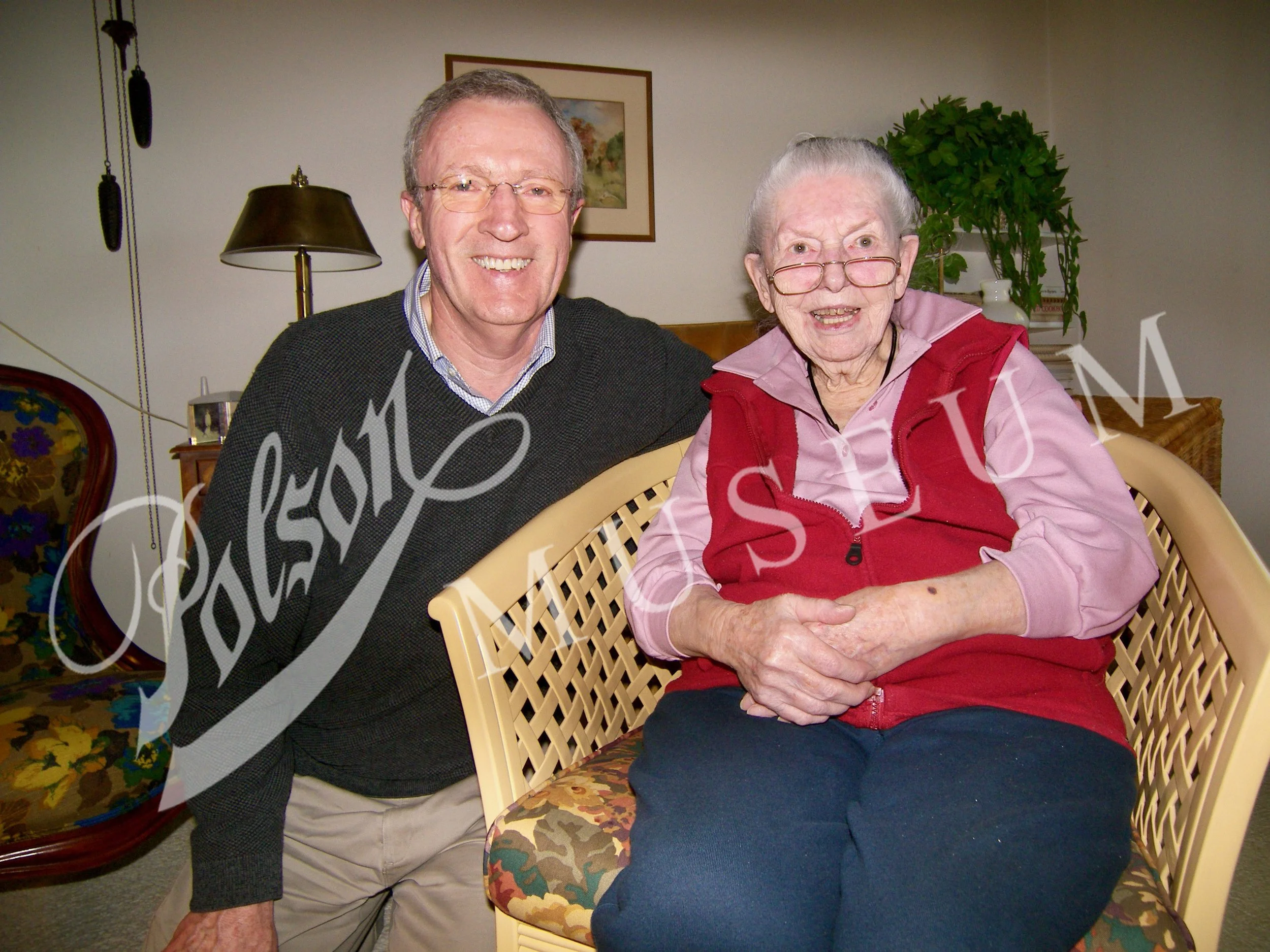
Tom Quigg and Gertrude Backstrom -(age 95) - Tom Quigg photo
-
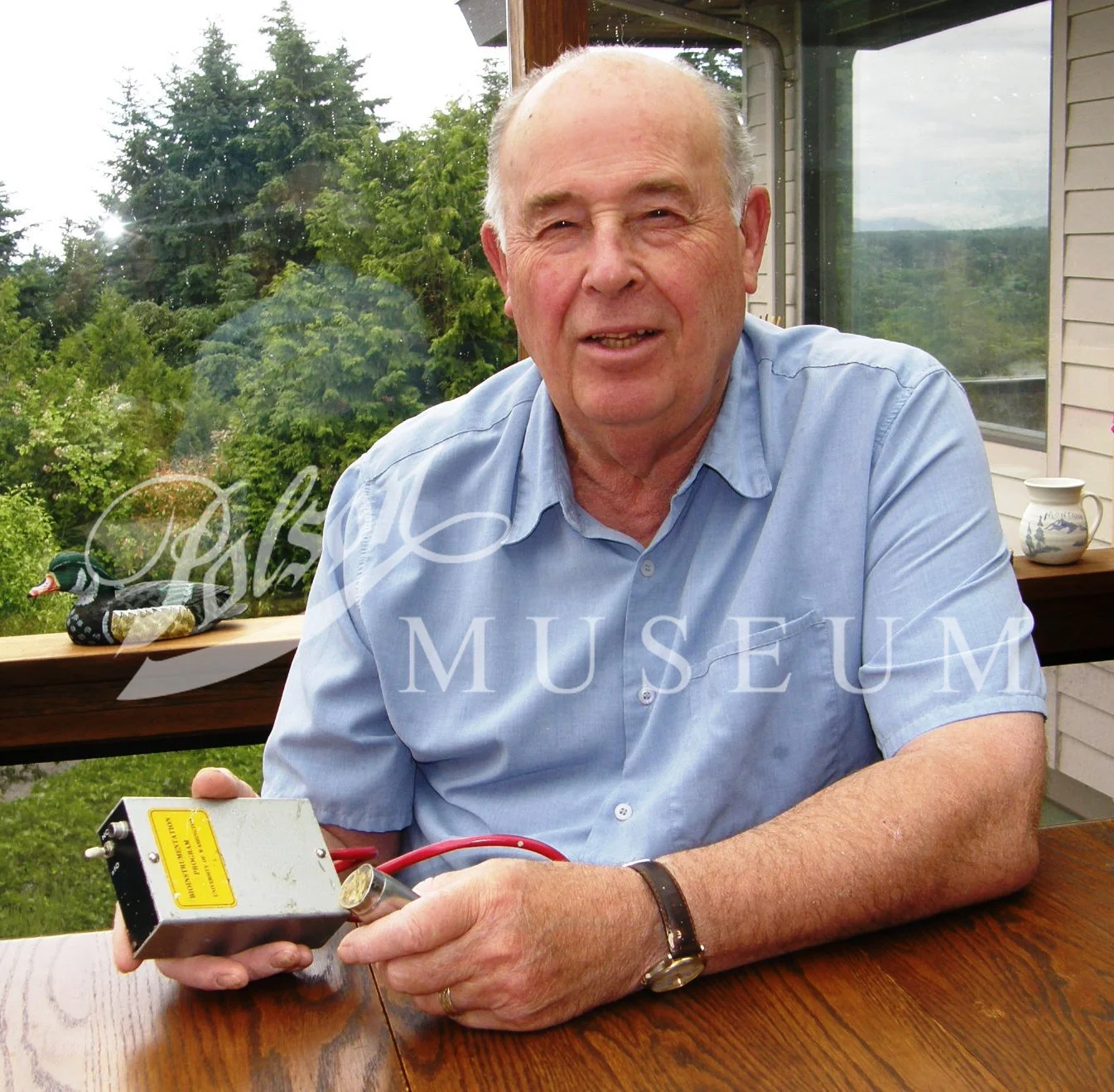
Don Baker with ultrasound prototype - Tom Quigg photo
-

LTC Bargewell with President George H W Bush during a debriefing of Acid Gambit – White House photo
-
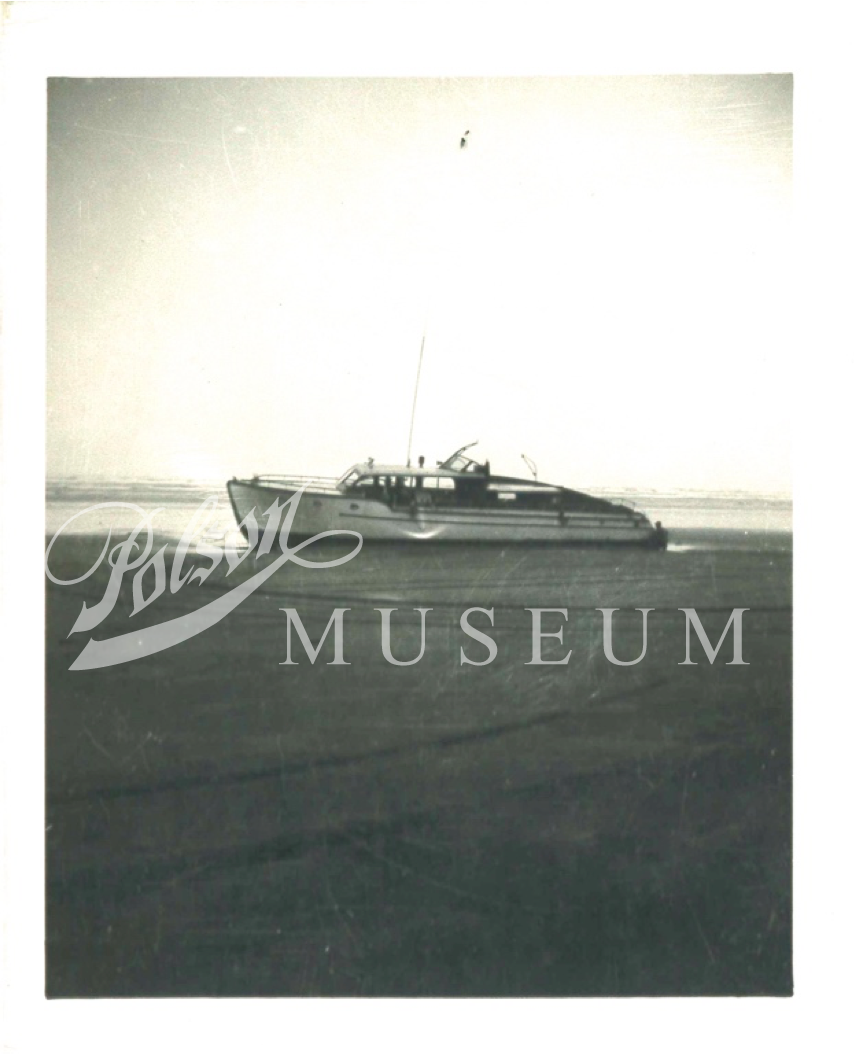
Beached Periwinkle - Quigg family photo by Patty Seaman
-
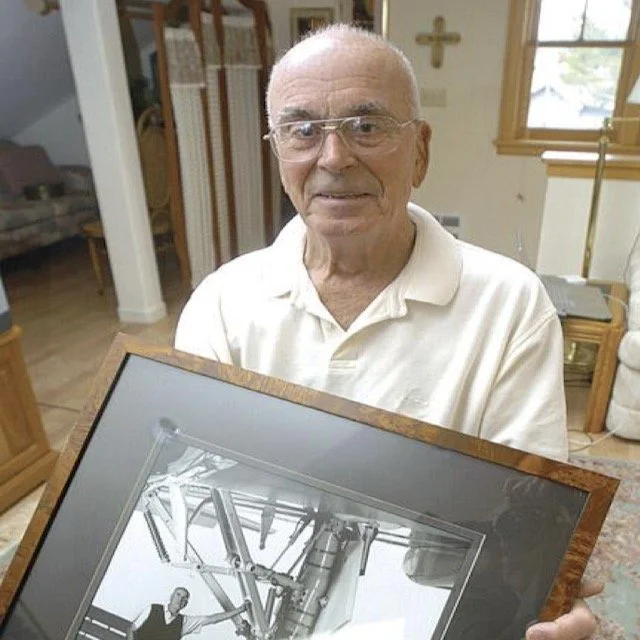
Bob Brown with photo of 767 landing gear - by Kathy Quigg, The Daily World
-

Trisha Brown receiving Presidential Medal of Arts - White House photo
-

Boeing land in Ocean Shores - by Tom Quigg using OpenStreetMap
-

B-17 at Bowerman Field 2012 - Tom Quigg photo
-
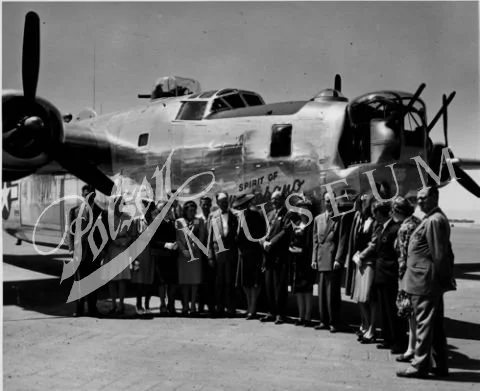
B-24 Spirit of Montesano - Vidette photo
-

Rip Caswell with MG Bargewell wax mold - Jay Fry photo
-
John Goddard family photo
-
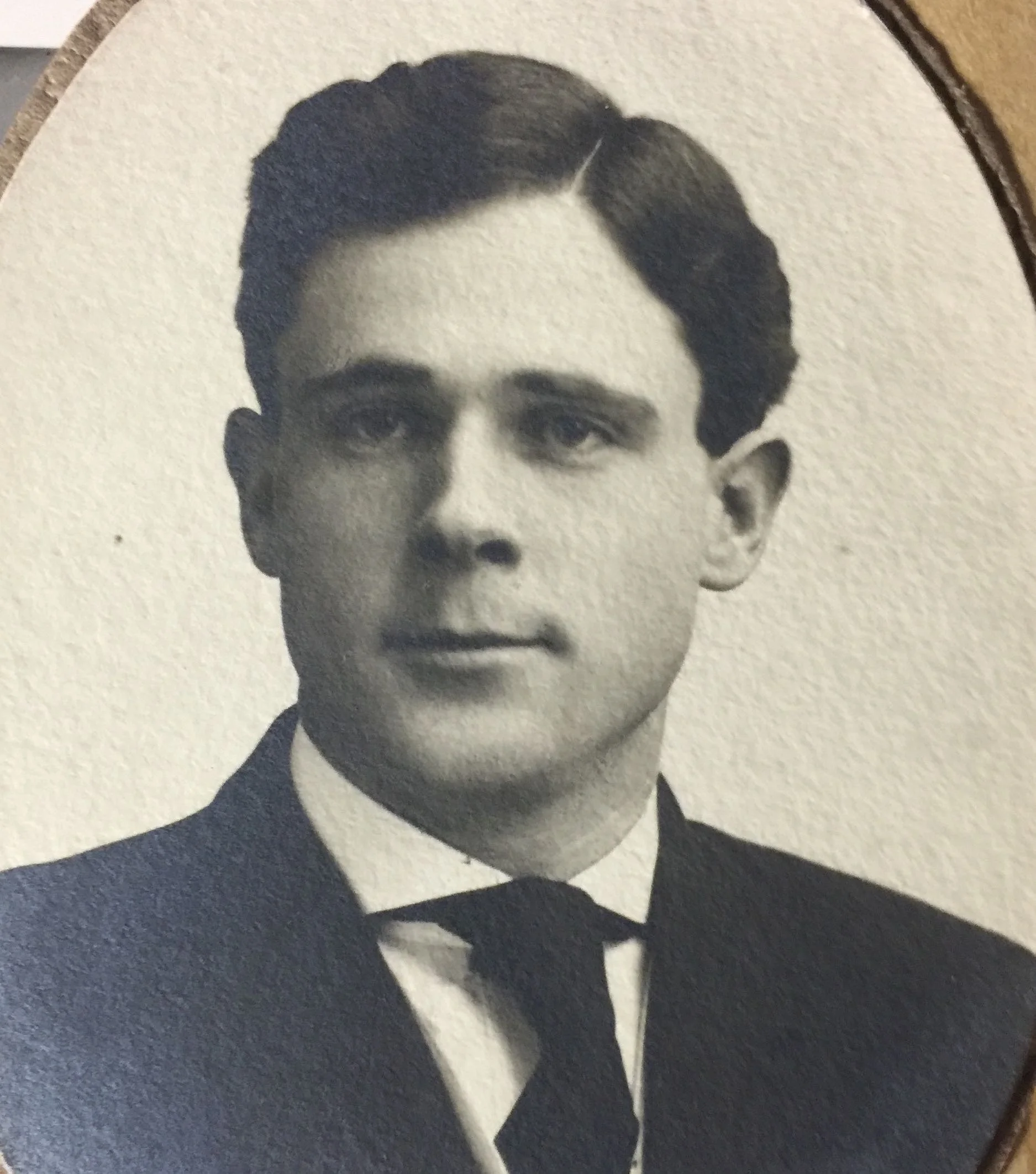
Jerry McGillicuddy in the early 1900’s. – McGillicuddy-Quigg family photo
-

Hitchings Home 814 Eklund, courtesy Polson Museum & Trudy Bendzok
-

Mayor Phyllis Shrauger, George Hitchings and his niece Rosali Christen – photo credit: Kathy Quigg, Daily World
-
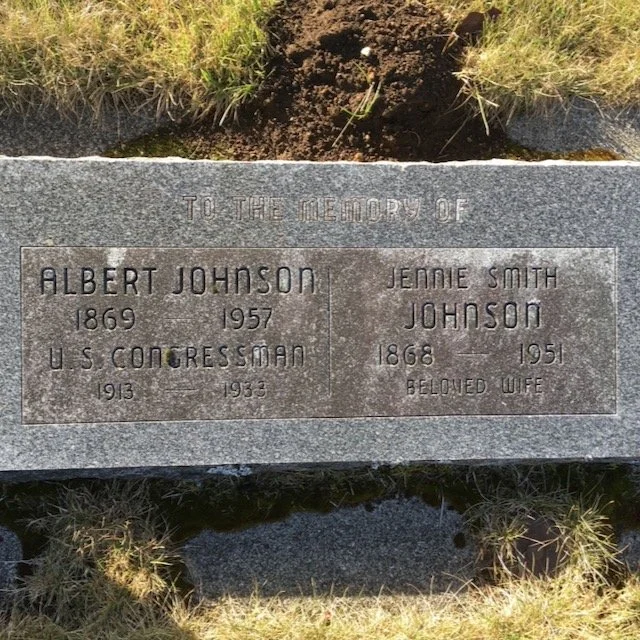
Albert Johnson tombstone - Tom Quigg photo
-
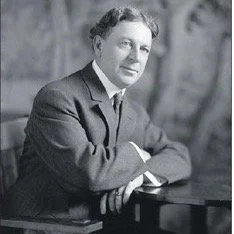
Albert Johnson – photo Daily World and Library of Congress
-

Jerry’s mother Barbara Leslie and Jerry Lambert with Tom Quigg 2012 – Tom Quigg photo
-
Doug Osheroff, Phyllis Osheroff (wife), Pat Oleachea and Tom Quigg - Tom Quigg photo
-
– The list is under development. Some the information is from personal recollections of the persons familiar with the subject, and not readily verifiable.
– Last updated 12/25/2024
Mary Elizabeth Achey – Lived in Wishkah. Considered the most prolific female artist in the Western US during the 19th century. – History of Mary Elizabeth Achey, unknown source.
Rick Anderson – Retired journalist for The Daily World and film critic. Author of the movie review book, Rewind.
Rick Anderson – raised and educated in Hoquiam. Feature journalist for the Seattle PI, Seattle Times, and the Seattle Weekly. Author of books of Pacific Northwest interest.
Thomas J Autzen – born in Hoquiam. Autzen Stadium at the University of Oregon is named in his honor.
Elton Bennett – lived and worked in Hoquiam – Prolific silkscreen artist, whose art is sought after by people with Harbor connections for its scenes of Grays Harbor. At one time worked on the Dredge Robert Gray for the Port of Grays Harbor.
Walton Butts – lived and worked in Hoquiam. Silkscreen artist of Grays Harbor scenery. Was the art instructor for the Hoquiam School District.
Mary Dispenza, – worked in Aberdeen. Notable Pacific Northwest advocate for survivors of abuse by priests. Former principal at St Mary School, Aberdeen. – Seattle Times, January 2016.
Lance Wood Hart – lived in Aberdeen and Cohassett Beach. Acclaimed artist of northwest scenes. Was a significant influence on the Aberdeen-born artist Robert Motherwell. – www.waynemorse.org
Jim Humphrey – raised in Willapa Valley, Raymon High School. contracting business in Aberdeen. National Soap Box Derby Champion 1965.
John Hughes – raised in Aberdeen. State of Washington Chief Historian and author of several books on Washington State History. – Office of the Secretary of State of Washington State.
Cordell “Corky” Jackson – Raised in Hoquiam. A founder of Arai Jackson Ellison Murakami Architects, which practices architecture, interiors and urban design throughout the Pacific Northwest.
Erik Larson – born and raised in Aberdeen. At the age 24, was elected as the youngest mayor in the history of Washington State. – The Daily World, January 2016.
Jim Olson – lives in Grays Harbor. Electric keyboard player for ____________ and local musical groups.
Bill Ramage – retired in Westport. In 1959 became the highest paid fashion model in the US, and retired in 1965. – WikiBin.com, unverified source.
Jay Ellis Ransom – Written "more than 400 magazine and journal publications in some 100 periodicals, 10 major books… and 76 professional publications." Attended Weatherwax High School, and Grays Harbor College.
Roxanne Sparks – raised in Hoquiam. At 8 years age was the 2004 World Karate Federation World Championship in her class..
Timberland Bank – headquartered in Hoquiam. The only Grays Harbor based company listed on the NYSE.
Acknowledgements
– by Tom Quigg
– (updated 10/29/2024)
There are many who have contributed to the content of The Harbor – A Culture of Success.
The first acknowledgement goes to Victor Grinich, who was raised and educated in the South Aberdeen neighborhood, of Aberdeen, Washington. In fact, if it wasn’t for Victor, this website would not function.
You will read in the short bios and story on Victor, that he was one of the “Fairchild Eight,” which was a team known for creating the process to make the first integrated circuit, or the microchip. In a 2007 phone conversation, Julius Blank, another member of the team said Victor’s expertise was electronics, which was what semiconductors were all about. “What we were doing was so new all of the equipment we used had to be built new, or redesigned for our use, and Victor understood how to make it happen.” Mr. Blank said one of the key roles Victor played was the development of the analog circuit, which is used today in any device requiring an electronic response. He added that “we could not have done it without Victor.”
Of course, none of the computers that drive the internet could operate if it weren’t for Victor Grinich. The internet has universally changed how people quickly gather information on various topics.
The production of thousands of copies of The Harbor – A Culture of Success had me leaning on several friends and associates. First it was Pat Oleachea, who gave me the initial nudge to begin the project. At the time, much of the timber harvesting surrounding the Harbor was under threat of closure because the spotted owl had been declared an endangered species. Regional unemployment spiked, and it seemed common for writers across the nation to occasionally refer to Grays Harbor as the “Appalachia of the West.” I would often explain that it was an unfair characterization of our community. And I would rattle off names of Harbor people who were leaders in certain fields and activities, both nationally and internationally. One day I complained to some people…”Why don’t the writers tell about our accomplishments, along with the negative stuff.” Well, it was Pat Oleachea who gave me the answer…”I guess you’ll have to tell them about the accomplished people.” So, I ran with the idea.
There was the encouragement and mentoring of The Daily World editor John Hughes, who taught me when to use italics rather than “quotation marks.” And how to properly create the format citations for all the sources of information and photos, which will hopefully keep the copyright hawks at bay. And he agreed that if I wrote stories on notable people and events, he would publish them.
A great help was Bob Preble. Bob began the highly regarded Alum of Distinction Designation at Weatherwax High School. It was Bob’s information that got me off to a quick start.
Proofreaders were instrumental in discovering my numerous typos and oversights, caused by my tendency to “type first – read later.” They helped me avoid numerous potentially embarrassing blunders. Over the years key proofreaders were Teresa Furstenwerth, Michelle Morrison, Pat Oleachea, and Harry Carthum. And as the years have passed numerous others have found, and continue to find, small errors in the print and online versions. Thanks for reading the material, checking the work, and above all thanks for taking the time to call, text or email your corrections and comments to me.
Of course, The Daily World was always willing to publish another story. They even pay a fee for the articles, which are donated to the Grays Harbor Community Foundation, or the Polson Museum.
John Larson and staff of the Polson Museum, and Terri Middleton of the Jones Photo Historical Collection, have been a great help in providing information and photos the museum has also agreed to host the culture of success website to spread the word about what a great place the Harbor is. Headquake Media of Montesano, Washington was instrumental in putting this website together so people like you will have easy access to this piece of Harbor history.
Final acknowledgement goes to the large number of folks who have called, emailed, written, or stopped me in the street to tell me of a person or event they know of. Here’s a big shout out to all those people. Thank you, and please stay in touch!